How Mold Architecture, Thermal Control, and Cavity Balance Determine Long-Term Production Stability

Production stability in injection molding is not proven by producing a few acceptable samples. It is proven when the same mold can repeatedly produce consistent parts across long production runs, changing shifts, material batches, environmental conditions, and thousands of molding cycles.

A mold may perform well during T0 or T1 trials because production conditions are controlled and forgiving. Cycle times may be longer, technicians may make frequent adjustments, and the mold has not yet accumulated heat, wear, or contamination.

Once mass production begins, the operating environment changes:

  • Cycle times become shorter
  • Mold temperature continues to accumulate
  • Automatic ejection replaces manual assistance
  • Cavity-to-cavity differences become more visible
  • Material and process variation occur across larger volumes
  • Tool wear gradually changes mechanical and thermal behavior

Under these conditions, small weaknesses in mold architecture, cooling balance, flow distribution, part design, and process control can develop into recurring production problems.

Stable high-volume production therefore depends on more than process settings. It requires a mold and product system designed to remain predictable as conditions change over time.


What Production Stability Means in Injection Molding

Production stability in injection molding means maintaining consistent product quality, cycle time, process behavior, and equipment performance throughout long-running production.

A stable process should consistently control:

  • Part dimensions
  • Surface appearance
  • Part weight
  • Filling behavior
  • Cooling and shrinkage
  • Ejection force
  • Cycle time
  • Cavity-to-cavity variation
  • Scrap and rework levels

A process should not be considered stable when acceptable parts can only be produced through frequent parameter adjustments, extended cooling, manual ejection assistance, or repeated mold maintenance.

The real objective is not to produce one good part. It is to maintain a repeatable process window that continues producing acceptable parts without constant intervention.


Why Mold Trials Do Not Always Predict Mass Production

Mold trials are necessary, but their conditions rarely represent the complete demands of long-term production.

During early trials:

  • The mold may start from a controlled temperature
  • Production runs may be short
  • Cooling times may be extended
  • Material conditions may be carefully controlled
  • Operators may adjust pressure, speed, or temperature between cycles
  • Only a limited number of parts may be inspected
  • Mold wear has not yet developed

These conditions can hide marginal design and tooling conditions.

A mold may pass sampling but become unstable after continuous cycling. Heat accumulation can change cavity dimensions, material viscosity, cooling performance, and ejection behavior. Small differences between cavities may also become more visible as production volume increases.

For this reason, mold trials should evaluate not only whether acceptable samples can be produced, but also whether the mold can maintain those results under realistic production conditions.


1. Mold Architecture and Structural Rigidity

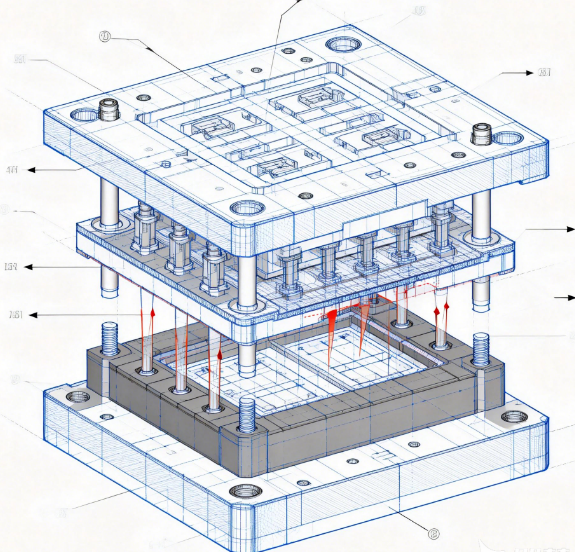
Injection mold architecture blueprint illustrating structural rigidity and load transfer influencing production stability

Mold architecture determines how loads are distributed through the mold during injection, packing, cooling, opening, and ejection.

Injection pressure creates repeated mechanical loads on:

  • Mold plates
  • Cavity and core inserts
  • Support pillars
  • Slides and lifters
  • Guide components
  • Parting surfaces
  • Ejection systems

If structural support is insufficient or uneven, the mold may experience small deflections during each cycle. These movements may be difficult to detect during short trials but can affect dimensional repeatability during long production runs.

Potential consequences include:

  • Flash at the parting line
  • Dimensional drift
  • Uneven wall thickness
  • Inconsistent sealing surfaces
  • Accelerated wear on guide components
  • Different behavior between cavities

Stable mold architecture requires balanced load paths, sufficient plate rigidity, appropriate support locations, and controlled alignment between moving components.

The design should account for long-term cyclic loading, not only whether the mold can withstand maximum injection pressure once.


2. Thermal Control and Long-Run Heat Accumulation

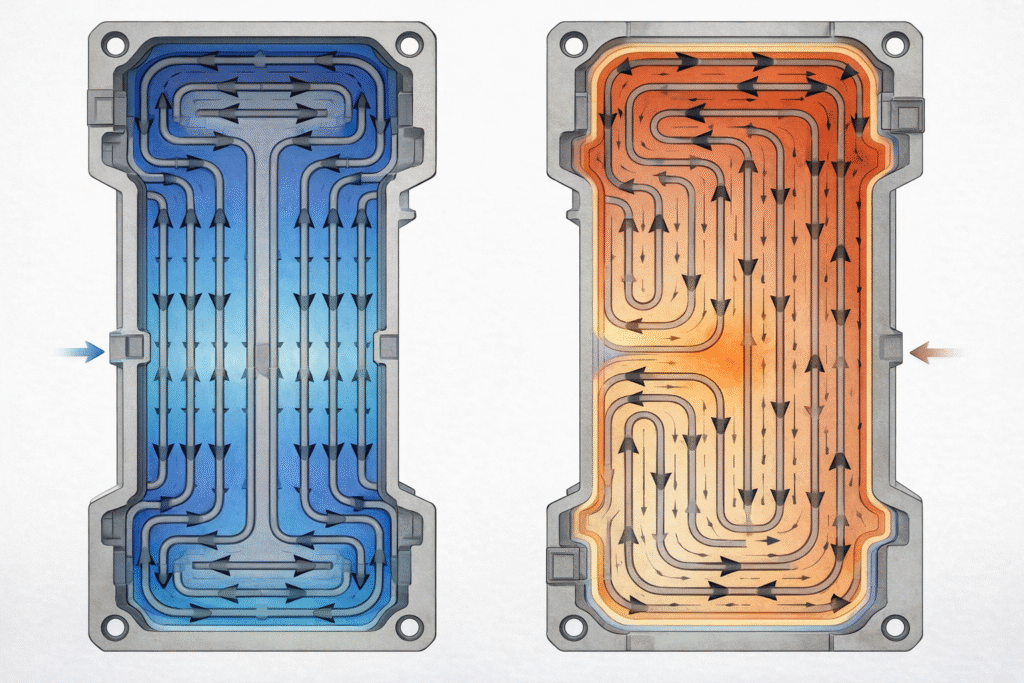
Cooling channel layout symmetry affecting thermal control and production stability in injection molding

Thermal control is one of the most important factors affecting production stability in injection molding.

During continuous operation, heat enters the mold through molten plastic and is removed by the cooling system. If heat removal is uneven, different areas of the mold reach different operating temperatures.

Thermal imbalance can cause:

  • Uneven shrinkage
  • Warpage
  • Dimensional variation
  • Localized sink marks
  • Different surface appearance
  • Longer or unstable cycle times
  • Inconsistent ejection behavior

Cooling-channel placement should follow the geometry and thermal load of the part. Simply placing channels at equal distances does not guarantee equal cooling.

Areas such as thick walls, ribs, bosses, deep cores, and complex inserts may retain more heat than surrounding regions. These areas may require additional cooling, baffles, bubblers, conformal cooling, or improved thermal contact between inserts.

Cooling performance should be evaluated after the mold reaches thermal equilibrium. Measurements taken during the first few cycles may not represent the conditions that develop after several hours of production.


3. Flow Balance and Cavity Symmetry

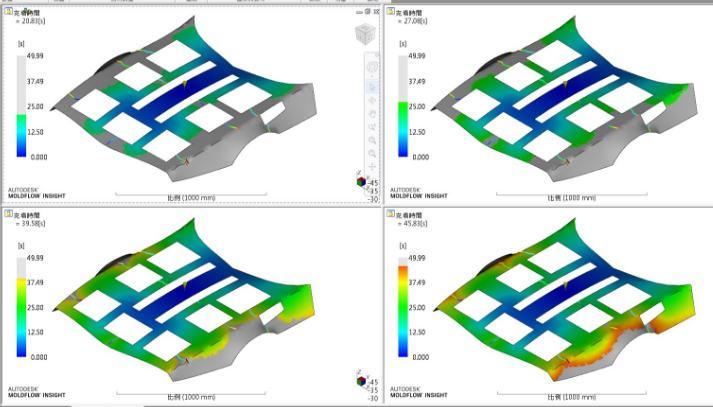
Moldflow pressure distribution analysis in multi-cavity injection mold supporting cavity balance and production stability

Multi-cavity molds require more than identical cavity geometry. Each cavity must receive material under sufficiently similar pressure, temperature, and timing conditions.

Flow imbalance may result from:

  • Unequal runner lengths
  • Different pressure losses
  • Gate-size variation
  • Uneven runner temperature
  • Inconsistent venting
  • Cavity machining differences
  • Hot-runner imbalance
  • Different cooling conditions

When cavities fill differently, operators may adjust process settings to correct the weakest cavity. This can overpack other cavities and create additional problems.

Possible symptoms include:

  • Cavity-to-cavity weight variation
  • Short shots in selected cavities
  • Flash in other cavities
  • Different shrinkage rates
  • Uneven dimensions
  • Inconsistent appearance
  • Different ejection forces

A stable mold should minimize the amount of process compensation required to balance cavities.

Flow analysis, pressure measurements, short-shot studies, part-weight comparison, and cavity-specific inspection can help reveal differences before full-scale production.


4. Thermo-Mechanical Interaction

Thermal and mechanical effects do not act independently.

As the mold temperature changes, mold plates, inserts, cores, and sliding components expand. Even small dimensional changes can affect alignment, shutoff pressure, venting, cavity size, and component movement.

Examples include:

  • A slide operating smoothly when cold but tightening after heat accumulation
  • A vent opening changing as the mold expands
  • An insert shifting slightly under repeated thermal cycling
  • A parting surface developing localized flash when the mold reaches operating temperature
  • An ejector system experiencing increased friction after prolonged running

These effects may not appear during a short mold trial.

Production stability requires evaluating how mold components interact after the tool reaches its normal operating temperature and remains there for an extended period.

Material selection, fit tolerances, thermal expansion, lubrication, component guidance, and maintenance access should all be considered together.


5. Tool Wear and Lifecycle Durability

Mold wear gradually changes production behavior.

Wear commonly develops at:

  • Gates
  • Vents
  • Shutoff surfaces
  • Slides
  • Lifters
  • Guide pins and bushings
  • Ejector pins
  • Textured cavity surfaces
  • Runner components

A small amount of wear may increase vent depth, gate size, clearance, friction, or component movement. These changes can alter filling, packing, appearance, ejection, and part dimensions.

A mold designed only for initial sampling may require frequent adjustment or repair during high-volume production.

Long-term stability depends on:

  • Suitable mold-steel selection
  • Appropriate hardness and surface treatment
  • Replaceable wear components
  • Reliable lubrication
  • Accessible maintenance points
  • Controlled shutoff geometry
  • Preventive maintenance planning
  • Defined inspection intervals

Tool-life planning should begin during mold design instead of after production problems appear.


6. Product Design Decisions That Affect Stability

Some production problems originate in the product design rather than the mold settings.

Important factors include:

For example, uneven wall thickness can create different cooling and shrinkage rates. Insufficient draft can increase ejection force as the mold heats up. Deep textures may require additional draft to prevent drag marks.

A feature that works during slow sampling may become unstable when cycle time is reduced and automatic ejection begins.

Production-safe design should provide enough margin to accommodate normal material, temperature, and process variation.


7. Process Sensitivity During Production Ramp-Up

Production ramp-up exposes the mold to conditions that are not fully represented during early trials.

As production volume increases:

  • Cycle time is reduced
  • Automation is introduced
  • Operators change between shifts
  • Material lots vary
  • Mold temperature becomes more difficult to stabilize
  • Maintenance intervals become important
  • Small cavity differences accumulate across larger quantities

A narrow process window may require frequent pressure, temperature, speed, or cooling adjustments.

This is a warning sign.

Stable production should not depend on one exact machine setting. The process should tolerate reasonable variation while continuing to produce acceptable parts.

Process-window studies should evaluate how the product responds when important parameters change within controlled limits.


8. Cumulative Deviation During Long Production Runs

Many production problems do not appear as sudden failures. They develop gradually.

Small deviations can accumulate through:

  • Thermal drift
  • Vent contamination
  • Gate wear
  • Material residue
  • Lubrication loss
  • Cooling-channel deposits
  • Ejector wear
  • Slide misalignment
  • Variation between material batches

Each change may appear minor individually. Together, they can shift the process away from its validated condition.

Typical warning signs include:

  • Increasing part-weight variation
  • Gradual dimensional drift
  • Longer cooling requirements
  • Rising ejection force
  • More frequent parameter changes
  • Growing cavity-to-cavity differences
  • Slowly increasing scrap levels

Monitoring trends is more useful than waiting for a measurement to exceed its specification limit.


9. Statistical Early Warning Signals

Production data can reveal instability before visible defects become common.

Useful indicators include:

  • Part weight by cavity
  • Critical dimensions
  • Cycle time
  • Mold and coolant temperature
  • Injection and cavity pressure
  • Fill time
  • Cushion position
  • Ejection force
  • Scrap rate
  • Maintenance frequency

These measurements should be reviewed over time rather than only as individual pass-or-fail results.

A process may still produce parts within specification while showing increasing variation. This indicates that the process margin is shrinking and future failures may become more likely.

Control charts, cavity comparisons, trend monitoring, and preventive-maintenance records can help teams identify changes early.

Statistical monitoring is most effective when it is connected to physical causes such as cooling imbalance, wear, vent condition, or material variation.


10. Engineering Validation for Production Stability

Validation should reproduce the conditions expected during real production.

A useful validation plan may include:

  • Continuous production at the target cycle time
  • Operation until thermal equilibrium is reached
  • Cavity-by-cavity weight and dimensional comparison
  • Automatic ejection testing
  • Process-window studies
  • Cooling-water flow and temperature checks
  • Mold-temperature mapping
  • Pressure and fill-time monitoring
  • Inspection after extended cycling
  • Controlled stop-and-restart testing

Restart testing is especially important. A mold may behave differently after a production interruption, maintenance event, or material change.

Validation should also define:

  • Acceptable process limits
  • Inspection frequency
  • Maintenance triggers
  • Corrective-action responsibilities
  • Production-release criteria

The goal is to demonstrate that the process remains stable under realistic variation, not only under ideal trial conditions.


System-Level Interaction in Injection Molding

Production stability is created by the interaction of several systems:

  • Part design
  • Mold architecture
  • Cooling system
  • Runner and gate design
  • Material behavior
  • Injection-molding machine
  • Process parameters
  • Automation
  • Maintenance
  • Quality control

Correcting one variable may not solve a problem caused by several interacting factors.

For example, increasing packing pressure may temporarily correct dimensional shrinkage but worsen flash or internal stress. Extending cooling time may reduce warpage but increase production cost and hide an inefficient cooling design.

Effective troubleshooting should therefore investigate the complete system rather than repeatedly adjusting machine settings.


Impact on Delivery, Quality, and Lifecycle Cost

Unstable production affects more than scrap rate.

It can cause:

  • Unplanned machine stoppages
  • Longer cycle times
  • Increased inspection
  • Rework and sorting
  • Repeated mold adjustments
  • Delayed deliveries
  • Higher maintenance frequency
  • Shortened tool life
  • Inconsistent assembly performance
  • Customer quality complaints

These costs often develop gradually and may not be visible in the original tooling quotation.

A mold with a lower initial price may create higher lifecycle costs if it requires constant adjustment, longer cycles, or repeated maintenance.

Production stability should therefore be evaluated as an engineering and commercial requirement.


Production Stability Review Checklist

Before approving a mold for mass production, review the following areas.

Mold Structure

  • Are load paths and support locations balanced?
  • Are critical inserts sufficiently supported?
  • Are slides, lifters, and shutoffs designed for repeated cycling?
  • Are wear components replaceable?

Thermal Control

  • Are cooling channels appropriate for the part geometry?
  • Are thick sections and deep cores adequately cooled?
  • Has the mold been tested after reaching thermal equilibrium?
  • Are coolant flow and temperature monitored?

Flow and Cavity Balance

  • Are runner lengths and pressure losses balanced?
  • Are gate dimensions consistent?
  • Are cavity weights and dimensions compared separately?
  • Is venting consistent across cavities?

Product Design

  • Is wall thickness reasonably uniform?
  • Are draft angles suitable for automatic ejection?
  • Are ribs, bosses, textures, and undercuts production-safe?
  • Have material shrinkage and assembly tolerances been considered?

Process Validation

  • Has the mold run continuously at the target cycle time?
  • Has a realistic process window been established?
  • Has automatic operation been validated?
  • Have stop-and-restart conditions been tested?

Maintenance and Monitoring

  • Are preventive-maintenance intervals defined?
  • Are wear points accessible for inspection?
  • Are production trends recorded by cavity?
  • Are corrective-action responsibilities clear?

Frequently Asked Questions

What is production stability in injection molding?

Production stability is the ability to maintain consistent product quality, dimensions, cycle time, and process behavior throughout long production runs without frequent adjustment or intervention.

Why can a mold pass trials but fail during mass production?

Short mold trials may not reveal heat accumulation, wear, cavity imbalance, process sensitivity, or automatic-ejection problems that develop during continuous production.

What is the most common cause of production instability?

There is rarely one universal cause. Common contributors include thermal imbalance, flow imbalance, insufficient structural rigidity, marginal part design, mold wear, and a narrow process window.

How can thermal stability be evaluated?

Thermal stability can be evaluated using mold-temperature mapping, coolant-flow measurements, cavity-temperature comparison, dimensional monitoring, and extended production runs after thermal equilibrium is reached.

Why is cavity balance important?

Cavity balance helps each cavity fill, pack, cool, and shrink under similar conditions. Poor balance can create different weights, dimensions, appearance, and defect levels between cavities.

Can process adjustments solve mold-instability problems?

Process adjustments can sometimes reduce symptoms, but they may not correct structural, thermal, or wear-related causes. Repeated adjustment is often evidence that the process lacks sufficient production margin.

How long should a production validation run?

The appropriate duration depends on product complexity, material, mold size, cycle time, cavity count, and production volume. The run should be long enough for thermal equilibrium and cumulative behavior to become visible.


Conclusion

Reliable production stability in injection molding depends on mold architecture, thermal control, cavity balance, part design, process capability, tool durability, and quality monitoring working together.

A successful mold trial confirms that acceptable parts can be produced. It does not automatically confirm that the mold can maintain the same results throughout long-term mass production.

By evaluating thermal behavior, structural loading, cavity variation, wear, process sensitivity, and statistical trends before production release, manufacturing teams can reduce unexpected stoppages, dimensional drift, rising scrap, and repeated process adjustment.

Long-term production stability is not achieved by finding one perfect machine setting. It is achieve

Get a Free Quote