
Mold wear mechanisms in high-volume injection molding are rarely the result of a single failure. Instead, they develop progressively — often unnoticed during early production — until dimensional variation, cosmetic defects, or cycle instability begin to surface.
During sampling, molds are tested under controlled conditions.
Cycle speeds are moderate. Production duration is short. Thermal buildup is limited. Under these conditions, the mold appears stable.
However, when production scales to continuous, high-speed operation, structural stresses accumulate. Over tens or hundreds of thousands of cycles, micro-level deformation evolves into measurable production drift.
Understanding mold wear mechanisms is essential for maintaining structural integrity and long-term manufacturing consistency.
1. Mechanical Fatigue in Mold Wear Mechanisms
Every injection cycle introduces compressive and tensile stress across mold components:
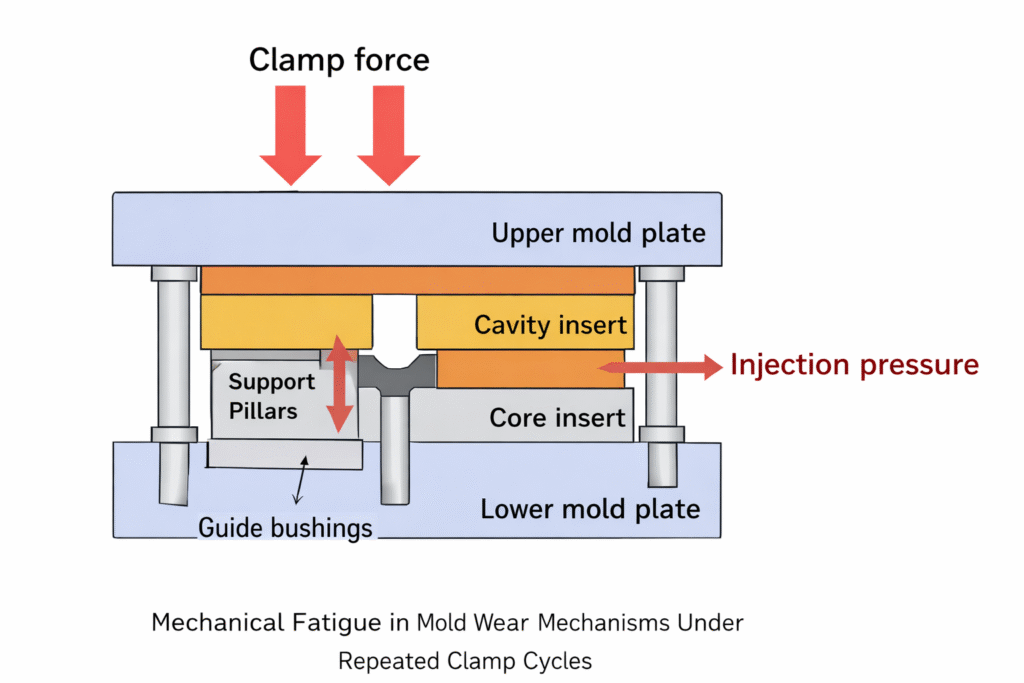
- Clamp tonnage compresses mold plates
- Injection pressure loads cavity surfaces
- Ejection introduces localized stress
- Mold opening generates impact forces
While individual cycles cause negligible deformation, repeated loading leads to mechanical fatigue.
Fatigue typically develops in:
- Support pillars
- Parting line interfaces
- Guide bushings
- Plate contact surfaces
Over time, even micron-level changes in plate flatness or alignment can affect:
- Flash behavior
- Cavity balance
- Gate sealing consistency
Mechanical fatigue is cumulative and nonlinear.
Early performance does not guarantee long-term stability.
2. Structural Deflection and Load Path Drift
In high-volume molds, especially multi-cavity and stack systems such as advanced stack mold designs, load distribution is not always perfectly symmetrical.
Small asymmetries in:
- Tie-bar spacing
- Platen rigidity
- Mold width-to-thickness ratio
may introduce slight deflection under clamp pressure.
Initially, deflection may remain within tolerance.
However, under continuous high-tonnage operation, repeated stress amplifies misalignment.
This can lead to:
- Progressive parting line mismatch
- Uneven cavity compression
- Differential vent gap change
- Localized wear acceleration
Structural load path design must consider not only static strength, but long-cycle stability.
3. Thermal Cycling and Expansion Fatigue
Injection molds operate in constant thermal fluctuation:
- Molten polymer introduces localized heat
- Cooling channels extract heat
- Mold opens and rebalances temperature
These repeated expansion and contraction cycles create thermal fatigue, a well-documented phenomenon in metallurgical and tooling materials.
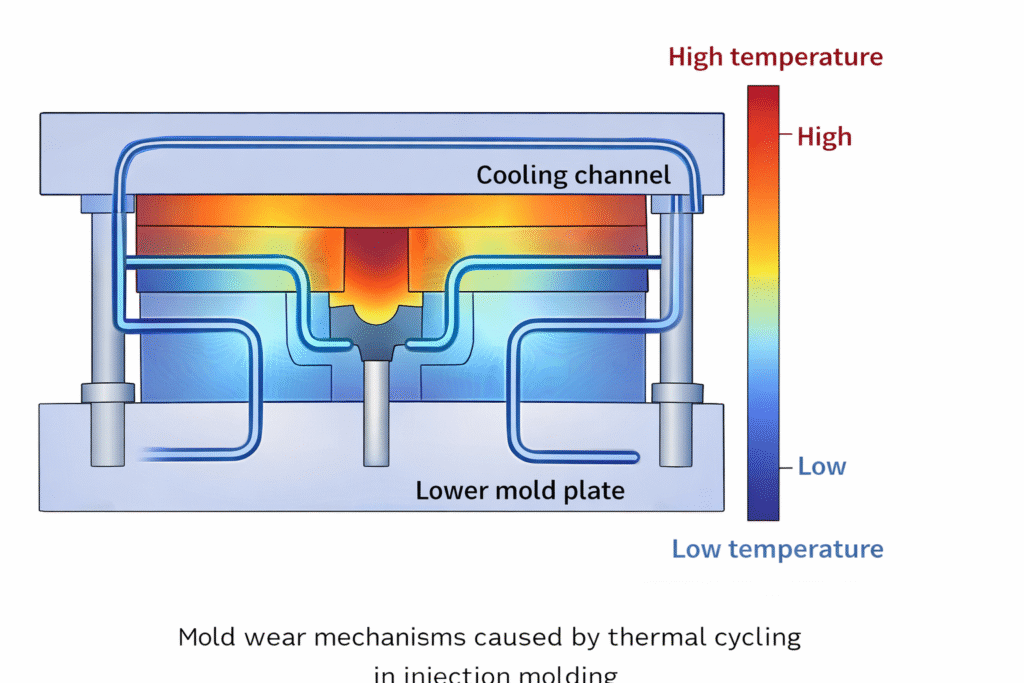
Thermal imbalance may result from:
- Uneven cooling channel distribution
- Variable coolant flow
- Localized hot spots near gates
Over time, thermal cycling contributes to:
- Cavity dimensional drift
- Surface gloss inconsistency
- Warpage increase
- Steel microstructure stress accumulation
Thermal fatigue often interacts with mechanical fatigue, accelerating wear progression.
Among all mold wear mechanisms, thermal fatigue often accelerates structural instability over extended runs.
4. Surface Contact Wear and Frictional Degradation
Friction-related wear is particularly prominent in:
- Guide pillars
- Ejector pins
- Sliders and lifters
- Gate bushings
High-speed production increases friction frequency and contact pressure.
Even with lubrication, micro-abrasion gradually modifies surface finish and dimensional tolerance.
Consequences include:
- Increased demolding resistance
- Sticking parts
- Drag marks
- Venting restriction
Surface wear tends to accelerate once protective surface coatings degrade.
Surface degradation remains one of the most visible mold wear mechanisms during sustained high-speed operation.
5. Venting Deformation and Gas Management Instability
Venting channels are delicate and sensitive to deformation.
Over extended cycles:
- Vent gaps compress
- Deposits accumulate
- Micro-flash alters vent geometry
This may cause:
- Burn marks
- Short shots
- Increased injection pressure demand
Venting deterioration is frequently misdiagnosed as process instability, when it is often structural wear related.
6. High-Speed Production as a Wear Multiplier
Ramp-up significantly increases:
- Injection frequency
- Shear heating
- Thermal accumulation
- Vibration amplitude
Higher cycle speeds amplify all mold wear mechanisms across structural interfaces.
A mold stable at 35-second cycles may behave differently at 18-second cycles under continuous operation.
This transition from controlled sampling to full ramp-up conditions often reveals structural limits that are not visible during mold trials.
Speed does not simply increase output — it multiplies structural stress.
7. Cavity Imbalance and Dimensional Drift Over Time
Wear does not always produce visible damage.
Instead, it often manifests as:
- Gradual dimensional shift
- Increased variation between cavity groups
- Cosmetic inconsistency
- Part weight fluctuation
In high-volume production, stability and repeatability are more critical than initial dimensional approval.
Long-term drift indicates structural degradation.
8. Preventive Engineering Strategies
Effective wear management begins at design stage:
- Proper steel grade selection
- Balanced structural reinforcement
- Optimized clamp force distribution
- Thermal simulation validation
- Predictive maintenance scheduling
Periodic dimensional audits and cavity balance checks are essential in high-volume environments.
Engineering foresight reduces emergency downtime and quality escapes.
Long-Term Stability Requires Structural Awareness
Mold wear mechanisms in high-volume injection molding are not random.
They are the predictable outcome of repeated mechanical, thermal, and frictional stresses.
Molds designed with structural balance and fatigue resistance in mind maintain:
- Dimensional consistency
- Cosmetic stability
- Cavity balance
- Production reliability
Ignoring wear mechanisms may not produce immediate failure, but sustained production inevitably exposes structural weaknesses.
Controlling mold wear mechanisms requires structural discipline and long-term monitoring.
Understanding wear is fundamental to achieving long-term manufacturing stability.