
Introduction

Choose an EMS supplier correctly is a critical decision that directly impacts product quality, delivery timelines, cost control, and long-term scalability.
Many companies initially focus on pricing when evaluating suppliers. However, in real manufacturing environments, the lowest quotation rarely represents the lowest total cost. Issues such as unstable quality, delayed delivery, inconsistent communication, and lack of engineering support often result in higher costs over time.
In practice, many production problems do not originate from manufacturing itself, but from decisions made during supplier selection. A supplier that looks competitive at the quotation stage may lack the capability to support stable production.
An experienced EMS partner does more than execute orders. They help identify risks early, optimize designs, and ensure a smooth transition from prototype to mass production.
This guide explains how to choose an EMS supplier based on real manufacturing criteria, not just pricing, so you can make more reliable and informed decisions.
1. Why Choosing the Right EMS Supplier Matters
An EMS supplier is not simply a manufacturer — they become part of your product development and production process.
Choosing the wrong supplier often leads to:
- Inconsistent quality across production batches
- Repeated delays due to poor coordination
- Increased costs from rework and engineering changes
- Lack of transparency in production status
These problems may not appear during initial prototyping, but they become significant when scaling production.
A capable EMS supplier can help prevent these risks early. For example, issues identified during a proper PCB design review checklist stage can reduce defects and improve production stability before manufacturing begins.
In contrast, a weak supplier may only follow instructions without identifying potential risks, allowing small issues to grow into large production problems.
This is why companies must carefully choose an EMS supplier rather than focusing only on price.
2. Evaluate Engineering Capability
Engineering capability is one of the most critical — yet often overlooked — factors when choosing an EMS supplier.
A strong EMS partner should not only manufacture your design but also review it critically and provide feedback.
What to Look For:
- Ability to review Gerber and BOM files
- Experience with Design for Manufacturability (DFM)
- Capability to suggest practical improvements
For example, an experienced engineering team may identify potential soldering risks, layout spacing issues, or component placement conflicts before production starts.
Without this level of support, these issues are often discovered too late — during assembly or testing — where they are more expensive and time-consuming to fix.
Engineering capability is one of the most important criteria when you choose an EMS supplier for long-term production.
3. Check Manufacturing Scope and Integration
EMS suppliers differ significantly in the range of services they offer.
Some suppliers focus only on PCB assembly, while others provide full integration, including sourcing, enclosure manufacturing, final assembly, and testing.
Typical EMS Capability Comparison
| Capability | Basic Supplier | Integrated EMS Supplier |
|---|---|---|
| PCB Assembly | ✔ | ✔ |
| Component Sourcing | Limited | Full support |
| Enclosure / Plastic Parts | ✖ | ✔ |
| Final Assembly (Box Build) | ✖ | ✔ |
| Testing Integration | Basic | Advanced |
Working with an integrated EMS supplier reduces the need to manage multiple vendors, minimizing communication gaps and improving project efficiency.
This is especially important for complex products that require coordination across multiple manufacturing stages.
Manufacturing scope is another key factor to evaluate when you choose an EMS supplier for complex projects.

4. Review Quality Control System
A structured quality control system is essential for ensuring stable production.
Quality should not rely only on final inspection. Instead, it must be built into each stage of the process.
Key Quality Control Points:
- SPI (Solder Paste Inspection)
- AOI (Automated Optical Inspection)
- Functional Testing (FCT)
- Final Assembly Inspection
A strong QC system helps maintain consistent production yield in electronics manufacturing, following industry standards such as IPC standards.
For example, early detection through SPI can prevent soldering issues from progressing into more serious failures later in the process.
5. Assess Supply Chain Management
Supply chain capability plays a major role in production stability.
Even if manufacturing processes are well controlled, poor sourcing can cause delays, cost increases, or quality issues.
Key Factors to Evaluate:
- Supplier network and sourcing capability
- Ability to handle component shortages
- Alternative component strategies
- Inventory and lead time management
For instance, during component shortages, a capable EMS supplier can quickly identify qualified alternatives and validate them without affecting performance.
In contrast, a weak supply chain can delay production for weeks or even months.
A strong supply chain is essential when you choose an EMS supplier that can support stable production.
6. Communication and Project Management
Communication is a critical factor that directly affects project execution.
Many production problems are not caused by technical issues, but by communication gaps.
Indicators of Strong Communication:
- Clear and timely updates
- Dedicated project manager
- Fast response to technical questions
- Transparent reporting of issues
For example, when an issue arises during production, a responsive supplier will immediately communicate the problem, propose solutions, and minimize impact.
Poor communication, on the other hand, often results in delays and misunderstandings.
7. Experience with Similar Projects
Experience allows suppliers to anticipate problems before they occur.
A supplier familiar with similar products can provide insights that reduce risks and improve efficiency.
Example Scenarios:
- High-density PCB designs
- Complex multi-module assemblies
- Products requiring strict reliability standards
Such experience helps ensure that potential issues are identified early rather than discovered during production.
8. Ability to Support Mass Production
The transition from prototype to mass production is one of the most challenging stages in electronics manufacturing.
Many suppliers perform well in prototyping but struggle to maintain consistency at scale.
Common issues include:
- Yield variation
- Process instability
- Assembly inconsistencies
A reliable EMS supplier should have standardized processes, controlled workflows, and scalable production systems to ensure stable output.
This is why businesses need to choose an EMS supplier that can scale from prototype to mass production.
9. Cost Structure and Quotation Transparency
Price alone is not a reliable indicator when selecting an EMS supplier.
A low quotation may hide risks that lead to higher costs later.
What to Evaluate in a Quote:
| Cost Factor | What to Check |
|---|---|
| Component Cost | Accuracy and sourcing reliability |
| Assembly Cost | Process complexity and labor |
| Testing Cost | Coverage and depth |
| Hidden Costs | Risk of rework or delays |
Understanding cost structure helps avoid unexpected expenses and ensures better decision-making.
10. Practical Evaluation Checklist
To simplify supplier selection, you can use a structured evaluation approach.
EMS Supplier Evaluation Checklist
| Evaluation Area | Key Question |
|---|---|
| Engineering | Can they review and improve your design? |
| Manufacturing | Do they support full production scope? |
| Quality | Is QC built into every stage? |
| Supply Chain | Can they manage sourcing risks? |
| Communication | Are they responsive and transparent? |
This structured approach helps compare suppliers objectively instead of relying on price alone.
Using a structured checklist makes it easier to choose an EMS supplier based on objective criteria rather than assumptions.
11. Common Mistakes When Choosing an EMS Supplier
Avoid these common mistakes:
- Choosing based only on price
- Ignoring engineering capability
- Overlooking communication efficiency
- Not verifying production capacity
- Assuming prototype success guarantees mass production success
These mistakes often lead to higher long-term costs and unstable production.
12. Build a Long-Term Partnership
The most successful EMS relationships are built on long-term collaboration.
A reliable EMS partner continuously improves processes, optimizes designs, and supports future product development.
This results in:
- Better product consistency
- Faster problem resolution
- More efficient scaling
Conclusion
Choosing the right EMS supplier requires more than comparing quotations. It involves evaluating engineering capability, manufacturing scope, quality systems, supply chain strength, and communication efficiency.
By taking a structured approach, you can significantly reduce production risks and improve project outcomes.
If you are preparing for production, it is also important to understand the full electronics manufacturing process from PCB assembly to final product integration to make better supplier decisions.
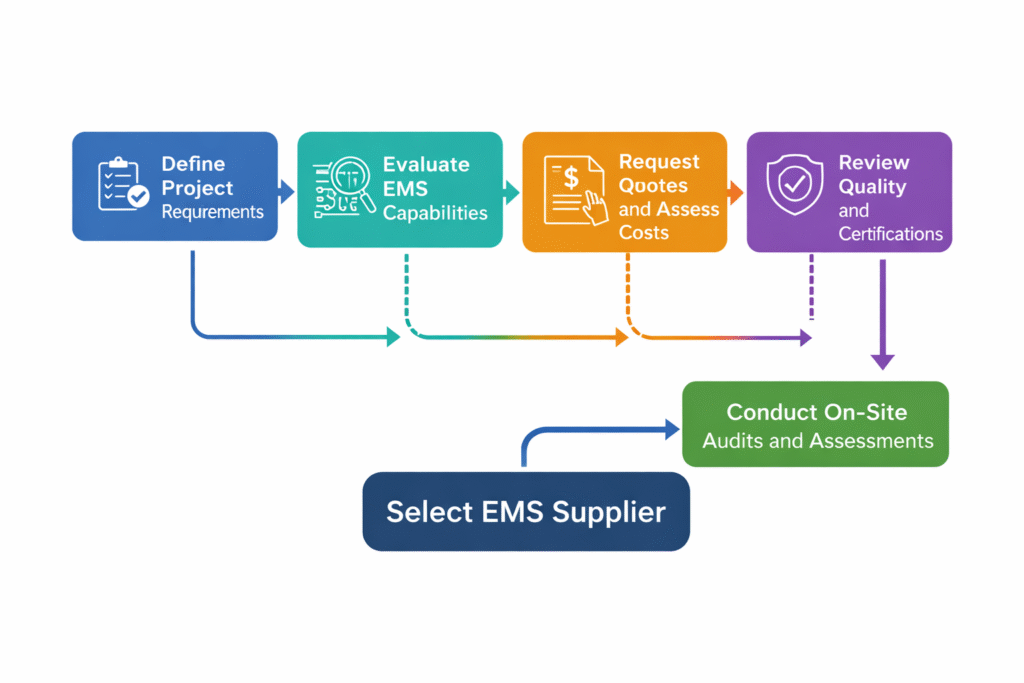
Taking the time to properly choose an EMS supplier can significantly reduce risks and improve long-term product success.
👉 Contact CINDY Mould to support your project from design review to full-scale production.