
Introduction: Why This Comparison Matters
When developing a new electronics product, one of the most important decisions is choosing the right manufacturing partner. Many buyers compare EMS vs OEM Manufacturing because both terms are commonly used in electronics production, but they do not always mean the same thing.
Understanding EMS vs OEM Manufacturing early can help buyers choose the right production model before costs, timelines, supplier responsibilities, and project risks become unclear.
At first glance, EMS and OEM manufacturers may seem similar. Both can help produce electronic products. Both may work with customer drawings, specifications, BOM files, samples, and quality requirements. However, the difference becomes clearer when you look at the project stage, service scope, engineering support, and level of production responsibility.
For electronics companies, EMS vs OEM Manufacturing is not only a terminology comparison. It directly affects how the product is developed, produced, tested, assembled, packaged, and delivered.
For a simple and mature product, an OEM manufacturer may be enough. But for an electronics project that involves PCB assembly, plastic enclosure production, functional testing, final product assembly, and shipment preparation, an EMS manufacturing partner may provide more complete support.
Understanding the difference between EMS and OEM manufacturing can help you reduce project risk, avoid supplier coordination problems, and choose a production model that better fits your product development stage.
What Is EMS Manufacturing?
EMS stands for Electronics Manufacturing Services. An EMS provider supports companies with the manufacturing, assembly, testing, and sometimes supply chain coordination of electronic products.
In many cases, EMS manufacturing is not limited to making one component. Instead, it focuses on helping customers turn electronic product designs into production-ready products.
An EMS manufacturing partner may support services such as:
- PCB assembly
- Electronic component sourcing support
- Functional testing
- Cable and wire assembly
- Plastic enclosure production
- Mechanical part integration
- Final product assembly
- Packaging and shipment preparation
For electronics projects, EMS is often useful when the product involves both electronic and mechanical parts. For example, a smart home device, audio product, control unit, sensor device, or handheld electronic product may require PCB assembly, plastic housing, button fitting, connector alignment, functional testing, and final assembly.
If these steps are handled by different suppliers, the buyer needs to manage communication between PCB suppliers, plastic part suppliers, assembly factories, testing teams, and packaging vendors. This can increase risk, especially when the product is still being improved for manufacturability.
An EMS partner helps reduce this coordination burden by supporting multiple production steps under one manufacturing workflow, especially when the project requires one-stop electronics manufacturing services from parts production to final assembly.
In an EMS vs OEM Manufacturing comparison, EMS is usually more suitable when the buyer needs support across several connected manufacturing steps rather than only one fixed production process.
What Is OEM Manufacturing?
OEM stands for Original Equipment Manufacturer. In general, OEM manufacturing means producing products according to a customer’s design, specifications, brand requirements, or product standards.
In an OEM model, the customer usually owns the product concept, design files, brand, and market channel. The OEM manufacturer produces the product based on the agreed requirements.
OEM manufacturing is often suitable when:
- The product design is already mature
- Drawings and specifications are clearly confirmed
- The BOM is stable
- Quality standards are well defined
- The customer mainly needs repeatable production
- The product structure does not require much engineering adjustment
For example, if a company already has a finished electronic product design and only needs a factory to manufacture it in stable volume, an OEM manufacturer may be a suitable choice.
However, OEM manufacturing can vary widely depending on the supplier. Some OEM factories only provide production according to fixed specifications. Others may offer more engineering support, sourcing support, or assembly services. This is why it is important to understand not only the label “OEM,” but also what the supplier can actually do.
This is why EMS vs OEM Manufacturing should be evaluated based on real project needs, not only based on supplier names or industry terms.
EMS vs OEM Manufacturing: Key Differences
The main difference between EMS vs OEM Manufacturing is the role each supplier plays in the project.
EMS focuses more on electronics manufacturing services, engineering coordination, assembly, testing, and production support. OEM manufacturing focuses more on producing products according to confirmed customer requirements.
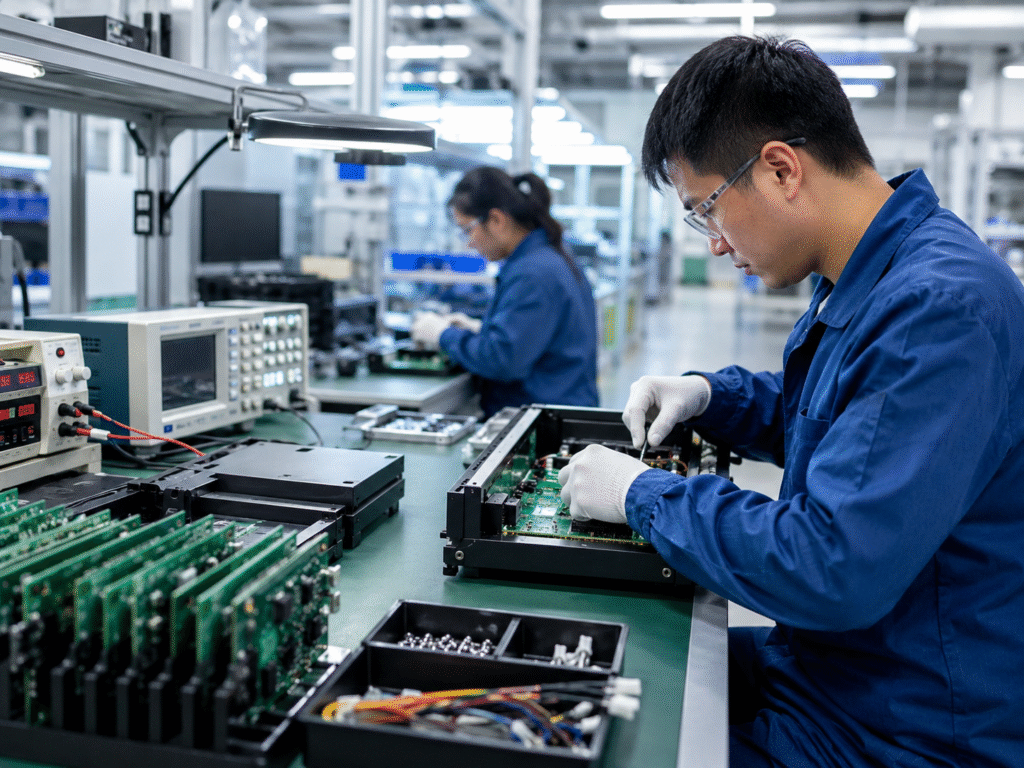
The table below explains EMS vs OEM Manufacturing from the perspective of service scope, engineering support, project stage, flexibility, and production responsibility.
| Comparison Point | EMS Manufacturing | OEM Manufacturing |
|---|---|---|
| Main Focus | Electronics manufacturing services and production support | Producing products according to customer specifications |
| Best Project Stage | Prototype, pilot run, early production, and mass production support | Mature products with stable specifications |
| Engineering Support | Often supports DFM review, testing planning, assembly review, and production feasibility | Usually follows confirmed drawings, samples, and production standards |
| Service Scope | PCB assembly, testing, product assembly, packaging, and supply chain coordination | Depends on the factory’s capability and product category |
| Flexibility | More flexible for multi-process electronics projects | More suitable for repeat production |
| Customer Involvement | Customer may work closely with the EMS team during development and production | Customer provides clear requirements and expects stable output |
| Project Complexity | Suitable for products involving PCB, enclosure, testing, and final assembly | Suitable for products with fixed structure and confirmed process |
| Main Value | Reduces coordination risk and supports manufacturing execution | Provides stable production based on defined requirements |
The key point is this:
EMS manufacturing is usually more service-oriented and process-oriented, while OEM manufacturing is usually more product-output-oriented.
This does not mean one is always better than the other. The better choice depends on your product stage, complexity, and how much manufacturing support you need.
When Should You Choose EMS Manufacturing?
When comparing EMS vs OEM Manufacturing, EMS is usually more suitable for projects that need engineering coordination, PCB assembly, testing, enclosure integration, and final product assembly.
EMS manufacturing is usually a better choice when your electronics project involves several connected production steps.
For projects that require PCB assembly support, plastic enclosure integration, testing, and final assembly, EMS manufacturing can help connect these steps into one more manageable production process.
You may need EMS manufacturing if your project includes:
- PCB assembly
- Plastic housing or enclosure production
- Mechanical part integration
- Functional testing
- Final product assembly
- Packaging and shipment preparation
- Engineering communication between electronic and mechanical parts
For example, a product may look simple from the outside, but during production it may involve several important details:
The PCB must fit inside the plastic enclosure.
Connectors must align with openings in the housing.
Buttons, speakers, LEDs, ports, and switches must be positioned correctly.
The product must pass functional testing after assembly.
The final packaging must protect the product during shipment.
If each step is handled separately, small problems can easily appear between suppliers. A PCB layout may be acceptable by itself, but it may not fit well with the enclosure. A plastic part may pass dimensional inspection, but it may create assembly difficulty. A product may look correct after assembly, but fail during functional testing.
EMS manufacturing helps reduce these risks by considering the product as a complete system, not just separate parts.
You should consider EMS manufacturing when your goal is not only to produce components, but to move the project from prototype to a finished, tested, shipment-ready product.
When Should You Choose OEM Manufacturing?
In the EMS vs OEM Manufacturing decision, OEM manufacturing may be more suitable when the product design is mature and the customer mainly needs repeatable production.
OEM manufacturing may be a better option when your product is already well developed and you mainly need stable production.
You may choose OEM manufacturing if:
- The product design is finalized
- The engineering files are complete
- The BOM is confirmed
- The product has already passed testing
- The structure is stable
- The production process is clear
- You do not need much engineering support
- Your main priority is repeatable output and cost control
For mature products, OEM manufacturing can be efficient. The customer provides clear requirements, and the manufacturer produces according to those standards.
This model can work well when there is little uncertainty in the product. If the product has already gone through design validation, testing, pilot production, and process improvement, the OEM model can help maintain stable production quality.
However, if the product is still changing, or if the customer is still solving fit, assembly, testing, or manufacturability issues, OEM manufacturing may not provide enough support unless the supplier also has strong engineering and integration capability.
Which Is Better for Electronics Product Development?
For electronics product development, the EMS vs OEM Manufacturing decision usually depends on whether the project needs only production output or broader manufacturing support.
There is no single answer to whether EMS or OEM manufacturing is better. The better choice depends on your project stage and product complexity.
If your product is already mature and you only need a factory to produce it according to confirmed specifications, OEM manufacturing may be suitable.
If your project still requires manufacturing feedback, PCB assembly support, plastic part integration, functional testing, or final product assembly, EMS manufacturing may be more practical.
For electronics product development, EMS is often more suitable when the project includes both electronic and mechanical requirements. Many electronics products are not only PCBs. They may include plastic housings, molded parts, cables, connectors, buttons, screens, speakers, sensors, batteries, packaging, and testing procedures.
If your project goes beyond bare PCB production, it may also be helpful to understand the difference between PCB assembly and box build assembly.
In this kind of project, the challenge is not only producing each part. The real challenge is making sure all parts work together as a finished product.
That is why EMS manufacturing is often valuable for companies developing new electronics products, especially when they want to reduce the number of suppliers and simplify production management.
Common Risks When Choosing the Wrong Manufacturing Model
Choosing the wrong manufacturing model can create problems later in the project. These problems may not appear at the quotation stage, but they can become costly during production.
When buyers evaluate EMS vs OEM Manufacturing, they should not only compare supplier labels. They also need to consider project complexity, communication workload, engineering support, testing requirements, and final delivery responsibility.
1. Supplier Coordination Becomes Difficult
If the PCB supplier, plastic parts supplier, assembly supplier, and packaging supplier are all separate, the customer must manage communication between all sides.
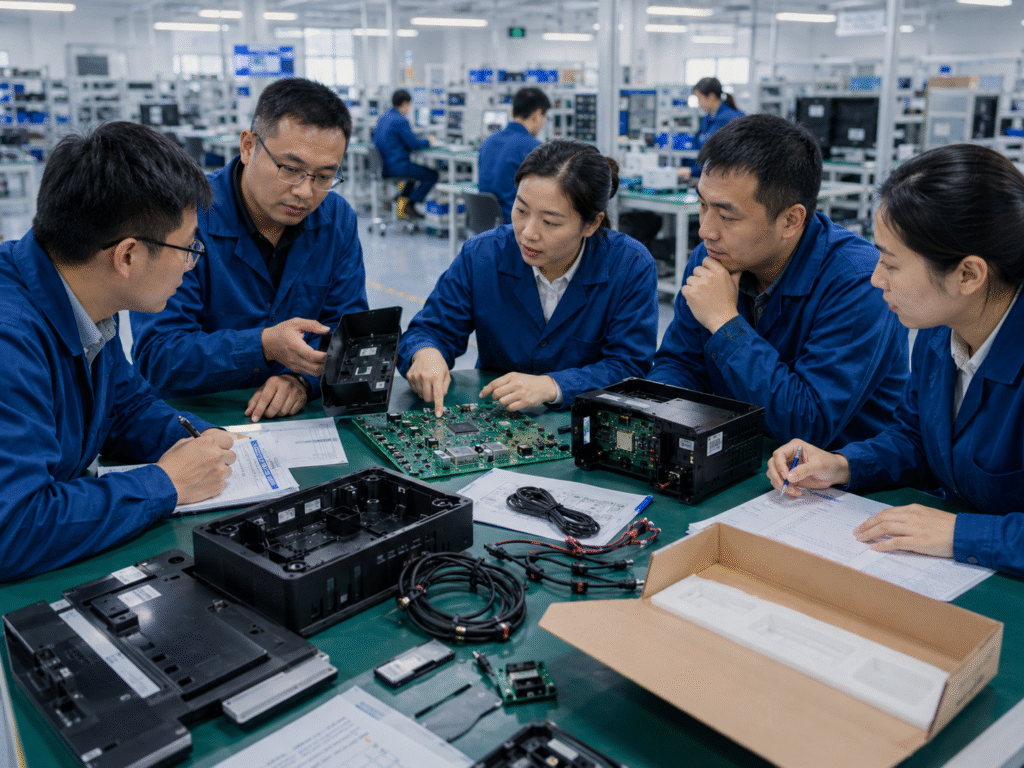
When a problem happens, it may not be clear who is responsible. The PCB supplier may say the enclosure design needs adjustment. The plastic parts supplier may say the PCB layout should change. The assembly team may say the tolerance is too tight. This can slow down the project and increase management costs.
A more integrated manufacturing partner can help reduce this back-and-forth communication.
2. Mechanical and Electronic Parts Do Not Fit Well
Many electronics products require close coordination between PCB design and mechanical structure.
For example:
- The PCB size must match the internal space of the housing
- The charging port must align with the enclosure opening
- Buttons must touch the PCB switch correctly
- LED indicators must match the light window
- Screws, clips, and ribs must not interfere with electronic components
If PCB assembly and plastic enclosure production are handled separately without enough review, fit problems may appear during final assembly.
This can lead to redesign, mold modification, PCB layout changes, assembly delays, or additional testing.
3. Functional Problems Are Found Too Late
Visual inspection is not enough for many electronics products. A product may look correct but still fail during use.
Functional testing is important because it checks whether the product actually works after assembly.
For electronics assembly quality, many manufacturers also refer to IPC standards to support consistent workmanship, reliability, and production expectations.
Depending on the product, this may include power-on testing, signal testing, audio testing, button testing, charging testing, sensor testing, or communication testing.
If functional testing is not planned early, problems may only be discovered after final assembly. At that stage, repair and rework are usually more expensive.
EMS manufacturing can help include testing as part of the production workflow, rather than treating it as an afterthought.
4. Initial Cost Looks Lower, but Total Cost Increases Later
Some buyers compare suppliers only by unit price. A separate PCB supplier, plastic part supplier, and assembly supplier may look cheaper at the beginning.
However, the total project cost may increase if there are problems such as:
- Extra shipping between suppliers
- Rework costs
- Delayed delivery
- Assembly failure
- Mold modification
- PCB redesign
- Additional inspection
- Communication time
A lower initial quotation does not always mean a lower final cost. For complex electronics products, reducing manufacturing risk can be more important than choosing the lowest unit price.
5. Project Responsibility Is Not Clear
When multiple suppliers are involved, responsibility can become unclear.
If the final product does not work, is the issue caused by PCB assembly, plastic housing, component quality, assembly process, or testing method?
Without a clear production workflow, the customer may spend a lot of time identifying the root cause.
A suitable EMS partner can help manage production steps more clearly and support troubleshooting across different parts of the product.
How to Decide Between EMS and OEM Manufacturing
The best way to decide between EMS vs OEM Manufacturing is to look at your project stage, product complexity, testing needs, and supplier management requirements.
Before choosing between EMS and OEM manufacturing, buyers should evaluate their project requirements carefully.
Here are some practical questions to ask:
- Is the product design fully finalized?
- Does the product include PCB assembly?
- Does the project require plastic enclosure or molded parts?
- Are electronic and mechanical parts closely connected?
- Is functional testing required before shipment?
- Do you need final product assembly?
- Do you need packaging and shipment preparation?
- Are you still improving the product for manufacturability?
- Do you want to reduce the number of suppliers?
- Is your priority the lowest unit price or lower overall project risk?
If your answers involve engineering coordination, testing, assembly, and multiple production steps, EMS manufacturing may be the better option.
If your product is already stable and you mainly need repeatable production based on confirmed files and specifications, OEM manufacturing may be enough.
A good way to think about it is:
Choose OEM manufacturing when the product is already mature. Choose EMS manufacturing when the project needs manufacturing support, production coordination, and end-to-end execution.
EMS vs OEM Manufacturing for Small and Medium Electronics Projects
For small and medium electronics projects, the EMS vs OEM Manufacturing decision is especially important.
Large companies may have internal engineering teams, sourcing teams, quality teams, and project managers. They can manage multiple suppliers more easily.
But smaller companies, startups, and overseas buyers may not want to coordinate many different suppliers. They may prefer one manufacturing partner that can help manage several steps, from parts production to final assembly.
In this situation, EMS manufacturing can be useful because it simplifies communication. Instead of contacting several suppliers separately, the customer can work with one team to review production requirements, confirm samples, test products, and prepare for shipment.
This can be especially valuable for products such as:
- Smart home devices
- Audio products
- Consumer electronics
- Control modules
- Sensor devices
- Small electronic appliances
- Industrial electronic products
- Custom plastic electronic products
These products often require both electronic manufacturing and mechanical integration. A supplier with only one capability may not be enough.
How CINDY MOULD Supports Electronics Manufacturing Projects
CINDY MOULD supports electronics manufacturing projects through a combination of plastic part production, electronics integration, functional testing, and final product assembly.
Our manufacturing support can include:
- Injection mold design and manufacturing
- Plastic injection molded parts production
- PCB assembly support
- Product functional testing
- Mechanical and electronic part integration
- Final product assembly
- Packaging and shipment preparation
For products that combine electronic parts, plastic housings, cables, and final assembly, electro-mechanical and box build assembly is often an important part of the manufacturing process.
This makes our service especially suitable for electronics products that require both plastic parts and electronic assembly.
Instead of managing separate suppliers for the enclosure, PCB, testing, assembly, and packaging, customers can work with one team to move the project toward a more complete manufacturing solution.
For buyers developing electronics products, this type of one-stop support can help reduce communication gaps, improve production coordination, and make the project easier to manage from prototype to shipment.
Conclusion
EMS and OEM manufacturing are both important production models, but they are not the same.
In the end, EMS vs OEM Manufacturing is not about which model is always better. It is about which model better matches your electronics product, production stage, and manufacturing support needs.
OEM manufacturing is often suitable for mature products with confirmed designs, stable specifications, and clear production requirements. It works well when the customer mainly needs repeatable production.
EMS manufacturing is often more suitable for electronics projects that require PCB assembly, functional testing, plastic enclosure integration, final assembly, and shipment preparation. It provides more manufacturing support across different production steps.
For electronics product development, the better choice depends on your project stage, product complexity, and how much support you need from your manufacturing partner.
If your project only needs stable production of a mature product, OEM manufacturing may be enough. But if your project involves electronics, plastic parts, testing, assembly, and packaging, EMS manufacturing may provide a more complete and practical solution.
For companies looking to simplify supplier management and move electronics products from parts to finished goods, working with an EMS manufacturing partner can help reduce risk and improve production efficiency.
If you are comparing EMS vs OEM Manufacturing for a new product, you can discuss your electronics manufacturing project with our team and review which production model is more suitable for your requirements.