
Introduction
For many electronic products, PCB assembly is only one part of the manufacturing process. A finished device also needs an enclosure, cables, connectors, mechanical parts, firmware loading, functional testing, labeling, packaging, and final shipment preparation.
This is where box build assembly becomes important.
Electro-mechanical and box build assembly connects the electronic, mechanical, and final product integration stages into one complete manufacturing process. Instead of managing separate suppliers for PCB assembly, plastic parts, wiring, testing, and product assembly, companies can work with one manufacturing partner to reduce communication gaps, assembly risks, and production delays.
For products such as smart home devices, industrial controllers, communication equipment, security electronics, medical electronic devices, and custom consumer electronics, box build assembly helps turn an assembled PCB into a complete or semi-finished product that is ready for use, testing, packaging, or shipment.
In this article, we will explain 7 key things to know about electro-mechanical and box build assembly, including what it means, how it differs from standard PCB assembly, what the process includes, and how to choose the right manufacturing partner.
1. What Is Electro-Mechanical and Box Build Assembly?
Electro-mechanical and box build assembly refers to the process of integrating electronic components, mechanical parts, cables, enclosures, and other hardware into a finished or semi-finished product.
In simple terms, it goes beyond standard PCB assembly. A PCBA may be the core of an electronic device, but the product is not complete until it is installed into the enclosure, connected with wires or connectors, assembled with mechanical parts, tested, labeled, and prepared for shipment.
Typical box build assembly may include:
- PCBA installation
- Plastic or metal enclosure assembly
- Cable and wire harness connection
- Connector and switch installation
- Screws, brackets, gaskets, and hardware assembly
- Firmware programming if required
- Functional testing
- Labeling and packaging
- Final inspection before shipment
For many electronic products, box build assembly is the stage where separate parts become a real product. This is especially important when the product includes both electrical and mechanical features, such as buttons, displays, charging ports, sensors, communication modules, cables, housing parts, and user interface components.
A well-managed box build assembly process helps ensure that the PCB, enclosure, connectors, cables, and mechanical structure all work together correctly.
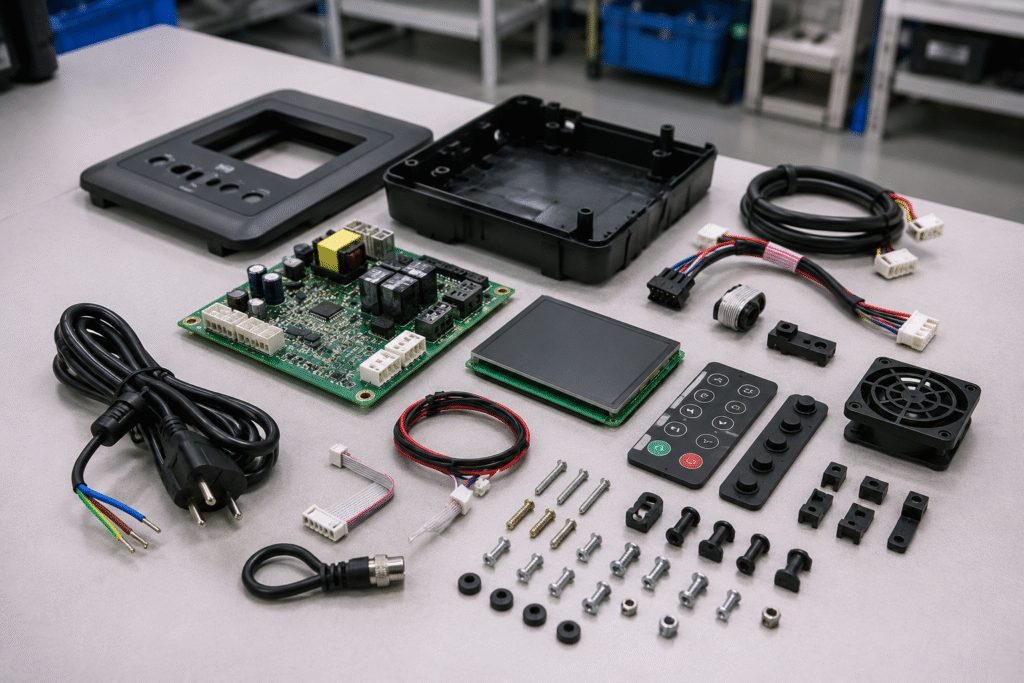
Electro-mechanical box build assembly components including PCBA, enclosure, cables, connectors, and mechanical parts
2. How Box Build Assembly Differs from Standard PCB Assembly
Standard PCB assembly mainly focuses on mounting electronic components onto a printed circuit board. For soldered electrical and electronic assemblies, manufacturers may also refer to IPC-J-STD-001, which covers requirements for soldered electrical and electronic assemblies. This may include SMT assembly, through-hole assembly, soldering, AOI inspection, visual inspection, and basic electrical testing.
Box build assembly is broader. It includes the PCB, but also covers the mechanical structure, enclosure, cables, connectors, user interface parts, final product testing, labeling, and packaging.
The difference can be understood this way:
PCB assembly produces an assembled circuit board.
Box build assembly produces a more complete electronic product.
This difference matters because many product failures do not come from the PCB alone. They may come from connector misalignment, poor cable routing, insufficient enclosure tolerance, weak fastening design, heat dissipation issues, or problems found only after the PCB is installed into the final housing.
| Item | Standard PCB Assembly | Box Build Assembly |
|---|---|---|
| Main focus | Circuit board assembly | Complete product integration |
| Includes enclosure | Usually no | Yes |
| Includes cables and connectors | Limited | Often required |
| Includes mechanical parts | Usually no | Yes |
| Includes functional testing | Basic board-level testing | Product-level testing |
| Typical output | PCBA | Finished or semi-finished product |
| Supplier coordination | May require multiple suppliers | Can be handled by one partner |
For buyers, understanding this difference is important. If your project only requires assembled circuit boards, standard PCB assembly may be enough. But if your product needs to be installed into a housing, connected with cables, tested as a complete device, and packed for delivery, box build assembly is the more suitable solution.
3. What Is Included in the Box Build Assembly Process?
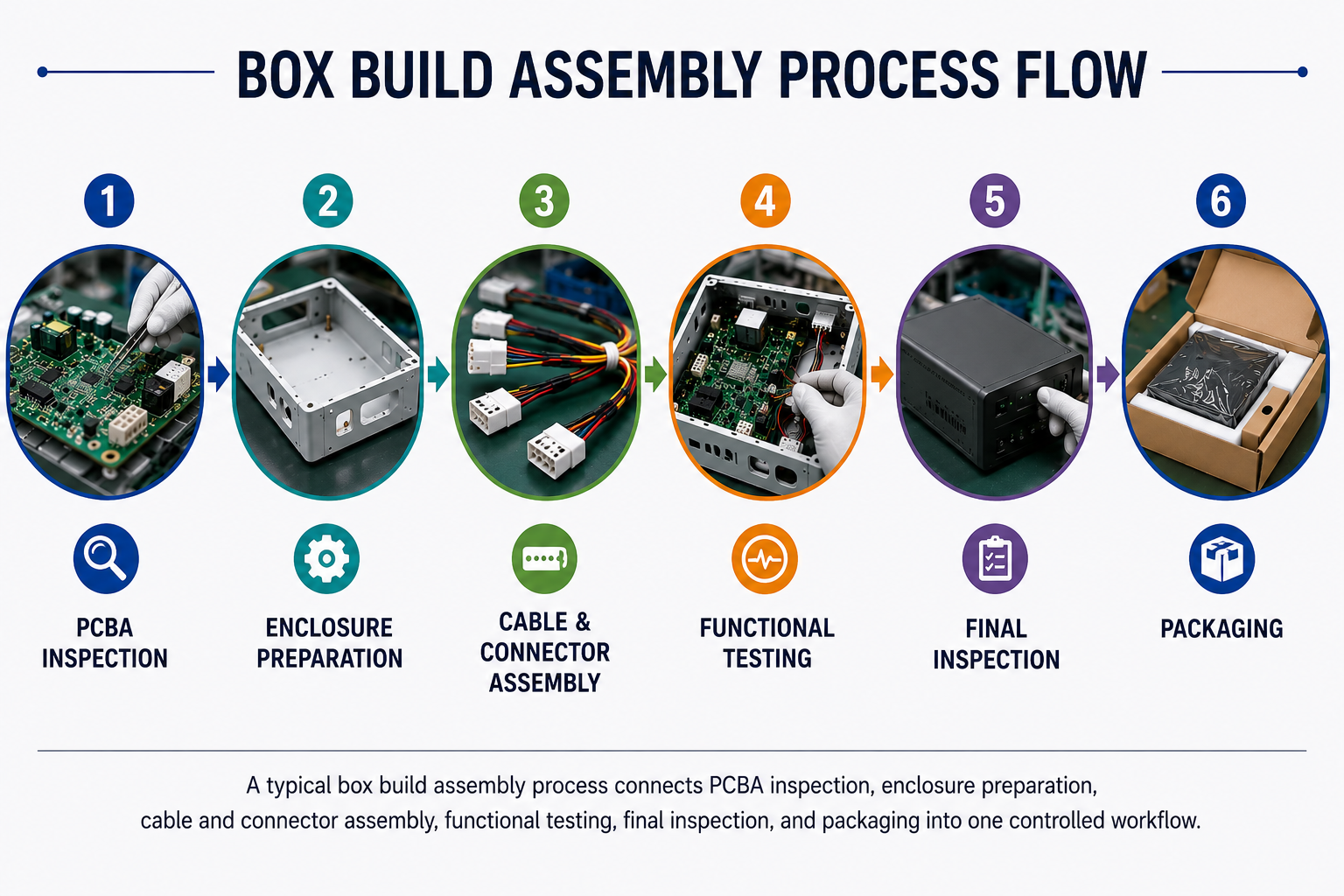
The box build assembly process can vary depending on product complexity, but most projects follow several key stages. These stages help ensure that each component is prepared, assembled, tested, and checked before shipment.
Material and Component Preparation
Before assembly begins, all required materials need to be prepared and checked. These may include PCBAs, plastic enclosures, metal parts, cables, connectors, screws, labels, packaging materials, user manuals, accessories, and product-specific components.
Material preparation is important because missing or incorrect parts can delay the entire production schedule. A reliable manufacturing partner should check the bill of materials, confirm part availability, and make sure the correct components are used for each production batch.
PCBA Inspection Before Integration
The assembled PCB should be inspected before it is installed into the enclosure. This may include visual inspection, AOI inspection, solder joint checking, and basic electrical testing.
This step helps avoid unnecessary rework later. If a PCB problem is found after the product is fully assembled, disassembly may take more time and increase the risk of damaging other parts.
Mechanical Parts and Enclosure Preparation
Plastic or metal housings, brackets, buttons, seals, and mounting parts should be checked before assembly. The enclosure must match the PCB layout, connector positions, screw holes, and internal structure.
For plastic enclosures, dimensional stability and tolerance control are especially important. If the housing is not accurate, the PCB may not fit properly, buttons may not move smoothly, or connectors may not align with openings.
Cable, Connector, and Hardware Assembly
This step may include routing cables, connecting wire harnesses, installing switches, tightening screws, fixing brackets, and securing internal components.
Cable routing should not be treated as a small detail. Poor routing can create assembly difficulty, interfere with moving parts, affect signal performance, or cause long-term reliability risks. Clear assembly instructions are important to ensure that every operator follows the same process.
Product-Level Functional Testing
After the product is assembled, functional testing helps confirm whether the complete device works as intended. This may include power-on testing, button testing, signal testing, communication testing, display checking, charging function testing, sensor testing, or other product-specific checks.
Product-level testing is different from board-level testing because it verifies the complete assembled product, not only the PCB.
Final Inspection and Packaging
The finished product should be checked for appearance, labeling, accessories, packaging, and shipment requirements. Final inspection may include surface condition, label position, screw tightness, cable placement, packaging accuracy, and quantity confirmation.
Packaging is also part of the customer experience. For products that go directly to end users or retail channels, packaging quality, labeling, and accessory placement must be controlled carefully.
4. Why Mechanical and Electrical Integration Matters
Electro-mechanical integration is one of the most important parts of box build assembly because electronic and mechanical designs must work together in the final product.
Even when the PCB works correctly on its own, problems can still appear after final assembly. For example, a connector may not align with the enclosure opening, a cable may be too short, a button may not press correctly, or internal parts may interfere with each other.
Good integration helps avoid:
- Connector misalignment
- Cable routing problems
- Assembly interference
- Loose components
- Heat dissipation issues
- Poor user experience
- Rework during production
- Delays caused by design changes
This is why early communication between mechanical design, PCB design, tooling, and assembly teams is important. When these teams work separately, small design gaps can become costly production problems.
For example, a PCB designer may place a connector in a location that looks fine on the board, but the connector may not match the enclosure opening after final assembly. A mechanical designer may design a compact housing, but there may not be enough space for cable routing or heat dissipation. These issues are often discovered too late when suppliers work separately.
A strong box build assembly partner should understand both the electronic and mechanical sides of the product. This helps identify potential risks before mass production and makes the final assembly process more stable.
5. Common Challenges in Box Build Assembly
Box build assembly often looks simple from the outside, but many details can affect final product quality and production efficiency. The more parts involved, the more important process control becomes.
Here are some common challenges in box build assembly.
Poor Fit Between PCB and Enclosure
If mounting holes, connectors, buttons, or enclosure openings are not aligned, the product may require rework or design changes. This can delay production and increase cost.
This problem often happens when PCB design and enclosure design are developed separately without enough assembly review.
Cable Routing Issues
Incorrect cable length or poor routing may cause assembly difficulty, signal problems, or long-term reliability risks. Cables may also be squeezed by the housing, blocked by other components, or placed too close to heat-generating parts.
Clear routing paths and work instructions are important for repeatable assembly.
Inconsistent Mechanical Parts
Plastic parts, screws, brackets, rubber parts, or other mechanical components must be stable enough for repeatable assembly. If part dimensions vary too much, operators may have difficulty assembling the product consistently.
For products that require injection molded housings, tooling accuracy and injection molding process control can directly affect box build assembly quality.
Lack of Clear Assembly Instructions
Without clear work instructions, different operators may assemble the same product in different ways. This can lead to inconsistent quality, longer assembly time, and more inspection problems.
Good assembly documentation should include process steps, torque requirements, cable routing methods, testing procedures, labeling position, and packaging requirements.
Testing Only at the PCB Level
A PCB may pass board-level testing, but the finished product may still fail after full integration. Problems may appear after cables are connected, the enclosure is closed, buttons are installed, or external ports are used.
This is why product-level functional testing is important in box build assembly.
Managing Too Many Suppliers
When PCB assembly, enclosure production, cable assembly, final assembly, and testing are handled by different suppliers, communication problems can easily appear. Each supplier may only focus on their own part of the project, while the final product requires all parts to work together.
Using one manufacturing partner for integrated assembly can help reduce communication gaps and improve production coordination.
6. Quality Control and Functional Testing Are Critical
Quality control is critical in box build assembly because the final product includes more variables than a single PCB. It includes electronic components, mechanical parts, cables, fasteners, enclosure fit, product appearance, labels, accessories, packaging, and functional performance.
In electronics manufacturing, quality expectations are often guided by industry standards such as IPC-A-610, which provides acceptance requirements for electronic assemblies.
A reliable quality control process may include:
- Incoming material inspection
- PCBA inspection before assembly
- Enclosure and mechanical part checking
- In-process assembly inspection
- Cable and connector checking
- Functional testing
- Appearance inspection
- Packaging inspection
- Final shipment check
Functional testing is especially important because it verifies whether the complete product performs as expected after assembly. This may include power-on testing, button testing, connection testing, signal testing, display checking, charging function testing, communication testing, or other product-specific tests.
For many electronic products, final product testing is the last chance to find problems before shipment. It helps reduce customer complaints, product returns, and costly after-sales issues.
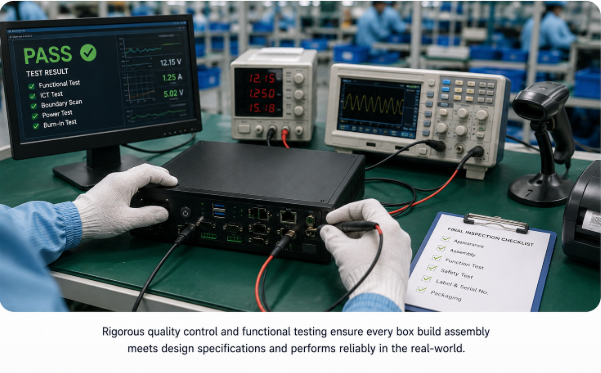
For example, a product may pass PCB testing, but after final assembly, the power button may not respond correctly, the connector may not make stable contact, or the product may fail under normal operating conditions. These problems can only be found when the product is tested as a complete unit.
A good box build assembly process should not treat testing as a final formality. Testing should be planned as part of the manufacturing workflow. The earlier quality risks are found, the easier and less expensive they are to solve.
7. How to Choose the Right Box Build Assembly Partner
Choosing the right box build assembly partner is not only about assembly cost. It is about whether the supplier can understand the complete product and control the process from components to shipment.
Before choosing a supplier, buyers should consider several questions:
- Can the supplier handle both PCBA and final product assembly?
- Do they understand mechanical and electrical integration?
- Can they support enclosure, plastic parts, or mechanical components?
- Do they provide functional testing before shipment?
- Can they create or follow clear assembly work instructions?
- Do they have experience with similar electronic products?
- Can they support prototype, pilot run, and mass production?
- Can they help reduce communication between multiple suppliers?
- Do they understand packaging and shipment requirements?
- Can they help identify assembly risks before mass production?
A good box build assembly partner should not only assemble parts. They should also help identify risks before they become production problems.
For overseas buyers, communication is also important. The supplier should be able to understand project requirements, provide clear feedback, support engineering discussions, and control production details. When communication is weak, even small assembly issues can become expensive delays.
If your product includes a PCB, enclosure, cables, connectors, testing requirements, and packaging, choosing a partner with integrated manufacturing capability can make the project easier to manage.
How CINDY MOULD Supports Box Build Assembly
At CINDY MOULD, we support electronics manufacturing projects that require more than PCB assembly. Our services cover PCBA, plastic parts, product assembly, functional testing, packaging, and shipment preparation.
For projects that involve electronic and mechanical integration, our team can help customers connect different manufacturing stages more smoothly. This is especially useful for products that require PCB installation, enclosure assembly, cable connection, testing, and final product delivery.
By working with one manufacturing partner, customers can reduce communication gaps, improve assembly consistency, and move from prototype to production with better process control.
Our manufacturing support is suitable for many types of electronic products, including smart home devices, communication electronics, security products, industrial controllers, consumer electronics, and customized electronic devices.
Instead of managing separate suppliers for PCBA, enclosure parts, assembly, testing, and packaging, customers can work with CINDY MOULD to support a more connected production workflow.
Conclusion
Electro-mechanical and box build assembly is an important step for turning an assembled PCB into a complete electronic product. It connects the electronic board, enclosure, cables, connectors, mechanical parts, functional testing, and final packaging into one integrated manufacturing process.
For buyers and product teams, understanding box build assembly helps reduce design risks, supplier communication problems, and quality issues during production.
A successful box build assembly project depends on more than simply putting parts together. It requires good coordination between electronic design, mechanical structure, material preparation, assembly process control, functional testing, and final inspection.
If your project requires PCBA, enclosure integration, functional testing, and final product assembly, choosing a manufacturing partner with complete box build assembly capability can make the production process more efficient, consistent, and reliable.
FAQ
What is box build assembly?
Box build assembly is the process of assembling a complete or semi-complete electronic product. It may include PCBA installation, enclosure assembly, cable connection, mechanical parts, functional testing, labeling, packaging, and final inspection.
Is box build assembly the same as PCB assembly?
No. PCB assembly focuses on mounting components onto a circuit board. Box build assembly includes PCB assembly but also covers enclosure integration, cables, connectors, mechanical parts, product-level testing, and packaging.
What products need box build assembly?
Products such as smart home devices, medical electronics, security equipment, industrial IoT controllers, communication devices, consumer electronics, and customized electronic products often require box build assembly.
Why is functional testing important in box build assembly?
Functional testing verifies whether the complete assembled product works as expected. It helps find problems that may not appear during board-level testing, such as connector issues, assembly errors, wiring problems, or product-level failures.
How do I choose a box build assembly supplier?
You should check whether the supplier can support PCBA, mechanical integration, enclosure assembly, functional testing, quality control, packaging, and production communication. A good supplier should help reduce assembly risks, not only provide assembly labor.