
Introduction
Traceability in electronics manufacturing plays a critical role in controlling quality and reducing risk across the entire production process.
In many projects, products pass testing and inspection, yet issues still appear after shipment. At that point, the challenge is no longer just technical — it becomes a question of visibility.
Engineering and procurement teams often face the same situation:
- A batch shows inconsistent performance
- A field issue is reported, but affected units cannot be clearly identified
- Multiple process steps are involved, but no single data link connects them
Without traceability, even simple problems become difficult to isolate, and resolution takes longer than expected.
For this reason, traceability in electronics manufacturing should not be treated as an optional system. It is a fundamental part of process control, product reliability, and risk management.
Why Traceability Matters in Electronics Manufacturing
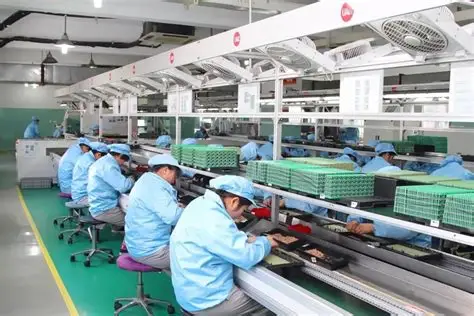
Modern electronics manufacturing involves multiple interconnected stages, including PCB assembly, component sourcing, firmware programming, final assembly, and packaging. Industry standards such as those from IPC help define quality and process control requirements across these stages.
Each stage introduces variables that can affect product performance.
Traceability in electronics manufacturing connects these variables into a structured system.
Without traceability, manufacturers may encounter:
- Delayed root cause analysis
- Inability to isolate affected batches
- Increased rework and warranty cost
- Inconsistent process control across stages
As production volume increases, these risks become more significant. A minor variation at the component or process level can propagate across large batches if not detected early.
Effective traceability in electronics manufacturing transforms isolated production data into actionable insights, enabling better control and faster response.
Traceability vs Visibility: What Teams Often Overlook
Traceability is often confused with visibility, but the two are not the same.
Visibility refers to knowing what is happening in production at a given moment. Traceability in electronics manufacturing goes further — it connects historical data across materials, processes, and finished products.
In practice, many teams have partial visibility through dashboards or inspection reports, but lack full traceability when issues occur.
For example:
- A defect is identified at final testing
- Inspection data is available
- But there is no clear link to component batch or process variation
This gap creates delays in root cause analysis and increases the risk of repeated issues.
Effective traceability ensures that data is not only visible, but also connected and actionable.
A Practical Framework: Three Levels of Traceability
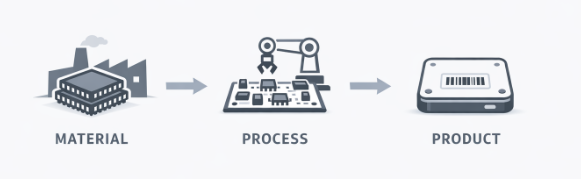
From a practical perspective, traceability in electronics manufacturing can be structured into three key levels: material, process, and product.
Material Traceability
Each component used in production should be traceable to its source.
Typical data includes:
- Supplier information
- Batch or lot number
- Date code
- Incoming inspection records
Material traceability allows quick containment when a component issue is identified.
Process Traceability
Process traceability records what happens during manufacturing.
This includes:
- SMT process data (reflow profile, solder paste batch)
- Assembly operations and workstations
- Inspection and testing results
- Firmware programming records
This level of traceability makes it possible to analyze variation across production conditions.
Product-Level Traceability
Each product should have a unique identifier, such as a serial number or barcode.
This connects all related data points across the manufacturing process.
Product-level traceability is essential for linking materials and processes to individual units.
Traceability Data Mapping Example
To make traceability effective, data must be structured and connected.
| Traceability Element | Example Data | Purpose |
|---|---|---|
| Component Batch | Supplier lot number | Identify material-related issues |
| Process Data | Reflow temperature profile | Analyze process variation |
| Firmware Version | Version ID | Ensure configuration consistency |
| Serial Number | Product ID | Track individual units |
This mapping approach helps transform traceability from record-keeping into a usable system.
Traceability Across the Manufacturing Workflow
In traceability in electronics manufacturing, data should be connected across the entire production workflow rather than isolated steps.
PCB Assembly Stage
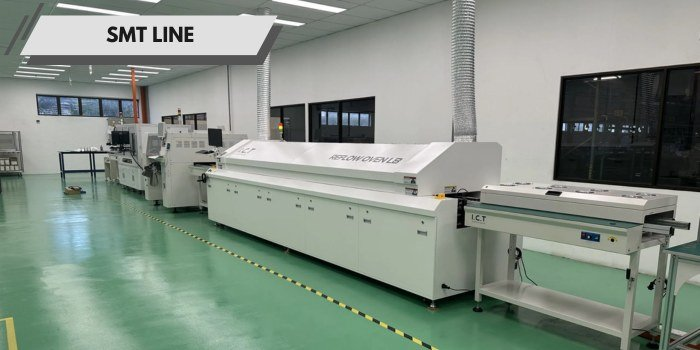
During PCB assembly, traceability focuses on:
- Component placement
- Soldering conditions
- Inspection data (SPI, AOI, AXI)
These data points help identify early-stage variations that may affect long-term reliability.
Firmware Programming Stage
Firmware programming defines product functionality.
Without proper traceability, different firmware versions may be applied inconsistently.
Recording version data, programming parameters, and timestamps ensures each unit can be traced back to its exact configuration.
Final Assembly Stage
Final assembly introduces additional variability, especially when multiple components, cables, and enclosures are integrated. In many cases, product reliability is influenced at this stage. Learn more about how final assembly affects product reliability in our related article.
- Component integration
- Assembly sequence
- Operator handling
- Functional testing
Traceability at this stage helps identify issues that may not be visible earlier.
Packaging and Shipment
Traceability should extend through packaging and shipment, especially when products are prepared for export. In this stage, proper packaging design also plays a critical role in protecting product integrity. You can refer to our article on electronics packaging for export shipping to understand how packaging affects delivery reliability.
Batch numbers, packaging records, and shipment data ensure that products can still be tracked after leaving the factory, which is especially important for export scenarios.
Real-World Scenario: When Traceability Becomes Critical
In many electronics manufacturing projects, traceability only becomes a priority after a problem occurs.
Consider a typical situation:
A batch of products passes final inspection and is shipped. After deployment, a percentage of units begin to show intermittent failures.
Without traceability, teams may need to:
- Recall a large portion of shipped products
- Re-test multiple batches
- Investigate across multiple process steps
This process is time-consuming and costly.
With proper traceability in electronics manufacturing, the response becomes more controlled:
- Affected units can be identified by serial number
- The issue can be linked to a specific component batch or process condition
- Corrective actions can be implemented with minimal disruption
This difference highlights the practical value of traceability beyond compliance.
Common Challenges in Traceability Implementation
Although traceability is essential, implementation can present challenges.
Data Overload
Collecting excessive data without a clear structure makes systems difficult to manage.
Inconsistent Data Recording
Manual processes can result in incomplete or inconsistent records.
Disconnected Systems
If data from different stages is not integrated, traceability becomes fragmented.
Limited Data Utilization
Traceability systems are sometimes used only for record-keeping.
Practical Checklist for Implementing Traceability
To implement traceability in electronics manufacturing effectively, focus on practical steps:
- Define product identification method (barcode or serial number)
- Identify key data points across materials and processes
- Standardize data recording procedures
- Integrate MES with production data
- Validate traceability through test scenarios
Key Traceability Metrics for Process Control
To evaluate the effectiveness of a traceability system, manufacturers can track a set of practical metrics. In many advanced manufacturing environments, these metrics are integrated into MES systems for real-time monitoring and analysis.
| Metric | Definition | Purpose |
|---|---|---|
| Traceability Coverage | % of process steps with recorded data | Ensure full visibility |
| Data Accuracy Rate | % of correct and complete records | Improve reliability |
| Root Cause Resolution Time | Time required to identify issue source | Measure response efficiency |
| Batch Containment Efficiency | % of affected units accurately isolated | Reduce recall scope |
| System Integration Level | Degree of data connection across systems | Improve usability |
How Traceability Reduces Quality Risk
Traceability improves both visibility and response speed.
When an issue is identified, manufacturers can:
- Quickly locate affected batches
- Isolate specific units
- Perform targeted root cause analysis
- Implement corrective actions
This minimizes the scope of impact and prevents issues from spreading across production.
When to Strengthen Traceability in Your Process
Traceability becomes more critical in:
- High product complexity
- Frequent engineering changes
- Export-oriented production
- Multi-supplier environments
Cost vs Value of Traceability
Implementing traceability requires investment, but the cost of poor traceability is significantly higher.
Without effective traceability, companies may face:
- Large-scale recalls
- Increased warranty claims
- Higher rework costs
- Loss of customer trust
Integrating Traceability into Manufacturing Strategy
Traceability should be integrated into:
- Product design
- Process planning
- Production setup
- Quality control
Conclusion
Traceability in electronics manufacturing is essential for controlling quality and reducing risk.
It provides visibility across materials, processes, and products, enabling faster problem resolution and more consistent performance.
At CINDY Mould, traceability is considered a key part of process control and quality management. From component sourcing to final assembly and shipment, structured data tracking helps ensure reliable and consistent product performance.
If you are looking to improve traceability in your manufacturing process or reduce quality risks, feel free to contact CINDY Mould to discuss your requirements.