
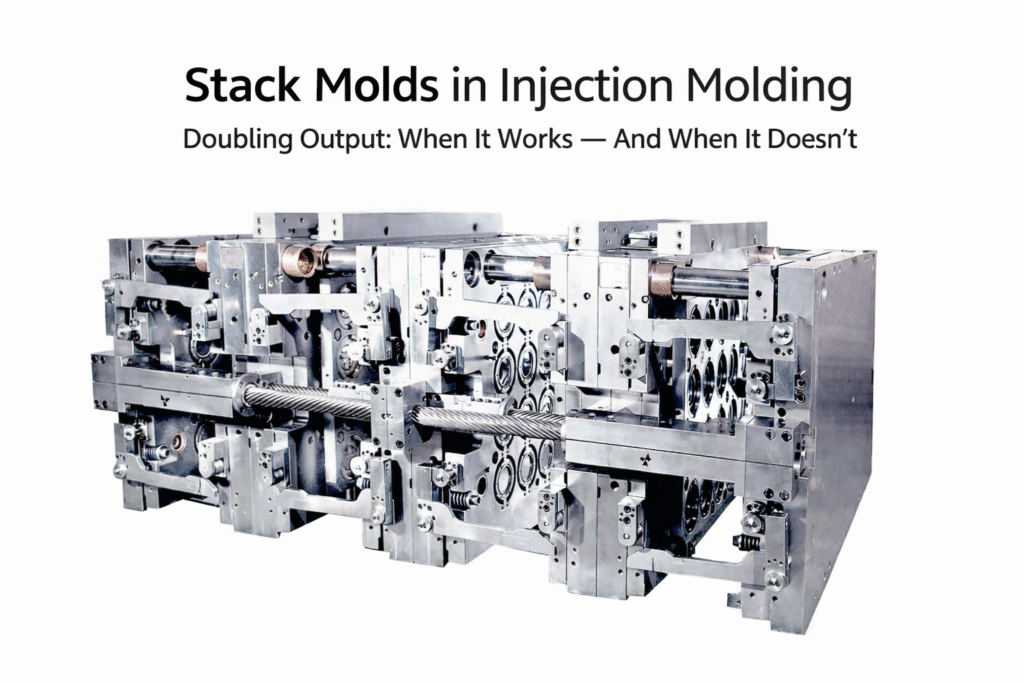
Stack molds in injection molding are often described as a way to double output without adding more machines. In theory, that statement is correct. In practice, the decision to use a stack mold is far more complex.
At CINDY MOULD, we view stack molds not as a shortcut for productivity, but as a long-term production strategy. When properly engineered, a stack mold can significantly improve injection molding productivity and reduce cost per part. When poorly evaluated, it can introduce instability, excessive maintenance, and unnecessary capital risk.
Understanding the difference is critical.
What Is a Stack Mold in Injection Molding?
A stack mold is a multi-level injection mold that contains two or more cavity layers within a single mold base. Unlike a traditional single-face mold, a stack mold produces parts on multiple parting lines during one injection molding cycle.
In most configurations:
- A central runner system distributes melt to both cavity layers
- The mold opens at multiple parting lines
- Parts are ejected simultaneously from both levels
The concept is straightforward. The engineering is not.
Because the projected area effectively increases, clamp force requirements rise. Because cavities are duplicated, runner balance becomes more critical. Because cooling must be symmetrical, thermal management becomes more demanding.
A stack mold is not simply “two molds in one.” It is a synchronized mechanical and thermal system.
When Does a Stack Mold Make Sense?
Not every injection molding project benefits from a stack mold configuration. Based on our engineering evaluations, stack molds are most suitable under the following conditions:
1. High-Volume, Long-Term Production Programs
Stack molds require higher initial tooling investment compared to conventional molds. They are best justified when annual production volume is stable and long-term.
If production forecasts are uncertain or product life cycles are short, the financial return may not offset the added complexity.
2. Balanced and Predictable Part Geometry
Parts that are:
- Symmetrical
- Moderate in wall thickness
- Free from extreme cosmetic requirements
are better suited for stack molds.
Highly asymmetrical designs, complex undercuts, or tight cosmetic tolerances increase the difficulty of balancing multiple cavity layers.
Early DFM analysis is essential before committing to a stack mold structure.
3. Adequate Injection Molding Machine Capacity
A common misconception is that if clamp tonnage appears sufficient, the machine can run a stack mold.
In reality, the following must be evaluated:
- Required clamp force based on total projected area
- Injection shot size capacity
- Tie-bar spacing
- Maximum mold thickness
- Ejection stroke capability
Underestimating clamp force in stack mold projects is one of the most frequent technical mistakes. Even if flashing does not appear immediately, long-term mold wear and dimensional instability often follow.
Key Engineering Considerations in Stack Mold Design
Clamp Force Calculation
Because stack molds increase total projected area, required clamp tonnage must be carefully calculated with sufficient safety margin.
High cavity pressure applications, especially thin-wall parts, demand conservative engineering assumptions.
A stack mold running near the upper limit of machine capacity may function during trial runs but struggle during mass production.
Hot Runner and Flow Balance
Flow balance is critical in stack mold injection molding.
Both cavity layers must fill uniformly. Imbalance can lead to:
- Short shots on one layer
- Overpacking on the opposite layer
- Increased scrap rate
- Dimensional inconsistency
Mold flow analysis should be conducted during the design stage, not after steel cutting.
Cooling Symmetry and Cycle Time Optimization
Cycle time reduction is often the primary motivation behind stack molds. However, cycle time improvements only materialize when cooling systems are symmetrically engineered.
If cooling circuits are not mirrored between layers:
- One cavity level may solidify faster
- Warpage may differ between levels
- Dimensional variation increases
Cooling design in stack molds must be treated as a system, not as duplicated circuits.
Ejection System Synchronization
In stack mold configurations, multiple sets of parts are ejected simultaneously. The ejection system must maintain alignment and rigidity over long production cycles.
Poor synchronization may cause:
- Part sticking on one layer
- Increased mechanical wear
- Frequent maintenance downtime
Mechanical stability is as important as productivity.
Cost Analysis: Does a Stack Mold Really Reduce Cost Per Part?
Stack molds typically increase tooling cost by approximately 30–50% compared to a single-face mold with equivalent total cavity count.
However, potential savings include:
- Reduced number of injection molding machines
- Lower labor per unit output
- Improved floor space utilization
- Increased production capacity without plant expansion
The true cost benefit depends on machine utilization rate and program stability.
For high-volume consumer products or packaging applications, the return on investment can be achieved relatively quickly. For specialized or low-volume parts, a traditional mold configuration may be more economically sound.
Stack molds reduce cost per part only when production conditions remain stable and predictable.
Real Production Scenario: A Practical Comparison
Consider a simplified example:
Single-face mold:
- 8 cavities
- 25-second cycle time
- One injection molding machine required
Stack mold configuration:
- 2 × 8 cavities
- 27-second cycle time (slightly longer due to complexity)
- Same machine footprint
Even with a slightly longer cycle, output per hour increases significantly. Over extended production runs, the effective cost per part decreases — provided quality and stability are maintained.
The engineering challenge is ensuring that productivity gains are not offset by downtime or scrap.
Common Misconceptions About Stack Molds
“Stack molds automatically halve cost per part.”
Not always. Energy consumption, maintenance complexity, and machine wear must be included in cost calculations.
“Any high-volume part should use a stack mold.”
Volume alone does not determine suitability. Part geometry and machine compatibility are equally important.
“Stack molds are just duplicated cavities.”
In reality, stack molds require integrated mechanical, thermal, and flow system design.
Frequently Asked Questions About Stack Molds
How much clamp force does a stack mold require?
Clamp force depends on total projected area and injection pressure. Because stack molds increase projected area, required tonnage often rises substantially. Detailed engineering calculation is necessary before machine selection.
Are stack molds suitable for thin-wall injection molding?
They can be, but thin-wall applications require careful pressure analysis and balanced hot runner systems. Clamp force margins must be conservative.
What industries commonly use stack molds?
Stack molds are frequently used in packaging, consumer goods, and high-volume plastic housings where production efficiency is critical.
When should stack mold decisions be made?
Stack mold strategy should be evaluated during the DFM stage, alongside part design and production planning — not after mold construction begins.
Stack Molds as a Strategic Production Decision
Stack molds in injection molding are powerful tools when applied correctly. They can increase output, optimize factory space, and reduce cost per part.
But they are not universal solutions.
At CINDY MOULD, we approach stack mold projects through structured engineering validation — including clamp force calculation, flow simulation, cooling layout study, and long-term maintenance assessment.