
In high-volume injection molding, stack mold design plays a critical role in determining production capacity and long-term stability.
By adding additional parting surfaces within the same clamp tonnage range, manufacturers can effectively double cavity output per cycle. On paper, this appears to be a straightforward efficiency upgrade.
In real manufacturing environments, however, stack molds are not simply capacity tools — they are structural systems.
Unlike single-face molds, stack molds introduce layered mechanical interfaces, extended load paths, and more complex thermal behavior. Any imbalance in structural symmetry, pressure distribution, or cooling uniformity is amplified across multiple cavity levels.
For high-volume production, where molds may run hundreds of thousands or millions of cycles, long-term performance depends not on cavity count, but on structural balance.
This article explores the structural design principles that define stable stack mold performance and explains why equilibrium across mechanical, thermal, and flow systems is essential for sustained manufacturing reliability.
1.Structural Load Path Design in Stack Mold Design: Managing Clamp Force Across Multiple Levels
In a conventional single-face mold, clamp force transfers through a relatively direct mechanical path. The load distribution is easier to predict and validate.
In stack mold design, the load path becomes layered.
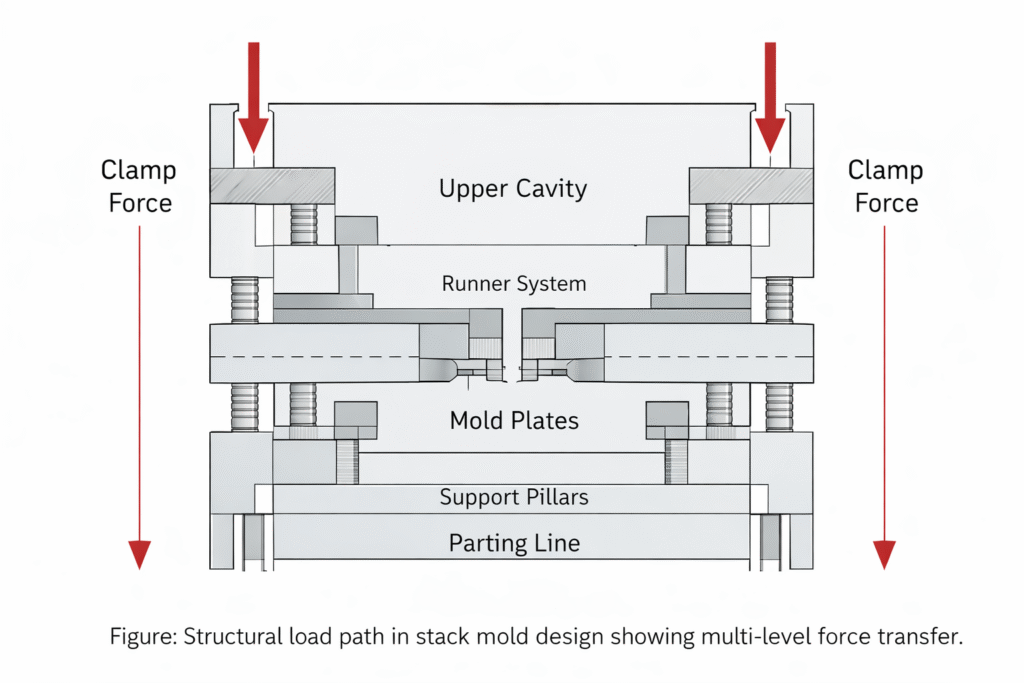
Clamp force must travel through:
- Multiple mold plates
- Spacer blocks
- Support pillars
- Additional parting surfaces
- Intermediary support structures
Each interface introduces tolerance accumulation and potential micro-deflection.
If the load transfer is not evenly distributed across both stack levels, the result may include:
• Uneven cavity compression
• Progressive parting line mismatch
• Flash appearing on one level but not the other
• Accelerated wear at guide components
During early mold trials, these effects may be minimal. Under continuous high-volume production, however, even micron-level deflection compounds over time.
Effective structural design requires:
- Verified platen rigidity under full clamp tonnage
- Tie-bar spacing compatibility with mold width
- Parallelism control between stack faces
- Deflection analysis rather than assumption-based reinforcement
Mechanical symmetry is the foundation of long-term stability in stack mold systems.
Without proper structural planning, stack mold design can gradually lose dimensional consistency over extended production cycles
2. Flow Channel Balance: Pressure Equilibrium Across Cavity Sets
In stack mold design, flow channel equilibrium directly determines cavity-to-cavity repeatability.
Adding cavities does not automatically guarantee balanced filling.
In stack mold design, melt must divide across multiple levels while maintaining equal flow resistance and packing pressure.
Small differences in runner geometry, gate design, or shear rate quickly lead to imbalance between upper and lower stack faces.
Consequences of poor flow balance may include:
• Short shots on one level
• Overpacking on another
• Dimensional variation between cavity groups
• Surface texture inconsistency
• Uneven shrinkage behavior
Flow simulation software can predict theoretical balance. Industry references, including guidance from the Society of Plastics Engineers (SPE), emphasize the importance of pressure equilibrium in multi-cavity mold systems. However, production validation at target cycle time is essential.
Stack molds often appear balanced during early sampling because cycle time is conservative and pressure margins are generous. Once production speed increases, pressure tolerance narrows, and imbalance becomes visible.
True flow equilibrium requires:
- Identical runner path lengths and geometry
- Symmetrical gate layout
- Controlled shear rate distribution
- Pressure validation during ramp-up
Stack mold performance depends on maintaining equal melt behavior across all cavity sets — not merely achieving acceptable first shots.
3. Thermal Uniformity: Managing Heat Across Extended Steel Mass
Thermal control becomes significantly more complex in stack mold structures.
Compared to single-face molds, stack molds introduce:
- Increased steel mass
- Extended heat transfer paths
- Multiple cooling circuit layers
- Greater sensitivity to coolant distribution
If cooling circuits are not independently optimized for each stack level, temperature gradients develop between upper and lower cavity sets.
Production-level consequences include:
• Differential shrinkage
• Warpage variation
• Gloss inconsistencies
• Dimensional drift over long runs
Thermal imbalance is often misinterpreted as material instability. In many cases, it is structural.
Effective thermal design principles include:
- Independent cooling circuits per stack face
- Balanced coolant flow resistance
- Thermal simulation before mold manufacturing
- Monitoring temperature delta between cavity groups
Temperature stability directly influences dimensional consistency. In stack molds, even small thermal differences are multiplied across multiple cavity layers.
For a deeper discussion on cooling channel optimization and temperature control strategy, you can refer to our article on cooling design in injection molding.
4. Rigidity and Deflection Control Under Injection Pressure
Stack molds are structurally longer and heavier than traditional molds.
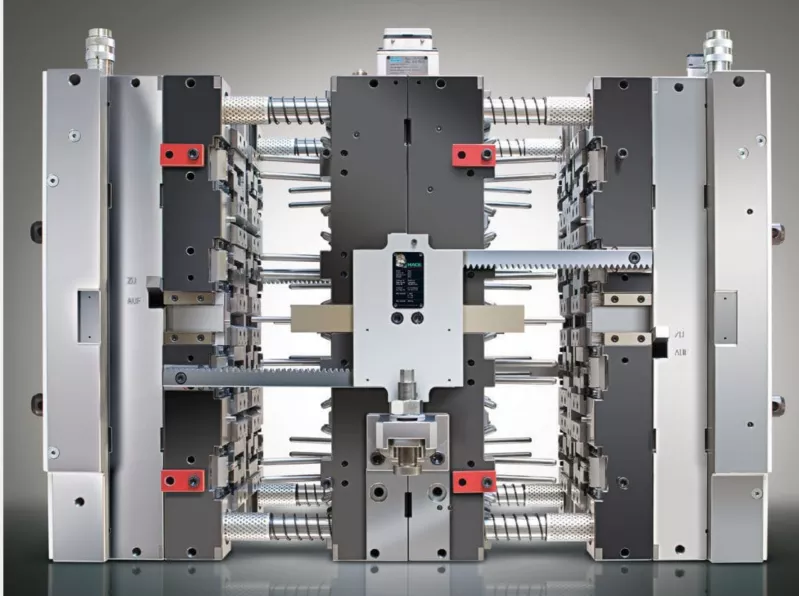
Under injection pressure, force is distributed across extended plate spans and multiple structural interfaces. Even minimal deflection can affect part geometry and alignment.
Long-term structural symptoms may include:
• Parting line mismatch
• Uneven cavity venting behavior
• Guide wear acceleration
• Feature misalignment between stack faces
Structural rigidity depends on:
- Steel grade selection
- Plate thickness calculation
- Support pillar placement and density
- Symmetrical reinforcement layout
Deflection is rarely visible during low-speed sampling. It becomes measurable during sustained, high-speed production where injection pressure cycles continuously.
In high-volume manufacturing, structural stiffness is not optional — it is essential for dimensional repeatability.
5. Machine Compatibility: Integrating Mold and Equipment Capabilities
Not every injection molding machine is suitable for stack mold design.
While clamp tonnage may appear adequate, additional machine factors must be evaluated:
- Platen parallelism tolerance
- Tie-bar stretch behavior under load
- Clamp force distribution uniformity
- Ejector stroke capability
- Machine rigidity during high-speed cycling
Stack molds amplify machine imperfections.
A machine that performs acceptably with a single-face mold may exhibit alignment drift when operating a multi-level stack mold.
Machine-mold integration should be validated before full production ramp-up. Equipment limitations often become visible only after extended cycling under production load.
6. Ramp-Up Sensitivity and Production Drift
During mold trials, operating conditions are typically controlled:
- Reduced cycle speeds
- Stable material batches
- Manual process adjustments
Under these conditions, stack molds may demonstrate acceptable performance.
During ramp-up, however:
- Cycle time is reduced
- Material variability increases
- Continuous thermal load accumulates
- Mechanical wear begins to develop
Stack molds are less forgiving than single-face molds. Minor asymmetries that remain manageable in simpler molds may multiply across stacked cavity sets.
Production validation must occur at real operating conditions — not idealized trial settings.
Long-term performance depends on confirming stability under sustained pressure, speed, and thermal load.
Production instability during ramp-up is a common but often underestimated issue in injection molding projects. A more detailed analysis can be found in our article on lead time instability during production ramp-up.
7. Long-Term Performance and Preventive Strategy
High-volume stack mold production requires:
• Structural symmetry
• Flow equilibrium
• Thermal consistency
• Regular alignment verification
• Preventive maintenance planning
When designed and maintained correctly, stack mold systems provide:
✓ Increased output without expanding floor space
✓ Consistent cavity-to-cavity performance
✓ Improved unit cost efficiency
✓ Long-term dimensional stability
When structural balance is neglected, increased cavity count becomes a multiplier of instability rather than productivity.
Stack mold design is not solely about increasing capacity.
It is about maintaining equilibrium across mechanical, thermal, and flow systems over extended production cycles.
Conclusion
Stack mold design for high-volume production demands more than cavity multiplication.
It requires disciplined structural engineering.
Each additional stack level increases both output potential and sensitivity to imbalance. Mechanical symmetry, pressure equilibrium, thermal uniformity, and machine compatibility must function as an integrated system.
In high-volume environments, structural precision determines long-term performance.
Stack molds are not simply production accelerators — they are stability multipliers.
When structural design principles are properly applied, stack molds deliver sustained efficiency and reliable part quality across extended production runs.
When structural balance is overlooked, instability gradually replaces productivity.
In stack mold engineering, equilibrium is not refinement.
It is foundation.