
Introduction: Manufacturing as a Coordinated System
Integrated manufacturing workflow is often misunderstood as simply offering multiple services under one roof. In reality, integration is not about proximity. It is about structural coordination across disciplines.
When products transition from prototype builds to scalable production, manufacturing complexity increases exponentially. PCB fabrication, PCBA, injection molding, firmware loading, mechanical fastening, quality validation, and logistics preparation must operate not as isolated capabilities but as synchronized systems.
A product may perform well in early engineering validation. However, production instability often emerges when independent processes converge without unified control.
An integrated manufacturing workflow reduces this risk by aligning upstream engineering decisions with downstream operational realities. The objective is not merely process completion. It is system-level stability.
1. Engineering Synchronization at the PCB Fabrication Stage
PCB fabrication establishes the dimensional and structural baseline of the product.
Beyond electrical routing considerations, fabrication decisions influence:
- Thermal expansion compatibility
- Mechanical stack-up tolerance
- Connector accessibility
- Mounting geometry
- Heat dissipation pathways
In non-integrated environments, PCB decisions are often validated electrically but not mechanically within final product constraints.
In an integrated workflow:
- PCB thickness is evaluated against enclosure cavity depth
- Mounting hole positions are reviewed relative to mold insert structure
- Component height restrictions are verified against internal enclosure clearance
- Panelization strategy is aligned with assembly handling equipment
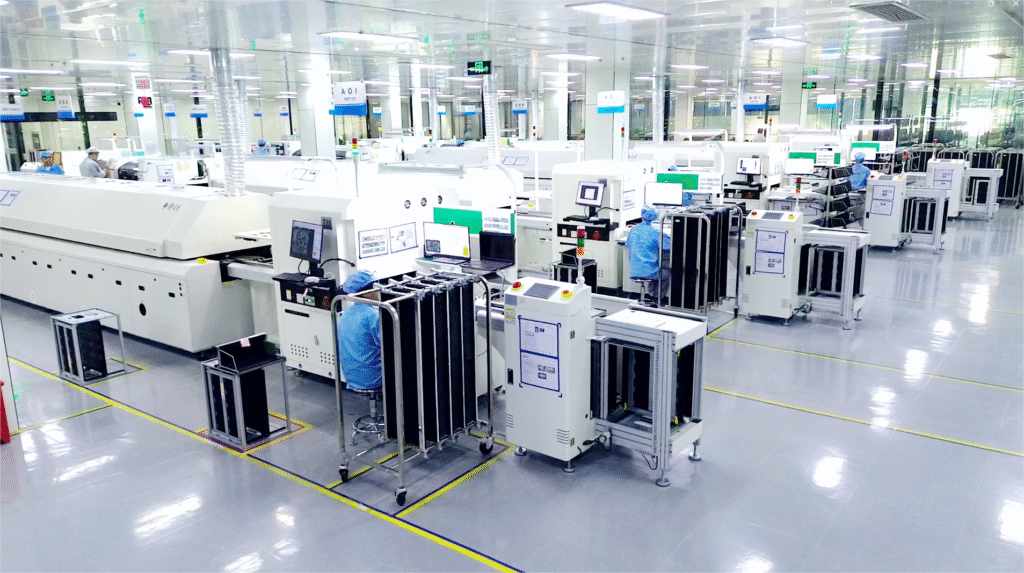
This early-stage cross-functional review prevents late mechanical conflict that typically surfaces during pilot builds.
Integrated manufacturing workflow ensures that PCB fabrication decisions are evaluated within the full system context rather than in isolation.
Integration begins before fabrication, not after.
Practical DFM control measures are outlined in our PCB DFM checklist for industrial applications, which emphasizes structural and assembly compatibility.
2. PCBA Stability and Yield Alignment with Assembly Throughput
Surface-mount technology introduces yield variability through:
- Solder paste deposition inconsistency
- Component placement tolerances
- Thermal profile fluctuations
- Rework frequency
In fragmented production structures, SMT yield data remains isolated from final assembly planning.
Within an integrated workflow:
- SMT first-pass yield informs takt time calculation
- Rework rate influences labor balancing models
- Functional test failures guide firmware refinement
- Placement deviation data supports enclosure tolerance adjustment
Production scaling amplifies minor inefficiencies. Alignment between PCBA yield stability and assembly throughput planning becomes critical to maintaining consistent output.
System-level evaluation replaces isolated optimization.
Real production examples of SMT and plating-related failures are analyzed in our industrial PCB DFM defect case studies.
3.Integrated Manufacturing Workflow in Tooling and Injection Molding Integration
Plastic enclosure manufacturing introduces dimensional behavior influenced by:
- Material shrinkage variation
- Gate positioning
- Cooling channel balance
- Mold wear progression
- Surface finishing variability
In integrated manufacturing environments, tooling engineers collaborate with electronics and assembly teams before mold steel cutting begins.
Key integration checkpoints include:
- Boss height relative to PCB mounting depth
- Screw engagement torque relative to material hardness
- Rib structure reinforcement against long-term stress
- Cosmetic surface protection during assembly handling
Injection molding therefore becomes a structural interface between mechanical design and electronics integration.
By evaluating dimensional tolerance stacking across PCB and molded components, integrated workflows reduce iterative tooling adjustments during pilot production.
4. Firmware Management and Production Synchronization
Electronic products evolve through firmware iteration cycles. During prototype stages, firmware changes may occur rapidly.
Without synchronized control:
- Hardware revision tracking may diverge from firmware versions
- Functional validation may rely on undocumented configurations
- Scaling production may freeze incorrect builds
An integrated workflow embeds firmware governance into manufacturing operations through:
- Controlled version release management
- Locked flashing station authorization
- Automated verification after programming
- Serialization-linked firmware traceability
Firmware becomes a managed production parameter rather than an engineering afterthought.
This prevents divergence during scale-up and supports long-term field reliability.
5. Assembly Line Architecture as Convergence Infrastructure
Assembly is where cumulative variation becomes visible.
At final integration:
- PCB tolerances meet enclosure tolerances
- Fastening force distribution affects structural stability
- Firmware interacts with final hardware conditions
- Cosmetic inspection reveals dimensional inconsistency
Assembly line design must therefore incorporate:
- Error-proofing mechanisms (poka-yoke)
- Torque verification systems
- Inline functional testing
- Visual inspection checkpoints
- Controlled material flow and buffer management
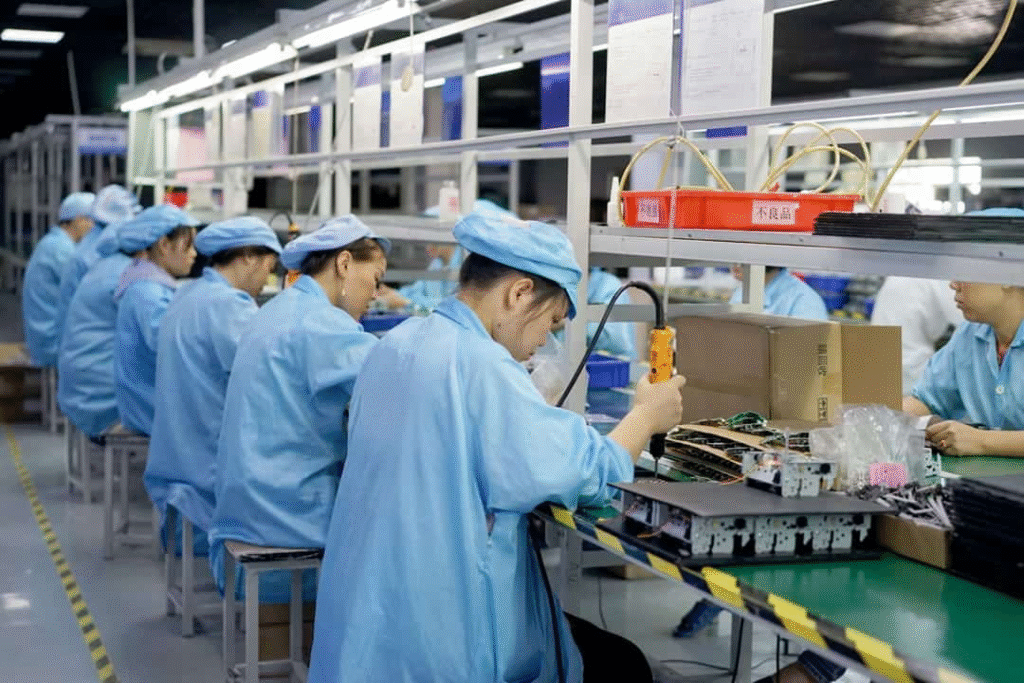
Rather than optimizing for speed alone, integrated manufacturing designs assembly lines as convergence infrastructure capable of absorbing controlled variation without destabilizing output.
Within an integrated manufacturing workflow, assembly lines are engineered to balance convergence with stability, ensuring minimal variation transfer across final assembly checkpoints.
6. Quality Systems and Data Traceability Across Processes
Scalable production introduces statistical complexity.
Integrated workflows connect process data across:
- PCB fabrication lot codes
- SMT production records
- Injection molding parameter logs
- Assembly torque records
- Firmware version history
- Final inspection reports
This unified traceability structure enables:
- Root cause identification
- Preventive maintenance scheduling
- Controlled engineering change implementation
- Regulatory documentation readiness
Traceability is not a compliance checkbox. It is a structural stability mechanism aligned with established quality frameworks such as ISO 9001 quality management systems.
Integrated manufacturing workflow centralizes traceability data across PCB fabrication, injection molding, firmware management, and assembly operations to support long-term production stability.
7. Risk Distribution: Integrated vs Fragmented Manufacturing
Fragmented manufacturing structures distribute responsibility across separate vendors. Each supplier may optimize local efficiency.
However, integration boundaries create systemic risk.
Common fragmentation consequences include:
- Extended issue resolution cycles
- Tolerance stacking across suppliers
- Documentation inconsistency
- Communication latency
- Increased coordination overhead
An integrated manufacturing workflow centralizes structural coordination. Responsibility remains unified, enabling faster root cause analysis and more consistent scaling performance.
The advantage lies not in eliminating technical challenges, but in reducing structural friction.
8. Commercialization Readiness and Logistics Alignment
Manufacturing completion does not equal commercialization readiness.
Integrated workflows evaluate:
- Packaging drop resistance
- ESD protection
- Regulatory labeling compliance
- Export documentation
- Delivery scheduling synchronization
By aligning logistics planning with upstream production capacity, commercialization timelines remain predictable.
Production stability extends beyond factory walls.
9. Long-Term Scalability Considerations
Products that succeed at low volume may fail at scale due to:
- Compounded tolerance drift
- Tool wear progression
- Firmware update instability
- Documentation inconsistency
- Supplier misalignment
Integrated manufacturing workflows continuously monitor system behavior over extended cycles.
Scalability depends on sustained structural alignment rather than initial prototype success.
Conclusion: Integration as Structural Strategy
Integrated manufacturing workflows are not defined by service breadth alone. They are defined by coordinated structural design across fabrication, molding, assembly, firmware control, quality systems, and logistics.
For complex electronic and electromechanical products, scalability depends on how effectively these elements interact under sustained production pressure.
System-level integration transforms manufacturing from a sequence of processes into a coordinated infrastructure capable of supporting commercialization with stability and traceability.