
Injection molding mold types are critical to achieving production stability in high-volume manufacturing. In the world of injection molding, selecting the correct injection molding mold types can significantly influence production efficiency and product quality. This article delves into how injection molding mold types impact mass production stability, and why understanding the characteristics of each mold type is crucial for long-term manufacturing success.
In the injection molding industry, mass production stability directly determines a manufacturer’s core competitiveness—especially in high-volume manufacturing sectors like consumer electronics, automotive parts, and medical devices.
Uneven part quality, frequent production interruptions, or excessive scrap rates often trace back to one critical decision: mold type selection.
Unlike the theoretical generalizations of mold characteristics, actual production practice shows that each injection molding mold type has its own adaptability to part design, material properties, and production rhythm.
To truly achieve stable, efficient, and cost-effective mass production, it’s essential to dive into the practical performance, on-site challenges, and stability-impacting factors of each common mold type, rather than just focusing on their basic structural differences.
Below, we analyze the most widely used mold types in injection molding, combining on-site operation experience to elaborate on how they influence mass production stability, and what key points manufacturers need to focus on during selection and application.
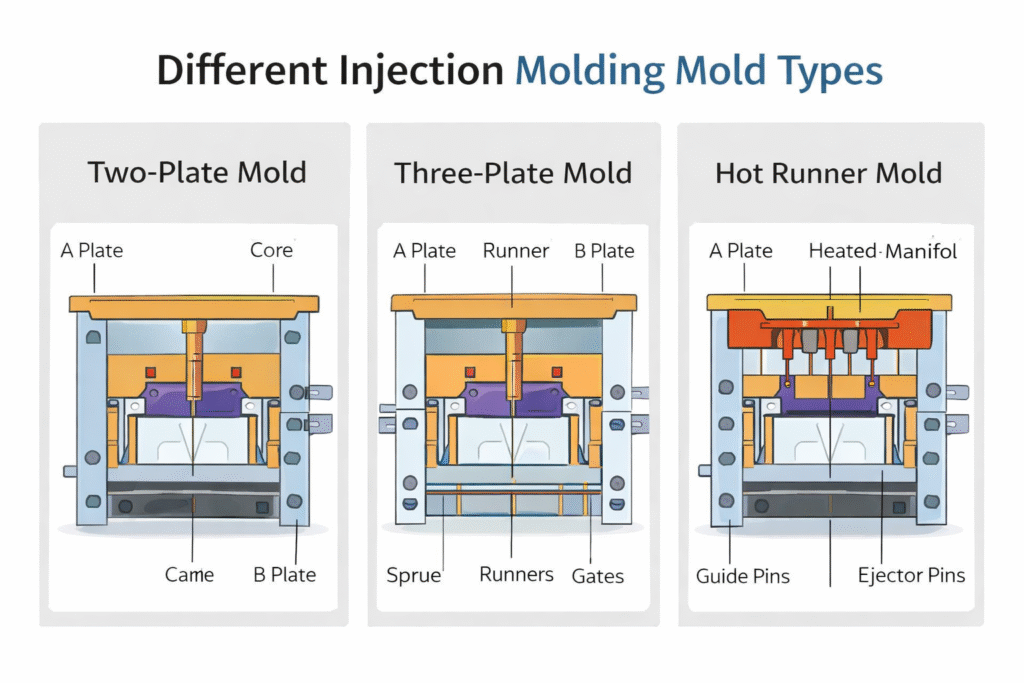
1. Two-Plate Injection Molding Mold Types: The Reliable Choice for Standard Part Mass Production
Injection molding mold types, such as two-plate molds, are the most commonly used in the injection molding industry. Their popularity stems not just from their simple structure but from their compatibility with high-volume standard part production. While two-plate molds are reliable, they are not always the best choice for parts requiring precise cooling or complex geometries. Understanding when to use these injection molding mold types is crucial for production stability.
Advantages:
- Cost-Effective: The design and processing cycles are 20%-30% shorter than other complex molds, significantly lowering tooling costs.
- Ease of Maintenance: Quick troubleshooting without complex operations, reducing downtime.
Challenges:
- Insufficient Cooling Efficiency: The limited space between plates often leads to inefficient cooling, especially for parts with uneven wall thicknesses.
- Warpage and Dimensional Deviation: Uneven cooling causes parts to warp or shift out of tolerance, increasing cycle time and scrap rates.
Example: When producing a plastic shell with varying wall thicknesses, a two-plate mold may result in slow cooling in thicker areas, leading to surface shrinkage marks and internal stress.
Conclusion: Two-plate molds are reliable for mass production of standard parts but struggle with complex parts requiring precise cooling.
2. Three-Plate Injection Molding Mold Types: Balancing Complexity and Production Stability
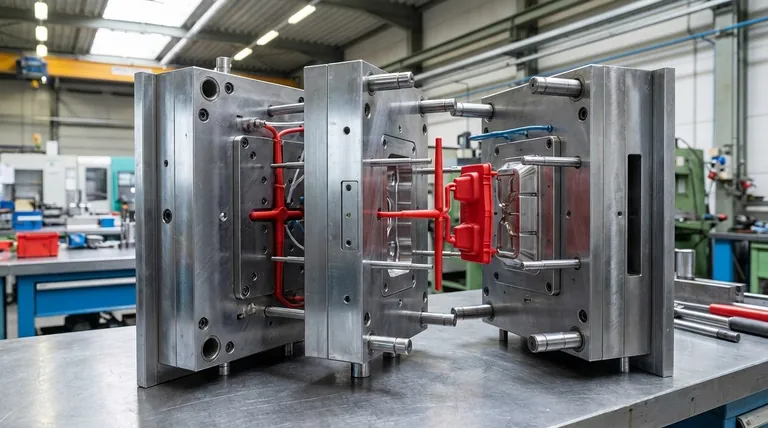
Three-plate molds improve upon two-plate designs by adding an additional parting plate, allowing for more flexibility in gating design. This is particularly beneficial for parts with complex geometries or surface quality requirements.
Advantages:
- Improved Gating Control: Multi-point or point gating ensures more precise material flow, ideal for complex parts with intricate internal structures or large surface areas.
- Better Cooling Efficiency: The third plate allows for more efficient layout of cooling channels, improving heat dissipation and reducing cycle time.
Challenges:
- Increased Complexity: Requires higher precision in mold processing; any misalignment in the three plates can lead to mold damage or part deformation.
- Higher Maintenance Costs: Additional components, such as parting pins and guide sleeves, make maintenance more complex and costly.
Example: A three-plate mold used for a plastic cover with a large surface area can ensure gate marks are automatically removed during mold opening, avoiding secondary processing.
Conclusion: Three-plate molds are ideal for complex parts but come with higher costs and maintenance requirements. Precision and regular maintenance are critical to stable production.
3. Hot Runner Molds: Precision-Driven Stability for High-End Mass Production
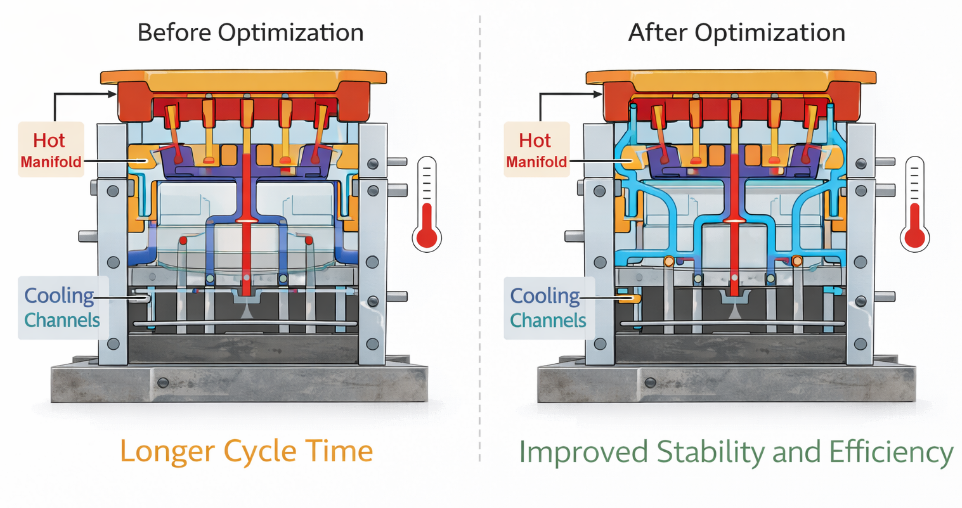
Hot runner molds provide precision and efficiency for high-end products, but their stability depends entirely on temperature control and regular maintenance. The diagram below shows how optimizing the cooling system in hot runner molds can significantly improve efficiency and production stability.
Advantages:
- Reduced Waste: Hot runner systems minimize runner waste, which is particularly important when using high-cost materials like PA66 or PEEK.
- Faster Cycle Times: Since there’s no need to cool and solidify the runner, cycle time can be shortened by 10-20 seconds per shot.
- Improved Part Quality: Stable material flow reduces defects like short shots, flow marks, or uneven shrinkage.
Challenges:
- Strict Temperature Control: Temperature variations in the hot runner system can lead to material degradation or blockages, affecting part quality.
- High Initial Investment: The upfront cost is 2-3 times higher than cold runner molds, and the system requires professional maintenance.
Example: In medical device production, hot runner molds ensure precision, reducing material waste and ensuring consistent quality throughout mass production.
Conclusion: Hot runner molds are the optimal choice for high-precision, high-volume production, but they require careful temperature control and regular maintenance to avoid costly downtime.
4. Family Molds: Efficiency-Oriented but Stability-Challenged
Family molds are designed to produce multiple related parts simultaneously in one mold. This mold type is ideal for producing parts that need to be assembled together, such as a set of plastic fasteners or electronic component housings.
Advantages:
- Increased Efficiency: Family molds reduce cycle time by producing several parts in one shot, improving overall throughput.
- Cost Savings: Tooling costs are reduced compared to producing separate molds for each part.
Challenges:
- Cavity Balance Issues: Parts with different geometries or sizes can lead to uneven material flow, causing some cavities to be overfilled (with flash) or underfilled (with short shots).
- Uneven Cooling: Different part sizes lead to inconsistent shrinkage, affecting part quality and assembly accuracy.
Example: Producing a set of plastic gears with varying sizes in a family mold may result in inconsistent tooth profiles, leading to assembly issues.
Conclusion: Family molds offer significant efficiency improvements but require precise cavity balance and cooling design to ensure stable production.
5. Overmolding Molds: Versatility with High Stability Requirements
Overmolding is the process of molding one material over another, such as soft TPE over hard ABS. This technique is widely used for parts requiring multi-material properties, like enhanced grip, shock absorption, or insulation.
Advantages:
- Enhanced Functionality: Overmolding allows for creating parts with multi-material properties, improving both performance and aesthetics.
- Design Flexibility: Complex parts, like handles with ergonomic designs, can be produced more efficiently without secondary assembly.
Challenges:
- Material Compatibility: Ensuring proper adhesion between different materials is crucial. If the temperature or injection parameters aren’t optimized, delamination can occur.
- Precise Injection Control: The accurate injection of each material is essential to avoid part failure.
Example: Overmolding a soft TPE handle over a hard ABS body requires precise temperature control to ensure strong bonding between the two materials.
Conclusion: Overmolding molds offer excellent design flexibility but require strict control over material compatibility and injection parameters to ensure stable and reliable production.
Conclusion: Selecting Molds Based on Actual Production Needs to Ensure Stability
In mass injection molding production, there is no “one-size-fits-all” optimal mold type—each injection molding mold type has its own strengths and limitations, and its impact on production stability is ultimately determined by the matching degree with part characteristics, material properties, and production goals.
- Two-Plate Molds are suitable for standard parts with low cost and high stability.
- Three-Plate Molds balance complexity and stability for complex parts, but require higher precision and regular maintenance.
- Hot Runner Molds provide precision and efficiency for high-end products, but their stability depends entirely on temperature control and regular maintenance.
- Family Molds improve efficiency but require strict cavity balance control to ensure stability.
- Overmolding Molds enhance versatility but have high requirements for material compatibility and parameter control.
For manufacturers, the key to ensuring mass production stability is not to pursue “high-end” molds blindly. Instead, they should conduct in-depth analysis of their own products.
This includes clarifying part complexity, dimensional tolerance requirements, material types, and daily output.
After that, manufacturers can combine on-site operation capabilities and cost budgets to select the most suitable mold type.
At the same time, strict control over mold processing precision, regular maintenance, and optimization of injection parameters are essential.
Only by integrating mold selection, mold maintenance, and on-site operation can manufacturers achieve continuous, stable, and cost-effective mass production—and gain an advantage in the fierce market competition.
For more information on injection molding mold types, refer to resources like ISO 9001 Quality Management and Plastics News.
You may also find valuable insights on mold design optimization and DFM best practices helpful for improving production stability.