
Functional test fixture design is not only about building a tool to hold a PCBA or finished product. It is part of the production testing process and can directly affect test repeatability, testing speed, fault detection, rework cost, and final product quality.
Functional test fixture design should be planned early because testing problems often become more expensive to fix after PCB assembly, product assembly, or mass production starts.
For many electronic products, manual testing may be acceptable during the early prototype stage. However, once a project moves toward small-batch or mass production, the test process needs to become more stable, repeatable, and easy for operators to follow.
A well-designed functional test fixture helps reduce manual wiring errors, unstable probe contact, unclear test judgment, and missed defects before shipment.
This guide explains 7 key factors in functional test fixture design and what buyers should prepare before production testing.
By reviewing functional test fixture design early, buyers can avoid many testing problems that are difficult to fix after mass production starts.
Quick Answer
A functional test fixture helps verify whether a PCBA or finished electronic product works correctly under defined test conditions, and functional test fixture design makes this process stable, repeatable, and suitable for production.
A good fixture should provide:
- Stable product positioning
- Reliable probe or connector contact
- Safe power and signal connection
- Clear pass / fail criteria
- Repeatable test results
- Efficient operation during production
Functional test fixture design should be considered before mass production, not after production problems appear.
In short, functional test fixture design helps turn product testing from a manual operation into a controlled production process.
Key Takeaways
- Functional test fixture design improves production test repeatability.
- Test points should be considered before PCB production.
- Connectors, buttons, LEDs, sensors, and displays may need fixture access.
- Firmware version and test procedures should be aligned before testing.
- Clear pass / fail criteria help reduce false failures.
- PCBA testing and finished product testing may require different fixture setups.
- A good fixture can reduce manual errors, rework, and shipment quality risks.
- Functional test fixture design should be reviewed together with product structure, firmware, testing requirements, and assembly process.
What Is a Functional Test Fixture?
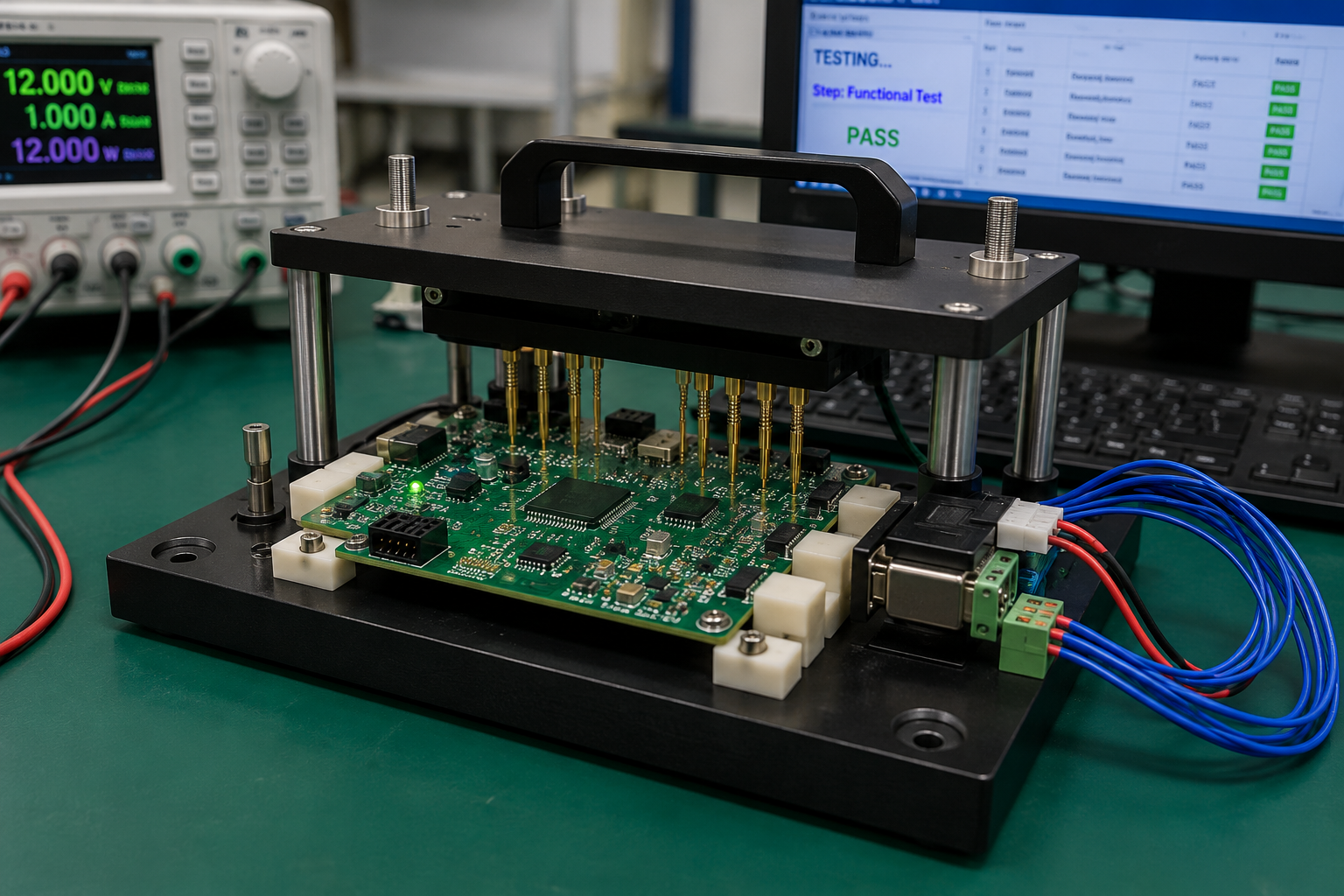
A functional test fixture is a tool used to hold a PCBA or finished electronic product during testing.
It usually connects the product to power, test probes, signal interfaces, communication ports, or external devices so that specific product functions can be verified in a repeatable way.
A functional test fixture may be used to:
- Hold the PCBA or product in a fixed position
- Provide stable power input
- Contact test points through pogo pins
- Connect product interfaces
- Trigger buttons or switches
- Check LEDs, displays, motors, relays, sensors, or communication functions
- Reduce manual wiring mistakes
- Improve testing speed and consistency
In electronics manufacturing, functional testing is often used together with inspection and assembly process control. For projects that require both PCBA and final product assembly, fixture requirements should be reviewed together with the full PCB assembly process.
In electronic manufacturing, functional test fixture design connects product function, test points, firmware, connectors, and production operation into one repeatable testing process.
For electronic products with multiple functions, functional test fixture design should consider not only the PCBA, but also the final product structure and user-facing operation.
Why Functional Test Fixture Design Matters
A functional test fixture can look simple from the outside, but functional test fixture design affects many production results.
When functional test fixture design is not reviewed early, production teams may rely too much on manual testing, which can increase inconsistency and operator error.
If the fixture is unstable, the product may fail because of poor contact instead of a real product defect. If the test process is unclear, different operators may judge the same product differently. If the fixture is difficult to use, testing time and human error can increase.
1. Test Repeatability
In production testing, the same product under the same test condition should produce consistent results.
Good functional test fixture design helps ensure that:
- The product is positioned the same way every time
- Test probes contact the same pads consistently
- Connectors are inserted correctly
- Power and signal connections remain stable
- Operators follow the same test sequence
Repeatability is especially important when testing larger quantities. Without repeatable testing, it becomes difficult to distinguish real defects from fixture-related failures.
2. Production Efficiency
Manual testing often requires operators to connect wires, press buttons, observe indicators, and record results.
A fixture can simplify these steps. It can reduce loading time, connection time, and manual judgment. This is especially useful when every unit needs to be tested before shipment.
In many projects, a stable fixture does not only improve quality. It also improves production efficiency.
3. Fault Detection
A well-designed fixture can help detect problems earlier in the production process.
Possible issues include:
- Soldering defects
- Missing or wrong components
- Connector failure
- Power input problems
- Sensor response problems
- Firmware communication issues
- Assembly-related functional problems
Good fixture design should match the product’s real function, not just check whether the board can power on.
4. Lower False Failure Risk
False failures are common when fixture contact is unstable or the test method is not clear.
A product may be judged as failed because:
- A pogo pin does not contact the test pad properly
- A connector is not fully inserted
- The product is not positioned correctly
- The firmware version does not match the test procedure
- The pass / fail range is not clearly defined
False failures increase rework, inspection time, and communication cost. A good fixture helps reduce these unnecessary problems.
5. Final Product Quality
Functional testing is one of the last opportunities to identify product issues before delivery.
For finished products, testing may need to confirm not only the PCBA but also the enclosure, buttons, display, wiring, connectors, sensors, and final user-facing operation.
That is why functional test fixture design should be connected with functional testing, product assembly, and final quality control.
7 Key Factors in Functional Test Fixture Design
The following 7 factors are important when preparing a functional test fixture for electronic product production.
These factors help make functional test fixture design more reliable for PCBA testing, finished product testing, and production quality control.
1. Test Point Accessibility
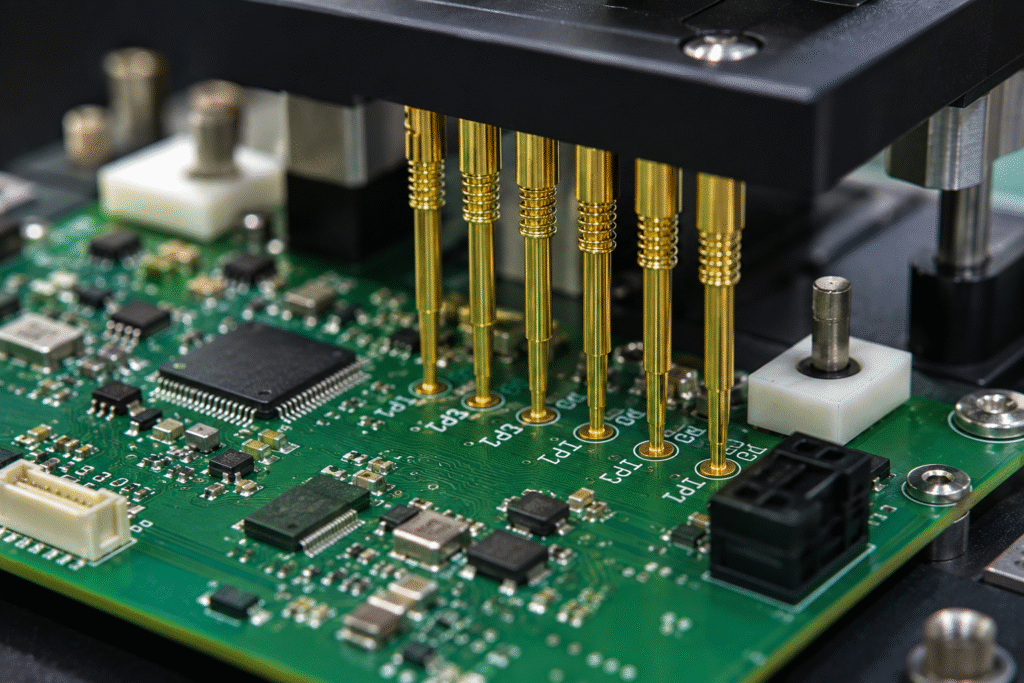
Test point accessibility is one of the most important parts of functional test fixture design.
If test points are missing, blocked, too small, or placed in difficult locations, the fixture may not be able to contact the board reliably.
Good test point design should consider:
- Whether test points are accessible after SMT assembly
- Whether test pads are large enough for stable probe contact
- Whether components block probe access
- Whether the test point layout matches the fixture pin layout
- Whether test points are placed on the correct side of the PCB
- Whether test points are protected from contamination or solder mask issues
Test points should be confirmed before PCB production. If this is ignored, the testing process may need to rely on manual wiring, connector testing, or temporary soldering, which reduces efficiency and increases risk.
For products moving from prototype to production, test point planning should be reviewed together with PCB Services and assembly requirements.
Without accessible test points, functional test fixture design may require more manual work, longer testing time, or less stable contact.
2. Connector and Interface Access
Functional testing often needs to check more than simple power-on behavior.
Many electronic products include connectors, buttons, displays, sensors, communication ports, or output devices. The fixture must be able to access these interfaces safely and efficiently.
Common interfaces may include:
- USB port
- DC jack
- Battery connector
- Display connector
- Sensor port
- Communication interface
- Button position
- LED indicator
- Motor output
- Relay output
- Speaker or buzzer output
If connector direction or location is not considered early, the fixture may become difficult to design. Operators may need to insert cables manually, which increases testing time and possible connection errors.
For finished electronic products, connector access should also be reviewed together with enclosure structure and product assembly.
3. Stable Power and Signal Connection
Functional testing is not only about checking whether the product turns on.
The fixture must provide stable power and signal connections during the entire test process. If power or signal contact is unstable, the product may show random failures that are not caused by the actual PCBA.
Important points include:
- Input voltage should be stable
- Current should be monitored when needed
- Signal lines should not loosen during testing
- Contact resistance should be controlled
- Power polarity should be protected
- Overcurrent or short-circuit protection may be needed
- Grounding should be considered for sensitive products
For products with motors, relays, displays, wireless modules, sensors, or battery charging functions, unstable power can lead to inaccurate test results.
A good fixture should make the electrical connection repeatable and safe for both the product and the operator.
This is why functional test fixture design should include power stability, signal reliability, and basic protection requirements from the beginning.
4. Firmware and Test Procedure Alignment
Many testing problems are not caused by hardware. They are caused by firmware version mismatch or unclear test procedures.
Before functional testing starts, the firmware version and test method should be confirmed.
This may include:
- Firmware version
- Test mode requirement
- Communication protocol
- Test command format
- Expected response
- Calibration data
- Test sequence
- Operator instructions
- Data recording method
If different firmware versions are used during prototype, small-batch, and production stages, test results may become inconsistent.
For example, one firmware version may support a factory test mode, while another version may not. One version may display LED feedback differently. Another may change communication response timing.
To avoid confusion, firmware and test procedure should be aligned before fixture validation.
Good functional test fixture design should match the confirmed firmware version and documented test procedure before production testing begins.
5. Clear Pass / Fail Criteria
A functional test fixture should not only perform actions. It should help define whether the product is acceptable or not.
Vague criteria such as “test OK” or “works normally” are not enough for production.
Clear pass / fail criteria may include:
- Voltage range
- Current range
- LED status
- Button response
- Display content
- Sensor output range
- Communication result
- Motor speed or response
- Relay switching result
- Sound or buzzer response
- Charging status
- Test time limit
Clear criteria reduce operator judgment and make testing more consistent.
For example, instead of saying “current should be normal,” the test requirement should define an acceptable current range. Instead of saying “LED should work,” it should define which LED status means pass and which status means fail.
This is especially important for production testing, where different operators may test hundreds or thousands of units.
Clear pass / fail criteria make functional test fixture design more useful for operators, engineers, and quality control teams.
6. Operator Safety and Ease of Use
A functional test fixture is usually used by production operators, not only engineers.
If the fixture is difficult to use, testing errors will increase. If the fixture is unsafe, it may create risk for both operators and products.
Good fixture design should consider:
- Easy product loading and unloading
- Clear product positioning
- Prevention of wrong insertion
- Stable clamping or holding
- Clear test status indication
- Simple operator steps
- Protection for high-voltage or high-current tests
- Safe access to moving parts or sharp edges
- Easy maintenance and probe replacement
The easier the fixture is to use correctly, the more stable the production test result will be.
In actual production, many quality problems are caused not by the test concept itself, but by inconsistent operation. A fixture should reduce operator dependence as much as possible.
7. PCBA Testing vs Finished Product Testing
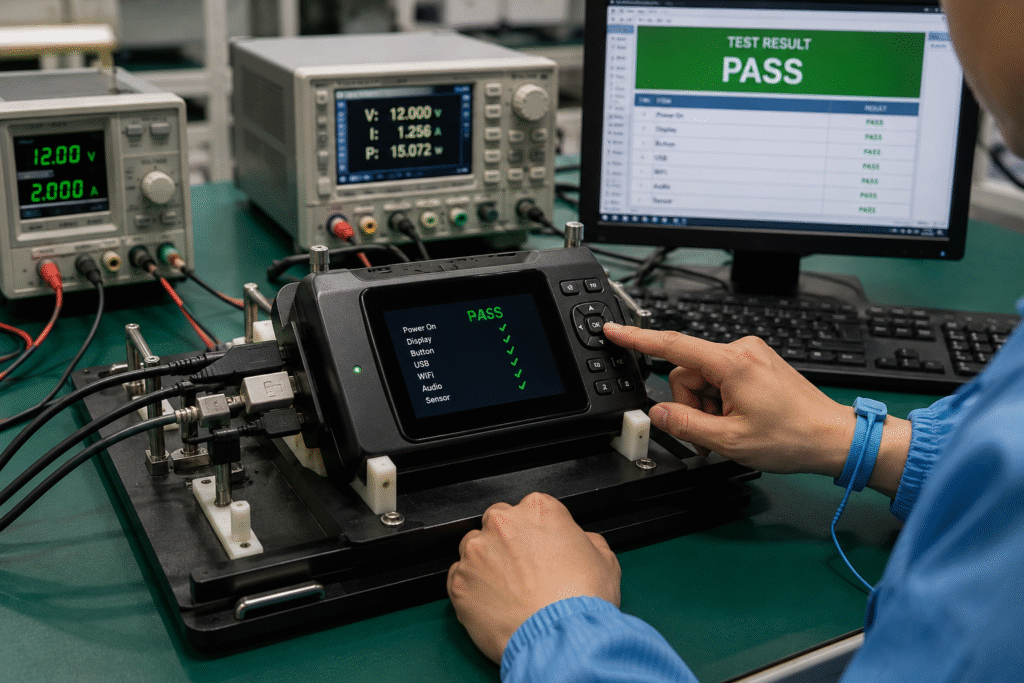
PCBA testing and finished product testing are not always the same.
Some problems can be detected at the board level, while others only appear after the PCBA is installed into the enclosure and connected with cables, buttons, displays, sensors, or other modules.
| Testing Stage | What It Checks | Why It Matters |
|---|---|---|
| PCBA Testing | Board-level electrical and functional response | Finds soldering, component, and circuit issues early |
| Finished Product Testing | Complete unit function after enclosure assembly | Confirms buttons, connectors, display, wiring, and final operation |
| End-of-Line Testing | Final check before packaging | Reduces shipment risk |
PCBA functional testing is useful for finding circuit-level problems early. However, some products also need finished product testing after assembly.
For example:
- A button may only be checked after the enclosure is assembled.
- A display may need alignment with the housing window.
- A connector may need to fit the external opening.
- A wire harness may affect final product function.
- A sensor may need to be tested in the final structure.
- A product may need final end-of-line testing before packaging.
For electronic assemblies, industry references such as IPC standards can also help define quality expectations, inspection consistency, and reliability requirements.
This is why fixture requirements should be reviewed together with assembly structure, wiring, enclosure design, and final inspection.
Cindy Mould’s Quality & Process approach also focuses on adjusting inspection points based on product function, assembly structure, usage scenario, and customer-defined requirements.
What Buyers Should Prepare Before Fixture Design
Buyers can help reduce fixture design delays by preparing complete product information before production testing.
Useful information includes:
- Gerber files
- BOM
- Schematic
- Test point location
- Product function description
- Firmware version
- Test mode requirements
- Power input specification
- Communication protocol
- Connector definition
- Pass / fail criteria
- Sample or prototype
- Expected production quantity
- Testing time requirement
- Final assembly requirement
A complete file package helps the supplier understand not only the board design but also how the product should behave during testing.
The more complete this information is, the easier it is to make functional test fixture design practical, stable, and suitable for production.
If the project is still at the quotation stage, a complete PCB Assembly RFQ Checklist can help buyers prepare testing requirements, assembly details, and quality expectations before production.
Common Functional Test Fixture Problems
Many fixture-related problems can be avoided if test requirements are reviewed early.
Many of these problems can also be avoided when functional test fixture design is reviewed before production instead of after quality issues appear.
Missing or Poorly Placed Test Points
If test points are missing or too small, probe contact may become unstable.
This can lead to false failures, longer test time, or manual workaround methods such as temporary soldering.
Connectors Are Difficult to Access
Connectors may be placed too deep, too close to the enclosure wall, or in a direction that is difficult for the fixture to reach.
This can slow down testing and increase operator handling errors.
Unstable Fixture Contact
Probe pressure, product positioning, and fixture alignment all affect contact stability.
If the fixture contact is unstable, the product may fail randomly even when the product itself is good.
Firmware Version Is Not Aligned
Different firmware versions may use different test modes, response timing, or communication logic.
If the firmware version is not controlled, the same product may produce different test results.
Pass / Fail Criteria Are Too Vague
Without clear criteria, operators may rely on personal judgment.
This can cause inconsistent results and make quality control harder during production.
Only PCBA Testing Is Planned
Some products pass PCBA testing but fail after enclosure assembly.
This can happen when buttons, displays, connectors, sensors, wiring, or mechanical alignment are involved. In these cases, finished product testing is also needed.
Manual Testing Takes Too Long
Manual testing may be acceptable for prototypes, but it can become inefficient in production.
If every product requires many manual connections and judgments, testing time, labor cost, and error risk will increase.
How Functional Test Fixtures Affect Production Cost
Functional test fixture design can affect the total production cost.
A test fixture may create upfront development cost, but it can reduce long-term production risk.
Cost-related factors include:
- Fixture design and fabrication
- Number of test items
- Test time per unit
- Automation level
- Operator labor time
- Probe and connector maintenance
- Rework caused by false failures
- Quality risk before shipment
Manual testing may have lower setup cost, but it usually depends more on operator skill and attention. Automated or semi-automated fixture testing may cost more at the beginning, but it can improve consistency and reduce human error during repeated production.
For buyers comparing quotations, testing and fixture cost should be considered together with the full PCBA cost breakdown.
A good fixture should not only increase cost. It should help reduce rework, false failures, quality complaints, and shipment risk.
How Cindy Mould Supports Functional Test Fixture Review
At Cindy Mould, functional test fixture requirements are reviewed together with PCB design, BOM, product function, assembly structure, firmware, and final testing requirements.
The goal is not only to check whether a product can power on. The goal is to support a stable and repeatable testing process for production.
PCBA Test Requirement Review
Before production, we review test points, connectors, power input, signal requirements, and product function.
If test points are difficult to access or product functions need special test conditions, these issues should be discussed before fixture preparation.
Product Assembly Testing
For products that require enclosure assembly, cable connection, display alignment, buttons, sensors, or mechanical parts, testing should also consider final product conditions.
This helps confirm that the assembled product works as intended, not only the PCBA.
Prototype and Small-Batch Validation
Prototype and small-batch production are useful stages for checking whether the fixture and test process are practical.
If the test steps are too slow, unclear, or unstable, these issues should be improved before mass production.
Final Inspection Before Packaging
For electronic products delivered as finished or semi-finished assemblies, final inspection before packaging can help reduce shipment risk.
This may include functional checks, visual inspection, labeling confirmation, accessories check, and packaging condition review.
Cindy Mould supports electronic manufacturing projects that require PCBA, functional testing, plastic enclosure integration, product assembly, and shipment preparation.
Conclusion
Functional test fixture design is not only about building a testing tool. It is about creating a stable, repeatable, and production-ready testing process.
A good functional test fixture can help:
- Improve testing efficiency
- Reduce manual wiring errors
- Lower false failure risk
- Detect functional problems earlier
- Support PCBA and finished product testing
- Improve final product quality
- Reduce shipment risk
The most important factors include test point accessibility, connector access, stable power and signal connection, firmware alignment, clear pass / fail criteria, operator safety, and the difference between PCBA testing and finished product testing.
Early functional test fixture design can help buyers reduce production risk, improve testing efficiency, and support more consistent product quality.
For buyers preparing a new electronic product, functional test fixture design should be treated as part of production planning, not only as a testing accessory.
If you are preparing an electronic product for production, Cindy Mould can review your PCBA, assembly structure, testing requirements, and fixture needs before mass production.
FAQ
What is a functional test fixture?
A functional test fixture is a tool used to hold a PCBA or finished product and connect it to power, signals, probes, or interfaces for repeatable functional testing.
Why is functional test fixture design important?
Functional test fixture design improves testing consistency, reduces manual errors, increases production efficiency, and helps detect product defects before shipment.
What information is needed for functional test fixture design?
Buyers usually need to provide Gerber files, BOM, schematic, test points, firmware, product function description, connector definition, and pass / fail criteria.
Is PCBA testing enough for electronic products?
Not always. Some products also need finished product testing after enclosure assembly to confirm buttons, connectors, displays, wiring, sensors, and final operation.
Does a functional test fixture increase production cost?
A functional test fixture may add initial fixture cost, but it can reduce manual testing time, false failures, rework, and shipment quality risks during production.
When should functional test fixture requirements be reviewed?
Functional test fixture requirements should be reviewed during the prototype or small-batch stage, before mass production. This helps confirm test points, fixture access, firmware version, and pass / fail criteria early.