
Introduction
The transition from prototype to mass production is one of the most challenging stages in electronics manufacturing.
A prototype works.
Testing looks acceptable.
The product is approved.
The project appears ready to move forward.
Then mass production begins, and problems start to appear.
Yield begins to drop. Rework increases. Assembly issues become more frequent. Output becomes harder to stabilize. Delivery pressure grows. What looked manageable during prototype builds suddenly becomes expensive, time-consuming, and difficult to control.
This is one of the most common patterns in electronics manufacturing.
A successful prototype does not automatically mean a product is ready for mass production, especially if design for manufacturability has not been fully reviewed. Early builds may prove that a concept works, but they do not always prove that the design, process, materials, and execution model can remain stable under production volume.
That transition point—from prototype to mass production—is where many electronics projects begin to break down.
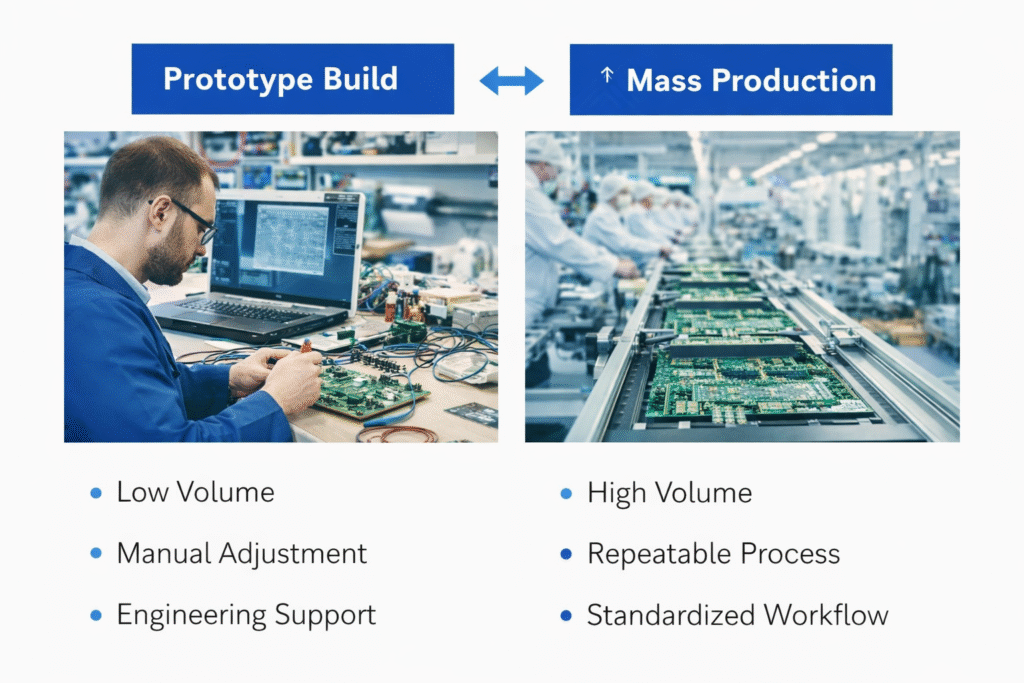
In most cases, the problem is not one dramatic failure. It is the accumulation of smaller gaps that were tolerated during early builds but become much harder to manage once production begins to scale.
This is why teams need to evaluate more than product functionality before moving into volume manufacturing. They also need to assess whether the entire manufacturing system is ready to repeat the result consistently, efficiently, and at scale.
Why the Prototype to Mass Production Transition Can Be Misleading
Prototype builds serve an important purpose. They help validate product concepts, confirm major functions, and support early engineering decisions. At this stage, teams are usually focused on whether the product can be built and whether it performs its intended function.
But prototypes are built under very different conditions from mass production.
In a prototype environment, volumes are low. Engineering attention is high. Manual adjustments are common. Decisions can be made quickly, and teams often compensate for weak points through experience, close observation, or extra handling.
That flexibility can make a prototype look more stable than it really is.
A process that works for 10 units may not work for 10,000. A component fit that seems acceptable in a few samples may create repeated assembly issues across larger batches. A minor handling adjustment that solves a one-time issue during engineering builds may not be practical in a production environment where speed, consistency, and repeatability matter.
This is why prototype success can create a false sense of readiness.
The key question is not only whether the product works once. The real question is whether the prototype to mass production transition can be managed repeatedly, efficiently, and consistently under volume pressure.
Repeatability Becomes the Real Test
One of the biggest differences between prototype builds and mass production is repeatability.
Prototype builds often rely on controlled conditions and close engineering involvement. Mass production depends on standardized processes that can deliver the same result across every unit, every shift, and every batch.
This is where many projects begin to struggle.
This is where the prototype to mass production transition becomes far more demanding than many teams expect.
A manufacturing process is not truly ready for scale until it can maintain stable performance without depending on constant manual correction. If the product only builds successfully when experienced engineers are standing by to solve problems in real time, the project is not yet prepared for production volume.
Repeatability requires more than a workable design. It depends on process stability, operator clarity, equipment control, material consistency, and well-defined work instructions. Once production begins, every weakness in those areas becomes more visible.
The challenge of scaling is not simply making more units. It is making more units without allowing defects, delays, and variation to grow with the volume.
Small Design Gaps Grow Larger at Production Scale
During early builds, small design limitations can often be overlooked or manually managed. Once production volume increases, those same issues begin to repeat across many units and quickly become costly.
This is especially common in electronics products involving multiple interacting parts, where PCB enclosure integration, connectors, housings, fasteners, cables, and subassemblies must work together consistently under production conditions.
Several types of design gaps tend to appear more clearly during mass production:
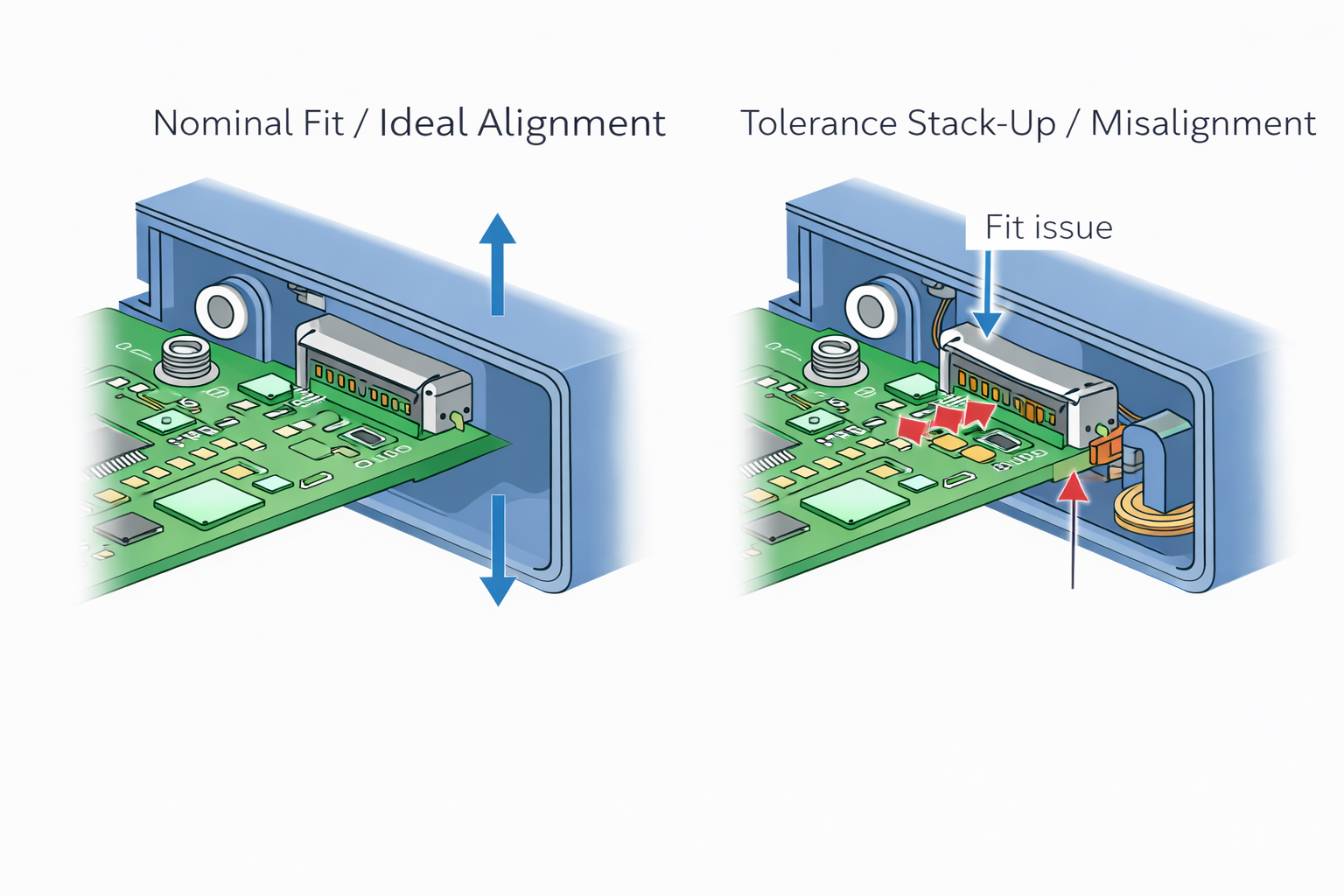
Tolerance accumulation
A single dimensional deviation may seem harmless on its own. But when multiple components each sit near tolerance limits, the combined effect can create tolerance stack-up, leading to poor fit, assembly difficulty, misalignment, or mechanical stress.
Assembly access limitations
A design may technically allow assembly, but if tool access is awkward or component positioning is difficult, the process becomes slower and less repeatable under production conditions.
Fastening and retention issues
Snap fits, screws, clips, and mounting features may appear acceptable in samples but become inconsistent when repeated at higher volume, especially if dimensional variation exists in molded or fabricated parts.
Connector and cable routing problems
Prototype units may be assembled with extra time and careful handling. In mass production, connector placement, wire routing, and insertion force must be stable enough for consistent execution.
Thermal or mechanical interaction
As products move into longer runs and broader operating conditions, heat, material behavior, and structural interaction can expose issues that are not obvious during limited engineering builds.
These are not always dramatic design failures. More often, they are small design decisions that were never fully stress-tested for production reality.
Material and Component Variation Starts to Matter More
In prototype builds, teams often work with smaller material quantities, closer engineering control, and more selective handling. This can reduce visible variation.
Mass production changes that.
As volume increases, projects become much more sensitive to variation in incoming materials, electronic components, fabricated parts, and molded parts. Differences between batches that seemed minor in small builds may begin to affect fit, soldering performance, assembly consistency, or final appearance.
A few common examples include:
- Variation in PCB flatness or surface condition
- Connector dimensional differences between suppliers or lots
- Plastic part shrinkage variation affecting fit
- Cable length or terminal consistency issues
- Labeling, packaging, or traceability inconsistencies
- Batch-to-batch differences in electronic components
In low-volume builds, these issues may be absorbed through sorting, manual adjustment, or engineering review. In mass production, that approach becomes inefficient and expensive.
This is why material readiness is not only about availability. It is also about consistency.
A project that depends on tight coordination between electronic and mechanical elements must be supported by materials and components that remain stable enough for the production process to stay under control.
Engineering Support Cannot Carry the Line Forever
Another common reason projects break down during scale-up is that early production success depends too heavily on engineering intervention.
During prototype and pilot stages, engineers may be present to answer questions, make fast judgments, approve temporary adjustments, or work around process weaknesses. That is normal and often necessary during development.
But mass production cannot depend on that same level of real-time engineering support for every batch.
As production volume increases, the process must become less dependent on individuals and more dependent on systems.
This means:
- Clear manufacturing documentation
- Stable work instructions
- Defined inspection standards
- Validated tooling and fixtures
- Controlled process windows
- Reliable change communication
- Consistent training across operators
If knowledge remains informal or concentrated in a few people, production becomes vulnerable. Output may differ between shifts. Response time slows down. Mistakes become harder to prevent. What was once manageable during engineering builds becomes unstable when multiple teams and higher volumes are involved.
A scalable production process is one that works because the system is defined—not because someone with experience happens to be nearby.
The Cost of Mistakes Increases Rapidly at Scale
A small issue in a prototype stage may affect only a few units. It may be inconvenient, but still manageable.
The same issue in mass production can affect hundreds or thousands of units.
That is where the real risk begins.
Once production is underway, even minor recurring problems can create significant downstream impact:
- Rework labor increases
- Material waste grows
- Output falls behind schedule
- Operators lose efficiency
- Delivery commitments are threatened
- Customer confidence becomes harder to maintain
This is why production problems become expensive so quickly.
The issue is not only the defect itself. The issue is repetition.
When a small weakness is repeated at volume, it becomes a cost multiplier. That is why scale-up planning must focus on prevention rather than reaction. The later a problem is discovered, the harder it becomes to correct without affecting time, cost, and delivery performance.
What Teams Should Review Before Moving into Mass Production
Before transitioning from prototype to mass production, teams should look beyond product approval and evaluate whether their new product introduction (NPI) process and manufacturing system are truly prepared for repetition.
Several questions are worth reviewing:
Is the design ready for repeatable assembly?
Can the product be assembled consistently without depending on manual correction or engineering interpretation?
Have tolerance and fit risks been fully evaluated?
Are the PCB, enclosure, connectors, cables, and fastening features aligned well enough for stable volume assembly?
Are material and component sources consistent?
Can incoming parts maintain the same quality and dimensional behavior across batches?
Are manufacturing documents complete and clear?
Do operators, inspectors, and production teams have the information needed to execute the build consistently?
Is the process stable across volume conditions?
Can the line maintain performance under real production speed, staffing, and throughput expectations?
Are known weak points resolved—or only temporarily managed?
A workaround that is acceptable during engineering validation may become a major disruption in mass production.
These questions help teams shift from a product-validation mindset to a production-readiness mindset.
That shift is essential for successful scale-up.
Mass Production Stability Starts Before Volume Begins
Many teams think production problems begin when the line starts running.
In reality, most of them begin earlier.
In many cases, prototype to mass production problems begin long before the first high-volume run starts.
They begin when a prototype is treated as proof of manufacturing readiness.
They begin when minor design concerns are accepted without enough scale-up review.
They begin when process dependence on manual adjustment is underestimated.
They begin when material variation is not evaluated early enough.
They begin when production readiness is assumed rather than tested.
Mass production does not usually break down because of one single major event.
It breaks down because smaller risks that were manageable during early builds become difficult to control when they are repeated at higher volume.
That is why successful scale-up depends on more than engineering approval.
It depends on whether the full manufacturing system—design, materials, assembly, process control, and execution discipline—is prepared to stay stable under pressure.
Conclusion
The transition from prototype to mass production is one of the most critical stages in electronics manufacturing.
A working prototype proves that a product can function.
It does not automatically prove that the product can be manufactured consistently, efficiently, and reliably at scale.
That next step requires a different level of preparation.
Repeatability, material consistency, tolerance control, process discipline, and production readiness all begin to matter more as volume increases. If those factors are not addressed early, small problems can quickly grow into rework, delay, cost escalation, and customer risk.
The goal is not simply to move faster into production.
The goal is to build a manufacturing system that remains stable when production pressure increases.
That is where scale-up succeeds—or breaks down.
That is why prototype to mass production planning should be treated as a separate readiness stage, not just a scale-up step.
Next Steps
If prototype to mass production readiness is still unclear after early approval, the next step is to review the full transition path more carefully.
A useful starting point is to evaluate one pilot build against practical scale-up indicators such as yield, rework rate, assembly fit, and process repeatability.
For teams that want to assess manufacturability, integration risks, and production readiness before ramp-up, a structured early-stage discussion can help clarify where the main risks still remain.
You can start here: Contact CINDY Mould.