
Choosing the right material for an electronic enclosure is not only a purchasing decision. It affects product strength, appearance, safety, assembly fit, testing results, production stability, and long-term reliability.
At the early stage of a project, many buyers ask a simple question: “Which plastic material should we use for the housing?” In practice, the answer is rarely based on material price alone. A smart home sensor, an industrial controller, a handheld device, a medical electronic product, and a security communication device may all use plastic enclosures, but their working conditions and risk points are very different.
For many buyers, electronic enclosure materials are reviewed too late, after the product structure, tooling plan, and assembly method have already been decided. This can create problems later, especially when the enclosure must fit a PCBA, connectors, buttons, screws, cables, sealing areas, or final product assembly requirements.
Some products need a clean and attractive surface. Some need higher impact strength. Some need better heat resistance. Some require flame-retardant grades. Some need stable dimensions so the PCB, connectors, screws, buttons, seals, and housing can fit correctly during final assembly.
That is why electronic enclosure materials should be selected based on product application, mechanical requirements, operating environment, safety expectations, appearance needs, production method, and assembly process. A material that works well for one product may create problems in another.
This guide compares common plastic materials used for electronic enclosures, including ABS, PC, PC+ABS, PA, PBT, and TPE / TPU. It also explains how buyers can make better material decisions before tooling, injection molding, PCBA integration, and final product assembly.
For buyers, understanding electronic enclosure materials early can make the later steps of tooling, injection molding, PCBA integration, testing, and final assembly much easier to control.
What Are Electronic Enclosure Materials?
Electronic enclosure materials are plastics or engineered polymers used to protect and support the internal electronic components of a product. The enclosure is not only a shell. It often protects the PCBA, supports connectors, holds buttons or displays, provides mounting points, helps with heat management, and gives the product its final appearance.
Electronic enclosures are commonly used in:
- Smart home devices
- Industrial controllers
- IoT sensors
- Handheld electronics
- Medical electronic devices
- Security and communication products
- Consumer electronic housings
- Audio devices
- Power-related products
- Control panels and monitoring equipment
The most common plastic materials include:
- ABS
- PC
- PC+ABS
- PA / Nylon
- PBT
- TPE / TPU
- Flame-retardant grades of different materials
Each material has its strengths and limits. The goal is not to find the “best” plastic in general. The goal is to find the right material for the specific product, use environment, manufacturing process, and quality requirements.
For electronic products, material selection should also be reviewed together with enclosure structure, injection molding feasibility, PCBA position, connector openings, screw bosses, snap fits, surface finish, and final assembly requirements. If these areas are reviewed separately, material-related risks may only appear during trial production or mass production.
Because electronic enclosure materials affect both mechanical protection and final product appearance, they should be discussed during the early engineering review stage.
Quick Comparison: ABS vs PC vs PC+ABS vs PA
Before looking at each decision factor in detail, it helps to understand the general differences between common electronic enclosure materials.
The following comparison summarizes several common electronic enclosure materials used in plastic housings and internal structural parts.
| Material | Main Strengths | Limitations | Common Use Cases |
|---|---|---|---|
| ABS | Good appearance, easy processing, cost-effective | Lower heat resistance and impact strength than PC | Indoor electronics, smart home housings, consumer product shells |
| PC | High impact strength, better heat resistance, transparent options | Higher cost, more demanding molding conditions | Protective covers, industrial electronics, high-strength housings |
| PC+ABS | Good balance of toughness, appearance, and processability | More expensive than ABS | Electronic enclosures requiring better strength and surface finish |
| PA / Nylon | High strength, wear resistance, good mechanical properties | Moisture absorption and dimensional change risk | Connectors, brackets, internal structural parts |
| PBT | Good electrical properties and dimensional stability | Lower impact resistance than PC in some applications | Electrical parts, connectors, internal components |
| TPE / TPU | Soft touch, sealing, flexibility | Not suitable as the main rigid housing | Gaskets, buttons, grips, protective edges |
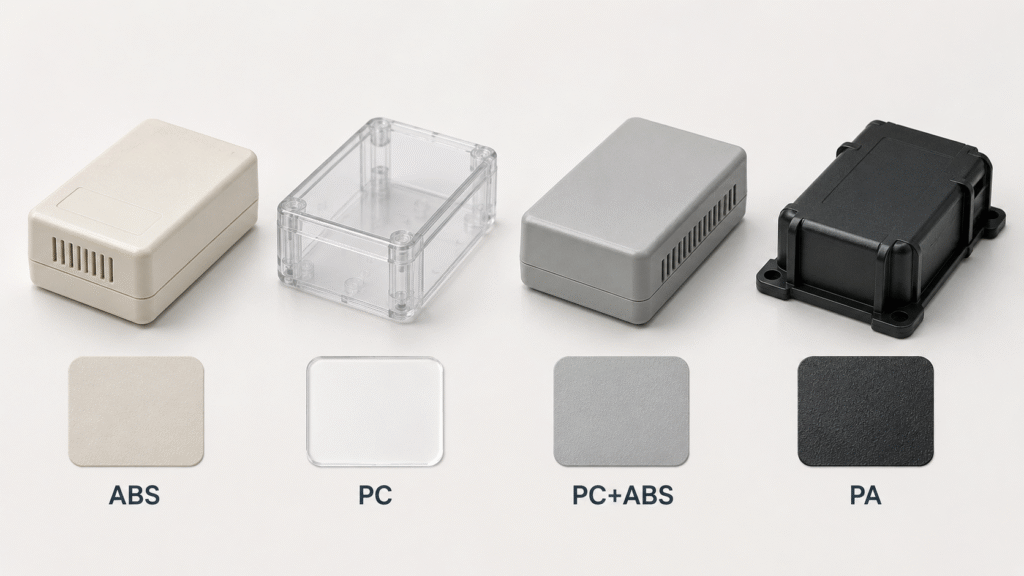
ABS is often chosen when appearance, cost, and processing efficiency matter. PC is selected when impact strength, heat resistance, or transparency is more important. PC+ABS is widely used when the product needs a balance between appearance, toughness, and manufacturability. PA is useful for stronger mechanical or wear-resistant parts, but it needs careful attention to moisture absorption and dimensional stability.
This comparison gives buyers a practical starting point for reviewing electronic enclosure materials before confirming the final plastic grade.
This comparison is only a starting point. The final choice depends on the product’s real use conditions.
1. Product Application Comes First
The first question should not be “Which material is cheaper?” It should be “Where and how will this product be used?”
Product application defines most material requirements. Different applications may require different electronic enclosure materials, even when the enclosure size or shape looks similar.
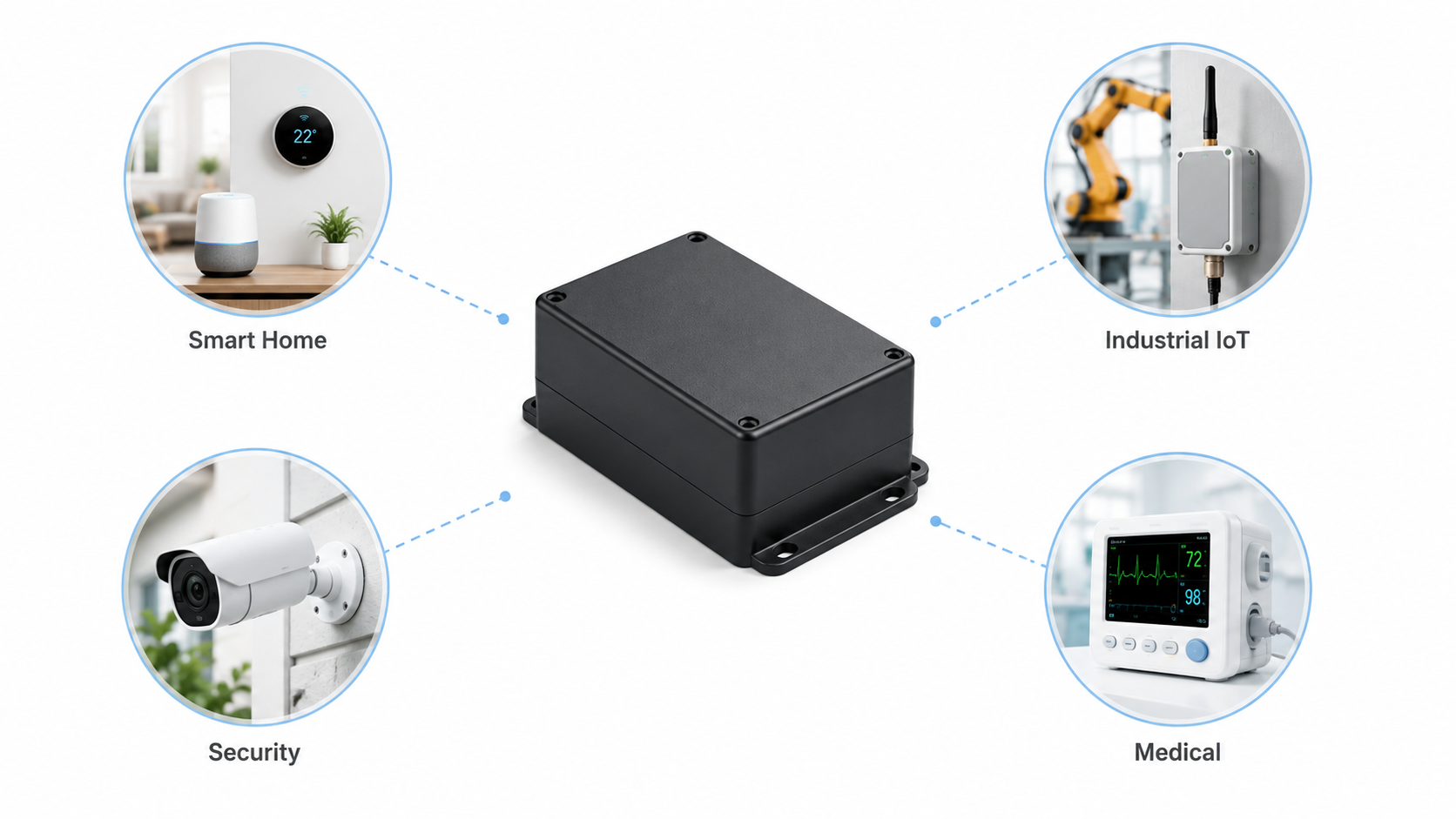
An indoor smart home product, for example, may not need the same level of impact resistance or heat resistance as an industrial controller. A security device installed near a building entrance may need better mechanical strength and environmental resistance than a small indoor remote controller.
Smart Home Electronics
Smart home devices usually need a good balance between appearance, cost, and production efficiency. Products such as sensors, control panels, gateways, alarms, and small connected devices often focus on:
- Clean exterior design
- Stable color
- Good surface texture
- Reasonable cost
- Indoor-use durability
- Easy assembly with PCBA and small components
ABS and PC+ABS are common choices for many indoor smart home housings. ABS can provide a good appearance at a competitive cost, while PC+ABS gives better toughness and heat resistance when the product needs a stronger enclosure.
For this type of product, electronic enclosure materials usually need to balance appearance, cost, color consistency, and assembly efficiency.
Industrial IoT Controllers
Industrial controllers and IoT devices often face more demanding conditions. They may be used near power modules, machinery, control cabinets, or environments with temperature changes.
In these cases, material selection may need to consider:
- Heat resistance
- Flame-retardant requirements
- Impact strength
- Dimensional stability
- Long-term reliability
- Screw boss strength
- Connector fit
- Resistance to deformation
PC+ABS, PC, and PBT may be considered depending on the product structure and working environment. If the enclosure needs to support connectors, mounting points, or repeated installation, the material must be strong enough to handle both assembly and field use.
In industrial applications, electronic enclosure materials may need stronger heat resistance, better dimensional stability, and more reliable long-term performance.
Security and Communication Devices
Security and communication products may require stronger housings, stable connector alignment, and better protection for internal electronics. Some devices may also need to consider EMI / EMC design, anti-tamper structure, sealing, or outdoor exposure.
Common material concerns include:
- Impact resistance
- Structural rigidity
- Heat resistance
- Flame retardancy
- Outdoor or semi-outdoor use
- Connector and cable access
- Assembly stability
PC and PC+ABS are common options when better strength is needed. For some applications, flame-retardant grades may also be required.
Medical Electronic Devices
Medical electronic products often require careful attention to stability, clean appearance, material consistency, and documentation. Depending on the product type and market requirements, buyers may also need to consider material traceability, cleaning compatibility, and specific regulatory expectations.
Common concerns include:
- Surface consistency
- Material documentation
- Stable dimensions
- Cleanable surfaces
- Assembly reliability
- Batch consistency
- Long-term product stability
PC, PC+ABS, and specific medical-grade materials may be used depending on the product function and compliance requirements.
The key point is simple: application comes first. Material choice should match the product’s real operating conditions, not only the buyer’s first cost target.
2. Mechanical Strength and Impact Resistance
Mechanical strength is one of the most important factors when choosing electronic enclosure materials. The enclosure may need to protect the PCBA, support screws, hold internal components, survive handling, and resist impact during shipping or daily use.
The mechanical requirements depend on questions such as:
- Will the product be handheld or fixed in place?
- Is drop resistance important?
- Does the housing include snap fits or thin walls?
- Are there screw bosses near the PCBA?
- Will users press buttons or connect cables repeatedly?
- Does the enclosure protect heavy internal components?
- Will the product experience vibration or field installation stress?
When comparing electronic enclosure materials, buyers should review both the plastic resin properties and the actual enclosure structure.
ABS can work well for many general indoor housings, especially when the design has enough wall thickness and does not face high impact loads. However, ABS is usually not the best choice when strong impact resistance or higher heat resistance is required.
PC offers higher impact strength and is often used for tougher housings, protective covers, transparent windows, and products that need better durability. However, PC is more expensive and may require stricter molding conditions.
PC+ABS is a common middle-ground material. It combines some of the toughness of PC with the processability and appearance advantages of ABS. For many electronic housings, PC+ABS is chosen because it provides better mechanical performance than standard ABS while still allowing good surface finish and reasonable molding performance.
PA / Nylon can provide high strength and wear resistance, but it is not always the first choice for outer electronic housings because moisture absorption can affect dimensions. It is often more suitable for internal parts, brackets, gears, connectors, or structural components where strength and wear resistance matter.
The right electronic enclosure materials should support the product structure instead of only meeting a basic material name on the drawing.
In real projects, strength does not only come from material selection. Wall thickness, rib design, screw boss structure, snap-fit geometry, gate location, and mold quality all affect final performance. A strong material cannot fully compensate for a weak structure. Likewise, a well-designed enclosure can sometimes perform well with a more cost-effective material.
3. Heat Resistance and Operating Environment
Heat resistance should be reviewed early, especially for products that operate continuously or contain heat-generating components.
Some electronic products have internal heat sources such as:
- Power modules
- Relays
- Wireless modules
- Batteries
- Charging circuits
- LED modules
- Motor drivers
- Transformers
- High-current connectors
If heat is not considered during material selection, the enclosure may deform, discolor, lose strength, or create assembly problems over time.
Heat performance is another reason why electronic enclosure materials should be selected according to the product environment, not only the expected unit cost.
ABS is suitable for many ordinary indoor electronic products, but its heat resistance is lower than PC, PC+ABS, or PBT in many applications. If the product is used near heat sources or in a warmer environment, ABS may not be the safest choice.
PC generally offers better heat resistance and impact strength. It can be useful for products that require higher durability or better thermal performance. PC+ABS also provides improved heat resistance compared with standard ABS and is often selected for electronic housings that need a balance of strength, appearance, and processing.
PBT can be a good option for certain electrical components, connectors, or internal parts because of its electrical properties and dimensional stability. It may not always be chosen for large visible housings, but it can be useful in specific structural or electrical applications.
PA also offers good mechanical strength and heat resistance, but its moisture absorption should be considered carefully. If dimensional accuracy is important, especially around connectors, screw bosses, or sealing areas, material behavior under humidity should be reviewed.
Operating environment also matters. Indoor consumer products, industrial control devices, outdoor sensors, medical electronics, and security products may all require different material performance. Temperature, humidity, sunlight exposure, chemical contact, cleaning agents, vibration, and installation conditions should be reviewed before confirming the material.
When heat is involved, electronic enclosure materials should be reviewed together with internal component layout, ventilation design, and expected operating time.
If a product is expected to work in a demanding environment, the material decision should not be made only from a standard material datasheet. It should be reviewed together with actual enclosure design, thermal conditions, assembly method, and testing plan.
4. Flame Retardancy and UL 94 Requirements
For many electronic products, flame retardancy is an important safety consideration. This is especially true for products used near power circuits, charging systems, industrial equipment, electrical cabinets, or regulated markets.
UL 94 is a commonly referenced standard for evaluating the burning behavior of plastic materials. Buyers may see ratings such as HB, V-2, V-1, and V-0 when reviewing plastic material options. In many electronic applications, V-0 flame-retardant grades may be required or preferred.
Buyers can refer to the UL 94 plastic material flammability standard when discussing flame-retardant requirements for electronic enclosure materials.
However, buyers should not assume that all ABS, PC, or PC+ABS materials automatically meet flame-retardant requirements. Different grades of the same material can have very different performance. A standard ABS and a flame-retardant ABS are not the same. A standard PC+ABS and a UL 94 V-0 PC+ABS grade are also different.
For power-related products, flame-retardant electronic enclosure materials may be necessary even when the outer housing looks simple.
Flame-retardant grades can affect:
- Material price
- Color options
- Surface appearance
- Flow behavior during molding
- Mechanical properties
- Availability
- Certification documentation
- Processing stability
This is why flame retardancy should be discussed before tooling and production, not after the mold trial. If the material is changed after tooling, shrinkage, flow, surface appearance, and part performance may also change.
For electronic enclosure materials, flame-retardant requirements should be confirmed early when the product will be used near electrical power, installed in industrial systems, shipped to regulated markets, or reviewed by customers with safety requirements.
It is also important to confirm whether the buyer needs material certificates, UL yellow card information, RoHS documentation, REACH documentation, or other compliance records. Documentation requirements may affect supplier selection and material sourcing.
For products sold in regulated markets, buyers may also need to review RoHS requirements for electrical and electronic equipment during material and supplier confirmation.
5. Appearance, Surface Finish, and Brand Feel
Electronic enclosures are not only protective parts. They are also part of the product’s identity. The feel, color, texture, and surface quality of the housing can influence how customers perceive the product.
For customer-facing products, electronic enclosure materials can directly affect the perceived quality of the finished device.
Appearance requirements may include:
- Matte or glossy finish
- Mold texture
- Color matching
- Spray painting
- Silk printing
- Laser marking
- Logo area
- Transparent or semi-transparent windows
- Scratch resistance
- Fingerprint resistance
- Color stability
ABS is often used when a good appearance and easy processing are required. It can provide a clean surface finish and is suitable for many indoor consumer electronics and smart home products.
PC can be used for transparent parts, protective covers, or high-strength housings. However, PC may be more demanding in terms of molding, surface defects, and processing control.
PC+ABS is often selected when the product needs a better balance between appearance and mechanical performance. It can be a strong option for electronic housings that need good surface quality while also requiring more toughness than standard ABS.
Material choice can affect surface defects such as flow marks, sink marks, weld lines, warpage, color variation, and poor paint adhesion. These issues are not only cosmetic. In B2B projects, poor surface quality can delay approval samples, create rework, or reduce buyer confidence in production stability.
If the product has strict branding or appearance requirements, material selection should be reviewed together with mold texture, gate location, wall thickness, painting requirements, color matching, and expected production volume.
This is why electronic enclosure materials should be selected together with surface finish requirements, not after the appearance standard has already been confirmed.
A material that looks good in a sample may still need process validation before mass production. Surface finish is not only about the material itself. It is the result of material, mold design, injection parameters, secondary processing, and quality control.
6. Dimensional Stability and Assembly Fit
Dimensional stability is especially important for electronic enclosures because the housing must work together with internal electronics and mechanical parts.
Stable electronic enclosure materials help reduce assembly problems around PCBA mounting holes, connector openings, screw bosses, and sealing areas.
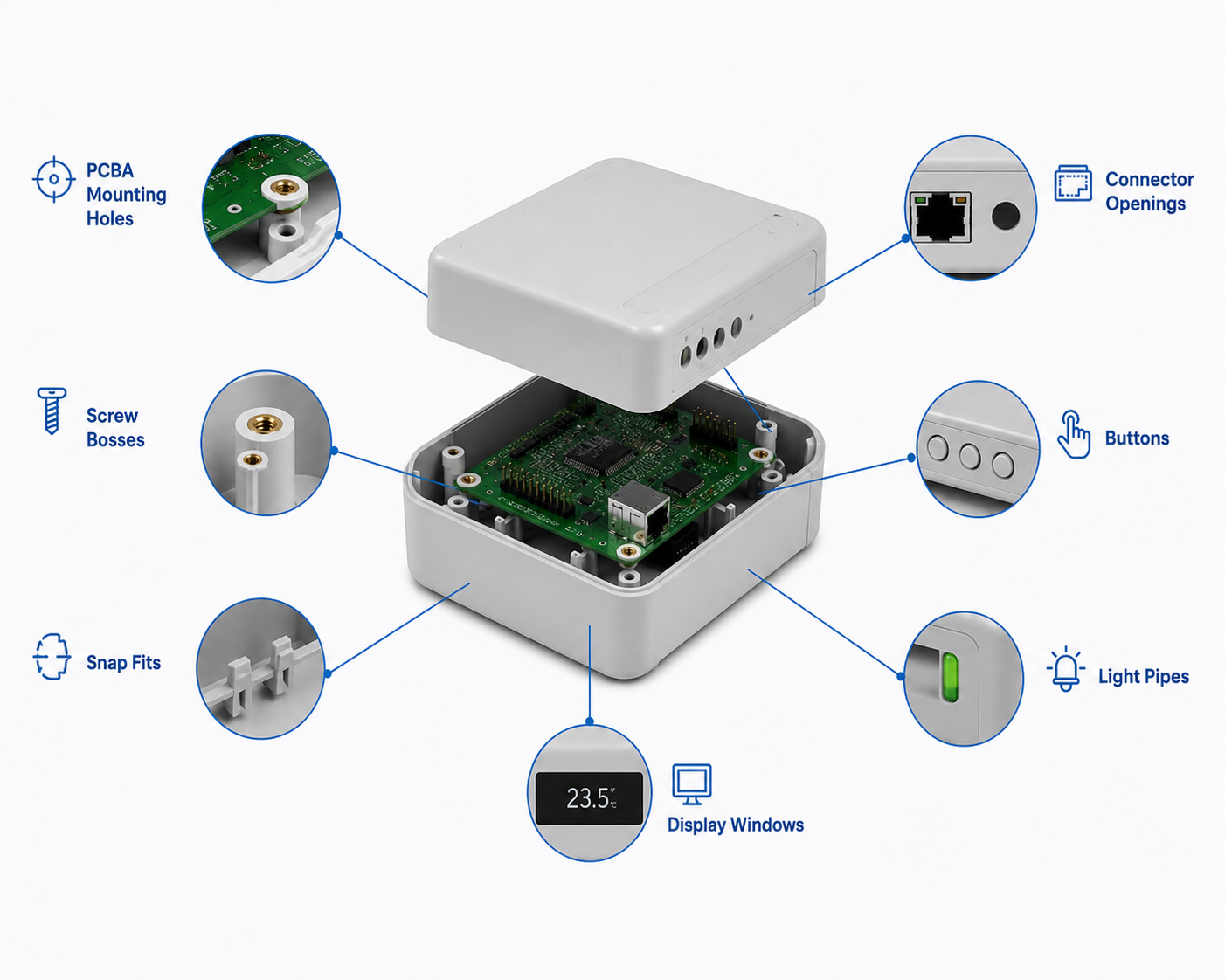
A plastic enclosure may need to align with:
- PCBA mounting holes
- Screw bosses
- Snap fits
- Connector openings
- Buttons
- Light pipes
- Display windows
- Cable exits
- Battery compartments
- Sealing areas
- Labels and inserts
If the material shrinks differently than expected, absorbs moisture, warps after molding, or changes dimension during use, assembly problems may appear. The PCBA may not sit correctly. Connectors may not align with openings. Screws may create stress. Snap fits may become too tight or too loose. Waterproof seals may not compress evenly.
Different materials have different shrinkage behavior. Mold design must consider the selected material from the beginning. If the material changes after the mold is already designed, dimensions and assembly fit may also be affected.
PA / Nylon is a good example. It can provide strong mechanical performance, but moisture absorption can change dimensions. This does not mean PA should not be used. It means the design and application must be suitable for the material.
PC+ABS is often used for electronic housings because it can provide a practical balance of dimensional stability, toughness, surface quality, and processability. But even with PC+ABS, mold flow, wall thickness, ribs, gate location, and cooling design still need to be reviewed.
For assembled electronic products, electronic enclosure materials must support stable fit between the housing, PCBA, connectors, screws, and external interfaces.
For products involving PCBA integration and final assembly, material selection should not be isolated from the assembly process. The enclosure must be reviewed together with the board, connectors, cable routing, screws, sealing design, and testing method.
This is one reason why buyers developing electronic products often benefit from suppliers that understand both plastic enclosure manufacturing and product assembly services. When the enclosure and electronics are reviewed together, fit and assembly risks can be identified earlier.
7. Cost Is Important, But It Should Not Be the Only Factor
Cost matters in every manufacturing project. But choosing the cheapest material does not always reduce the total cost.
The cost of electronic enclosure materials should be reviewed together with molding difficulty, finishing requirements, assembly yield, and long-term product risk.
Material cost is only one part of the full cost structure. Buyers should also consider:
- Injection molding difficulty
- Cycle time
- Scrap rate
- Surface finishing cost
- Painting or printing cost
- Assembly yield
- Testing failure risk
- Rework cost
- Long-term quality risk
- Customer complaint risk
- Certification or documentation needs
For example, ABS may be cost-effective for many indoor products. But if the product needs higher impact strength, better heat resistance, or flame-retardant performance, choosing ABS only because it is cheaper may create problems later.
PC may provide better performance, but if the product does not need that level of strength or heat resistance, it may increase cost unnecessarily. PC+ABS can be a good balance, but the exact grade still needs to match the product requirements.
The real question is not “Which material is the cheapest?” The better question is “Which material gives the right balance of performance, manufacturability, appearance, compliance, and cost for this product?”
In electronics manufacturing, a low material price can become expensive if it leads to deformation, cracking, poor assembly fit, surface defects, test failure, or customer complaints. Material selection should be treated as a risk-control decision, not only a purchasing decision.
This is similar to how buyers should review the full manufacturing cost instead of only unit price. A material decision may affect tooling, molding, assembly, testing, packaging, and long-term product reliability. If buyers are comparing full project cost, our article on PCBA cost breakdown may also help explain how different manufacturing factors affect the final quote.
Prototype Material vs Mass Production Material
Prototype materials and mass production materials are not always the same. This is a common source of misunderstanding in enclosure development.
At the prototype stage, buyers may use 3D printing, CNC machining, or vacuum casting to check product shape, assembly fit, and early market feedback. These methods are useful, but they may not fully represent the final injection molded material.
A 3D printed enclosure can help verify shape and layout, but it may not match final material strength, surface finish, heat resistance, flame-retardant performance, or long-term durability. Vacuum casting can be closer to production appearance in some cases, but it is still not the same as injection molding with the final production resin.
Buyers should confirm whether the prototype material truly represents the final electronic enclosure materials planned for injection molding.
Before mass production, buyers should confirm:
- Final material grade
- Color
- Texture
- Flame-retardant level
- Shrinkage rate
- Surface finish
- Painting or printing process
- Assembly fit
- Drop or impact test requirements
- Heat resistance expectations
- Compliance documentation
Prototype testing should not only check whether the enclosure looks correct. It should also help identify whether the selected material can support final product requirements.
Trial production is also important. During trial production, the team can check molding stability, part dimensions, assembly fit, screw boss strength, connector alignment, surface quality, and functional testing after assembly.
A prototype can show shape and fit, but it may not fully represent the final injection molded enclosure material. For this reason, buyers should confirm the production material before tooling decisions are finalized. If the project is still in the early stage, rapid prototyping can help test design direction before moving into production tooling.
Common Mistakes When Choosing Electronic Enclosure Materials
Material selection mistakes often appear later in the project, when changes are more expensive. The following issues are common in electronic enclosure development.
Many problems come from treating electronic enclosure materials as a simple purchasing item instead of a product engineering decision.
Choosing ABS Only Because It Is Cheaper
ABS is a useful and cost-effective material for many indoor products. But it is not suitable for every electronic enclosure. If the product needs higher impact resistance, better heat resistance, or flame-retardant performance, standard ABS may not be enough.
The risk is not only material failure. It may also lead to repeated sample changes, customer concerns, or delayed approval.
Ignoring Flame-Retardant Requirements
Some buyers only discuss flame retardancy after the product reaches testing or customer review. This can create serious delays. If a flame-retardant grade is required, it should be discussed before tooling because material changes can affect shrinkage, molding behavior, color, and part performance.
Using Prototype Material Assumptions for Mass Production
A prototype material may look acceptable, but it may not behave like the final injection molded material. A 3D printed sample, CNC sample, or vacuum casting sample cannot fully represent final production performance.
Buyers should avoid making mass production decisions based only on prototype appearance.
Overlooking PCBA and Connector Fit
The enclosure must fit the electronics. If material shrinkage or warpage affects connector openings, screw bosses, or internal supports, assembly problems can appear even when the PCBA itself is correct.
Material selection should be reviewed together with PCBA layout, connector position, cable routing, and final assembly sequence.
Forgetting Surface Finish and Color Stability
Material choice affects color, texture, painting, printing, and long-term appearance. If the product requires a premium look, stable color, or strong brand consistency, surface finish requirements should be part of early material discussion.
Not Discussing the Operating Environment
Indoor, outdoor, industrial, medical, and security products have different material requirements. Temperature, humidity, UV exposure, cleaning agents, mechanical stress, and installation conditions should all be considered.
A material that works well in a controlled indoor environment may not be suitable for a harsher operating condition.
Most material selection mistakes can be reduced when electronic enclosure materials are reviewed together with tooling, PCBA fit, testing, and final assembly.
How Cindy Mould Supports Material Selection for Electronic Enclosures
CINDY MOULD supports electronic product projects that require plastic enclosure manufacturing, injection molding, PCBA integration, product assembly, functional testing, and shipment preparation. For projects involving both electronics and plastic housings, material selection is often reviewed together with structure, tooling, assembly, and production requirements.
During early project review, our team can help evaluate:
- Product application
- Enclosure structure
- Material options
- DFM and moldability
- Wall thickness and rib design
- Screw bosses and snap-fit areas
- PCBA fit and connector alignment
- Cable routing and internal space
- Surface finish requirements
- Flame-retardant or compliance expectations
- Assembly and testing needs
- Prototype and production stage requirements
For many projects, the best material choice is not decided by a single factor. It comes from balancing product risk, cost, appearance, molding feasibility, and assembly stability.
If the project requires both enclosure manufacturing and electronic assembly, reviewing material choice together with PCBA and final assembly can help reduce late-stage problems. This is especially important for products that include connectors, internal cables, sealing structures, functional testing, or box build assembly.
CINDY MOULD provides one-stop electronics manufacturing services for projects that need coordinated support from enclosure production to assembly and testing. Early material review can help buyers reduce tooling risk, improve assembly fit, and prepare for smoother production.
Conclusion: Choose Materials Based on Product Risk, Not Only Price
Choosing electronic enclosure materials is not about selecting the most expensive plastic or the cheapest option. It is about matching the material to the product’s real requirements.
The best electronic enclosure materials are the ones that match the product’s application, safety requirements, production process, and assembly needs.
ABS, PC, PC+ABS, PA, PBT, and TPE / TPU all have useful applications. ABS can be a good choice for cost-effective indoor housings. PC can support higher impact and heat resistance. PC+ABS can offer a practical balance for many electronic enclosures. PA can work well for structural and wear-resistant parts, but moisture absorption must be considered. PBT and TPE / TPU can be useful for specific electrical, internal, sealing, or flexible parts.
The right decision depends on the product application, mechanical strength, heat resistance, flame retardancy, surface finish, dimensional stability, assembly method, and production stage.
Material selection should also be reviewed together with mold design, PCBA fit, connector layout, functional testing, and final product assembly. When these factors are considered early, buyers can reduce the risk of warpage, cracking, poor fit, test failure, delayed approval, and unstable mass production.
If you are developing an electronic product enclosure, you can share your 3D files, application requirements, material expectations, and assembly needs with our team. We can help review material options before tooling and production.