
Why Early Mold Decisions Often Lock in Costs During Production Ramp-Up
In injection molding, early mold decisions lock production ramp-up costs — cost overruns and efficiency bottlenecks rarely pop up out of nowhere. From our decade of working with automotive, 3C, and consumer goods clients, we’ve found a consistent pattern: the real cost drivers are locked in long before mass production kicks off — specifically, during the earliest mold design and tooling decisions.
The problem isn’t that these early choices are “wrong” outright. More often, they’re made with short-term priorities in mind: hitting sample deadlines, passing initial validation, and keeping the project moving. What gets overlooked? The long-term realities of production ramp-up — things like scaling volume, maintaining cycle times, and minimizing unplanned maintenance. By the time production ramps up and cost pressure hits, those early decisions have already baked in most of your cost structure.
Below, we break down the most common early mold missteps we’ve seen (from real client projects) that quietly limit cost control during ramp-up — and why they hurt so much when you’re trying to scale.
Technical illustration of a stack mold showing cavity layout and guide pins, highlighting how early mold design affects production efficiency.
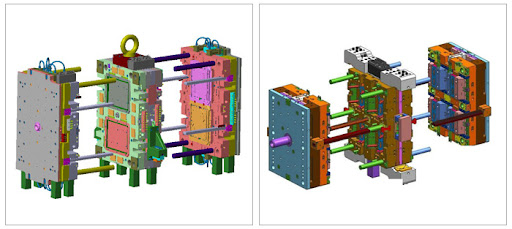
1. Early Mold Decisions That Lock Production Ramp-Up Costs: Molds Designed for Fast Sampling, Not Stable Mass Production
These are classic examples of early mold decisions lock production ramp-up costs, and they’re far too common in fast-paced projects.
Even small shortcuts here can turn into major expenses later, proving how early mold decisions lock production ramp-up costs are often the root cause of budget overruns.
We get it: early in a project, the pressure is intense. Clients need samples fast to validate design fit, pass quality checks, and get sign-off to move forward. To meet that timeline, mold designers often simplify tooling to cut lead time and initial costs — a move that works great for T1/T2 trials, but falls apart when volume ramps up.
Here are the most common shortcuts we see (and have fixed for clients):
- Simplified or undersized cooling systems: We recently worked with a 3C client that opted for a basic single-circuit cooling system on their phone case mold to speed up sampling. The T1 parts looked perfect, but when they ramped up to 10k units/day, cycle time jumped from 28s to 42s — because the undersized cooling couldn’t keep mold temperature consistent. Parts started warping, and they had to add a secondary cooling station (a $12k unplanned cost). This is exactly how early mold decisions lock production ramp-up costs.
- Mold layouts optimized for low-volume trials: A consumer goods client used a 2-cavity layout for their plastic bottle cap mold, focused solely on getting trial parts fast. When demand spiked to 50k caps/day, the 2-cavity design couldn’t keep up — and reworking the mold to 4 cavities cost $35k and delayed production by 3 weeks.
- Single-cavity designs without expansion planning: Many startups opt for single-cavity molds to save upfront costs, assuming they’ll “deal with scaling later.” But we’ve seen this backfire: one medical device client had to scrap their entire single-cavity mold (a $50k loss) when they needed to scale from 1k to 10k parts/week — the mold wasn’t engineered to add cavities, and reworking it was more expensive than starting over.
- Limited allowance for automation: Manual gating or part ejection works for small trials, but becomes a bottleneck at scale. An automotive component client had to hire 8 additional operators when ramping up — because their mold wasn’t designed for robot integration. Adding automation retrofits later cost $18k and cut OEE (Overall Equipment Efficiency) by 15% during the transition.
The pattern here is clear: these decisions work for trials, but fail at scale. By the time you notice the problem, fixing it requires mold rework, additional tooling, or even new molds — all of which eat into profits and delay deliveries.
Why this kills cost control during ramp-up:
- Longer cycle times = higher unit costs (every extra 10s of cycle time can increase part cost by 8-12%, based on our data).
- Inconsistent mold temperatures = more wear, more maintenance, and higher scrap rates (we’ve seen scrap jump from 2% to 15% in these scenarios).
- Post-launch tooling changes are 2-3x more expensive than designing for scale upfront — and they disrupt production schedules, leading to missed client deadlines.
2. Early Mold Decisions That Lock Production Ramp-Up Costs: Conservative Material & Tolerance Choices That Lock Ramp-Up Costs
This is another case where early mold decisions lock production ramp-up costs by prioritizing short-term safety over long-term efficiency.
Teams often overlook this trade-off, but it’s a clear example of how early mold decisions lock production ramp-up costs can erode profit margins over time.
Another common pitfall: over-engineering mold materials and tolerances “just to be safe.” Teams want to avoid quality risks, so they select premium steels, ultra-tight tolerances, and complex adjustment mechanisms — even when the part’s function or production volume doesn’t require it.
Here’s what we see most often:
- Over-specified tool steel: A client recently used H13 tool steel (a high-grade, heat-resistant steel) for a mold producing simple plastic clips — parts with no high-temperature requirements and a production volume of 500k units/year. Standard hardened P20 steel would have worked perfectly, and it would have cut tooling cost by 25% upfront. The H13 steel was unnecessary, and it didn’t improve part quality or mold life in this case.
- Tight tolerances applied across the entire part: A medical client specified ±0.005mm tolerances for their entire plastic housing — even though only the mating surface with the electronic component needed that precision. The rest of the part could have had a ±0.02mm tolerance. Maintaining the ultra-tight tolerance at scale was a nightmare: downtime for adjustments tripled, and scrap rates hit 18% (vs. the 3% we achieved after relaxing non-critical tolerances).
- Molds relying on manual tuning: A packaging client’s mold was designed with manual adjustment screws for gate size — a choice made to “fine-tune” parts during trials. But at scale, manual tuning meant 20 minutes of downtime per batch to adjust for temperature variations, cutting production output by 20% and increasing labor costs.
The irony? These overly conservative choices often hurt quality and cost more than they help. Tight tolerances are harder to maintain at high output, manual adjustments increase downtime, and premium materials add unnecessary upfront costs — all without delivering real value. This is a direct consequence of early mold decisions lock production ramp-up costs.
Why this hurts cost control during ramp-up:
- Higher upfront tooling and machining costs (premium steels and tight tolerances can add 20-40% to initial tooling expenses).
- Increased downtime for adjustments and tuning — every hour of downtime costs our clients an average of $1,200 (varies by industry).
- Higher scrap and rework rates at scale, as ultra-tight tolerances become harder to maintain with increased production speed.
3. Early Mold Decisions That Lock Production Ramp-Up Costs: No Clear Plan for Scaling Production Output
Without a forward-looking design, it’s all too easy for early mold decisions lock production ramp-up costs to catch teams off guard.
This lack of foresight is exactly how early mold decisions lock production ramp-up costs and leave teams scrambling.
One of the biggest mistakes we see is the “we’ll deal with scaling later” mindset during mold design. In reality, if scalability isn’t built into the mold from day one, your options become extremely limited once the tooling is built — and all of them are costly.
Common oversights (and their consequences) include:
- No provision for additional cavities: A food packaging client had a 4-cavity mold for their plastic lids, but when demand doubled, they realized the mold couldn’t be expanded to 8 cavities. They had to rush-order a second 4-cavity mold for $60k, and they lost 2 weeks of production while waiting for it.
- No modular inserts for design changes: A 3C client launched a new phone model, but their mold didn’t have modular inserts for minor design tweaks (like a slightly modified button shape). When they needed to update the part mid-ramp-up, they had to rework the entire mold cavity — a $20k cost and a 10-day delay.
- No backup tooling strategy: An automotive client relied on a single mold for their dashboard component, with no backup. When the mold broke down during ramp-up (a worn ejector pin), they lost 5 days of production — costing them $60k in missed deliveries and penalties.
- Ignoring automation compatibility: This is especially common with IML (In-Mold Labeling), IMR (In-Mold Decoration), and stack molds — we’ve seen clients prioritize appearance validation during sampling, only to realize their mold can’t integrate with automated labeling systems at scale. Adding automation retrofits later cost one client $25k and cut production efficiency by 18%.
When demand increases, teams are left with three bad options: run the mold harder than it’s engineered for (leading to more breakdowns and shorter mold life), accept higher unit costs (due to inefficiency), or invest in new tooling under time pressure (paying a premium for rush delivery). None of these are cost-friendly. This is why early mold decisions lock production ramp-up costs.
Why this hurts cost control during ramp-up:
- Limited output flexibility — you can’t scale volume without major cost or time penalties.
- Lower OEE — pushing a mold beyond its design limits reduces efficiency and increases downtime.
- Unplanned capital spending on additional tooling or retrofits — money that could have been invested elsewhere in the project.
How to Avoid Cost Traps from Early Mold Decisions That Lock Production Ramp-Up Costs
The good news? Most of these issues are preventable — if you address them during the early design phase. Based on our experience fixing these exact problems for clients, here’s what works:
1. Design Molds With Production Reality in Mind (Not Just Sampling)
Fast sampling is important, but it shouldn’t come at the cost of future scalability. When designing your mold, ask these questions (we walk our clients through this every time):
- What’s the maximum production volume we might need in 1-2 years?
- Can the cooling system handle that volume without increasing cycle time?
- Is the mold layout (cavity count) expandable if demand spikes?
- Can we integrate automation later (even if we don’t need it now)?
For example, adding a modular cooling system upfront (instead of a simplified one) might add 1-2 weeks to sampling, but it will save you tens of thousands in rework when you ramp up. It’s a trade-off worth making.
2. Apply Tolerances Where They Truly Matter (Not Everywhere)
Work with your design and quality teams to identify “critical to function” (CTF) and “critical to appearance” (CTA) zones on the part. Apply tight tolerances only to these zones — and relax tolerances on non-critical areas. This not only reduces tooling and production costs but also improves stability at scale.
Pro tip: Use DFMEA (Design Failure Mode and Effects Analysis) early on to map out which dimensions truly impact part performance. This will help you avoid over-specifying tolerances “just to be safe.”
3. Build in Flexibility, Even If You Don’t Use It Immediately
Modular inserts, cavity expansion slots, and backup tooling plans might seem like “nice-to-haves” upfront, but they become lifesavers during ramp-up. For example:
- Designing a mold with modular cavities lets you add more cavities later (without scrapping the entire mold).
- Adding spare ejector pins and wear parts to your tooling package reduces downtime if something breaks.
- Planning for a backup mold (even if you don’t order it upfront) lets you quickly place an order if demand spikes — avoiding rush fees and delays.
The key: flexibility is cheaper to build in early than to add later. We’ve seen clients save 30-40% on ramp-up costs by investing in these small, forward-thinking design choices.
Final Thought: Cost Control Starts with Avoiding Early Mold Decisions That Lock Production Ramp-Up Costs
By addressing these risks upfront, you can ensure early mold decisions lock production ramp-up costs never derail your project’s budget or timeline.
By the time cost pressure becomes visible during production ramp-up, it’s often too late to make meaningful changes — the mold has already locked in your cost structure. Negotiating lower piece prices with suppliers or pushing your team to work faster rarely solves the real problem.
True cost control comes from making intentional, forward-thinking decisions during the earliest mold design phase — balancing sampling speed, quality requirements, and long-term production efficiency. The projects that scale smoothly, stay on budget, and meet deadlines aren’t lucky — they’re the result of careful planning and design choices made before the first sample is even produced.
If you’re in the early stages of a mold project and want to avoid these traps, reach out — we’ve helped dozens of clients design tooling that scales efficiently, without unplanned costs.