Blog

prototype to production hardware manufacturing process

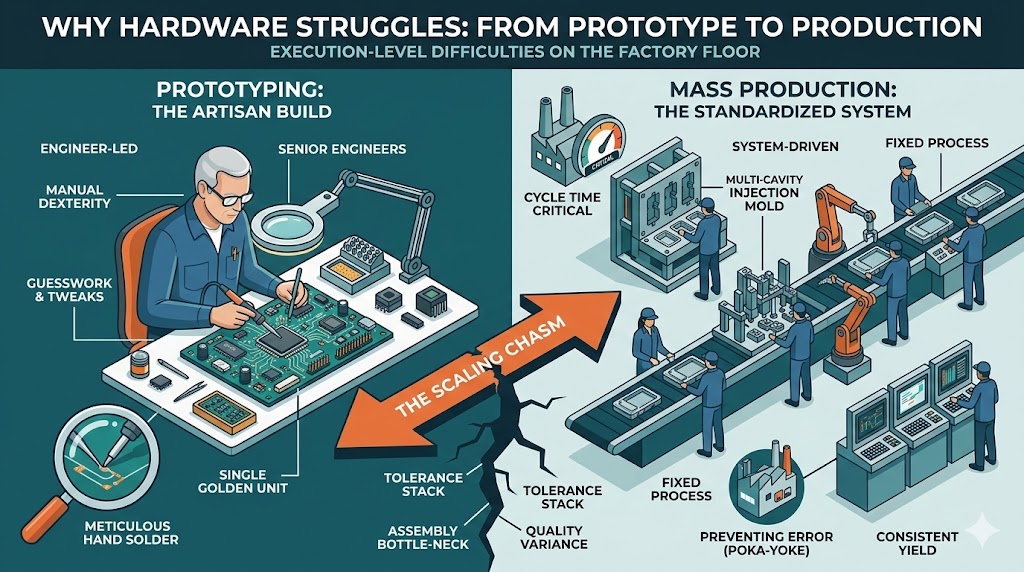
From Concept to Consumer: Why Hardware Products Struggle When Scaling From Prototype to Production

CINDY Mould The “Hardware is Hard” Reality Check In the hardware startup world, there’s a common saying: “The first 1% is the idea, the next 9% is the prototype, and the remaining 90% is the struggle to scale.” For many engineering teams, seeing a functional prototype finally come to life is a moment of triumph. The PCBA design works, the mechanical enclosure fits, and the firmware performs as expected. However, the transition from a single “golden unit” to a production run of 10,000 units is rarely straightforward. What appears stable in a prototype environment often becomes fragile when exposed to the realities of mass manufacturing. Products that perform perfectly in a lab environment may experience assembly issues, quality inconsistencies, or supply chain disruptions once production volumes increase. Understanding why hardware products struggle when scaling from prototype to production is essential for teams preparing to commercialize their designs. 1. The Fundamental Dichotomy: P
Read More »
sink-mark-defect

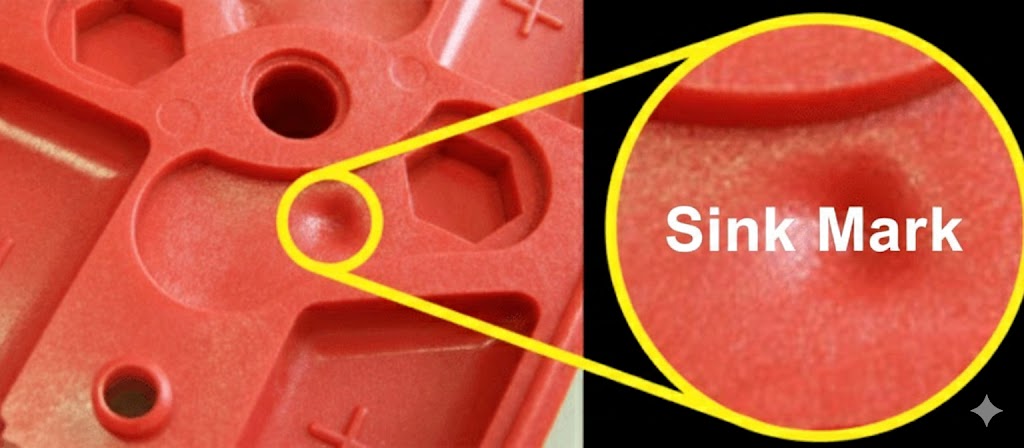
Why Sink Marks Still Appear Even With Perfect Mold Design

Sink marks in injection molding are one of the most common cosmetic defects in plastic parts. They typically appear as small depressions on the surface of molded components, often above ribs, bosses, or thick sections. Most plastic design guidelines recommend maintaining uniform wall thickness, proper rib ratios, and efficient mold cooling. In theory, following these rules should prevent sink marks from appearing. However, in real manufacturing environments, sink marks can still occur even when the mold design is technically correct. This happens because sink marks are not caused by a single factor. Instead, they result from the interaction between material properties, mold design, cooling conditions, and processing parameters. In this article, we explore the most common reasons why sink marks in injection molding still appear despite a well-designed mold. What Are Sink Marks in Injection Molding? Sink marks are surface depressions that occur when the interior of a plastic part shrink

Read More »
IML and IMR in Injection Molding

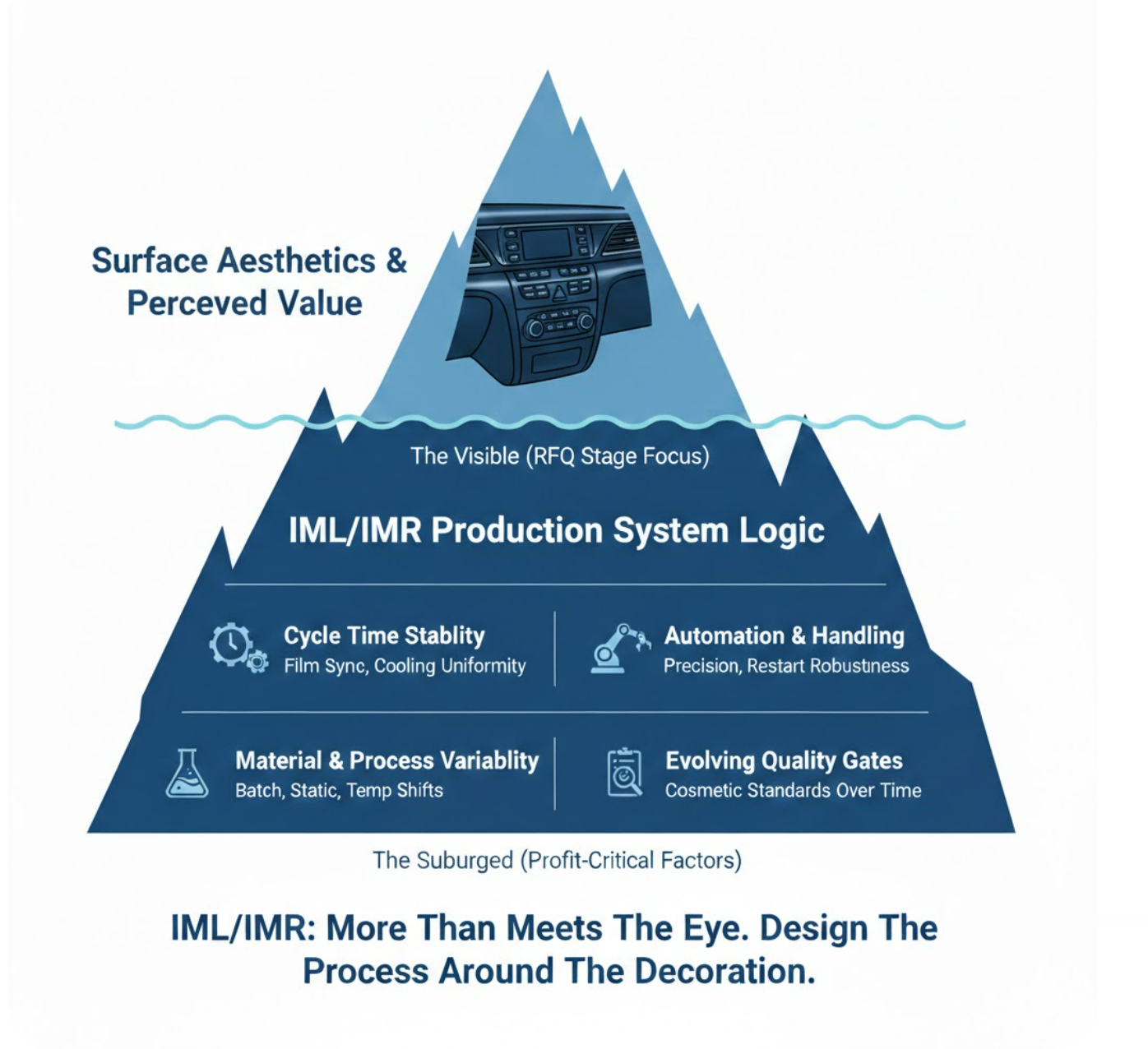
IML and IMR in Injection Molding: How In-Mold Decoration Impacts Cycle Time and OEE

In many projects, IML and IMR are introduced as surface finishing upgrades. Better appearance.Improved durability.Elimination of secondary printing. Technically accurate. But in injection molding, IML injection molding and the IMR process are not simply decoration choices. They fundamentally change how the entire production system behaves. When in-mold decoration becomes part of the molding cycle, it reshapes: Projects rarely struggle because decoration is difficult.They struggle because decoration is treated as cosmetic — instead of structural. What Are IML and IMR in Injection Molding? IML (In-Mold Labeling) and IMR (In-Mold Roller Decoration) are both forms of in-mold decoration integrated directly into the injection molding process. In IML injection molding, a pre-printed label is inserted into the mold cavity before injection. The molten plastic bonds to the label during molding. In the IMR process, a continuous decorative film transfers ink onto the part surface during injection

Read More »
Stack Molds

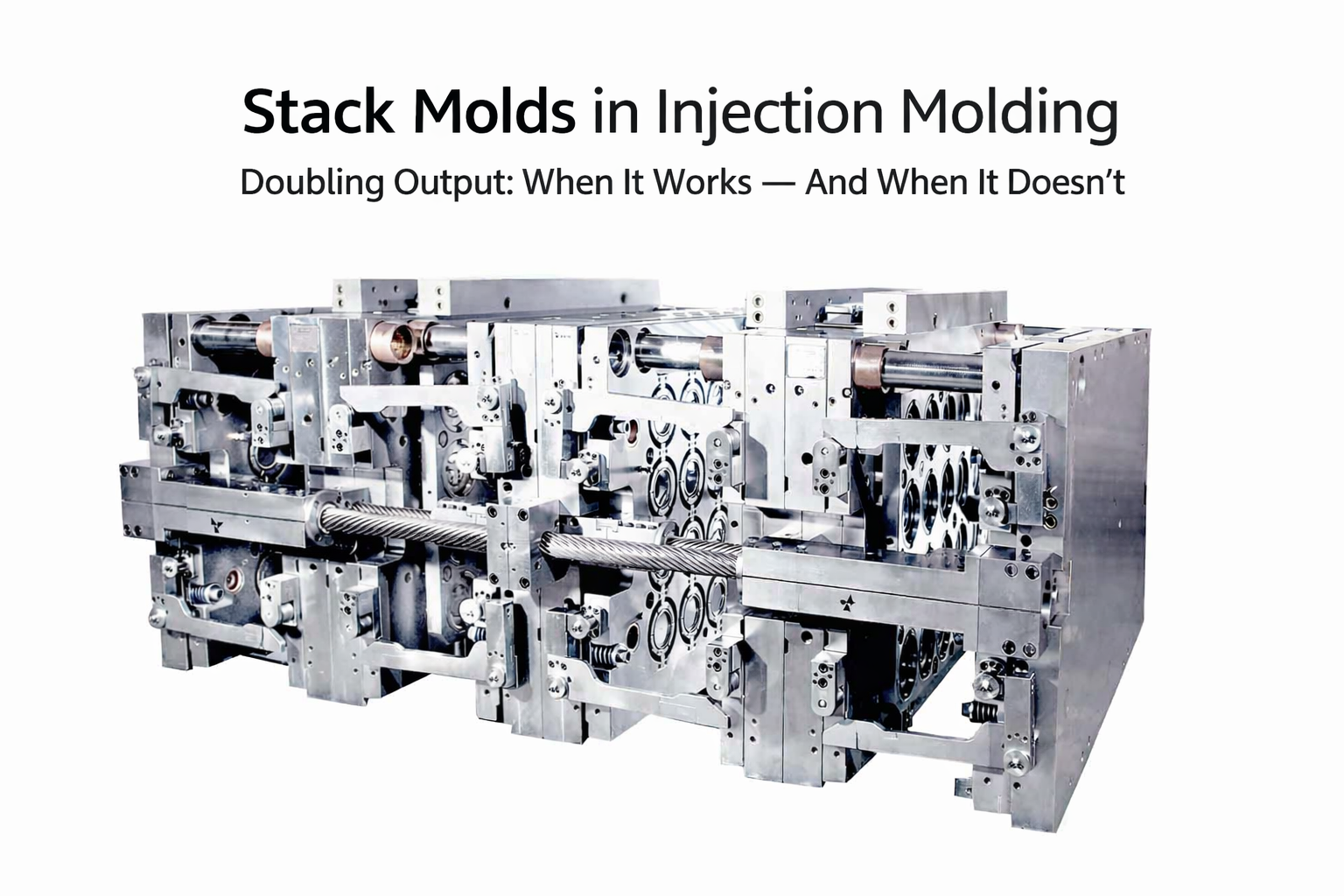
Stack Molds in Injection Molding: When Doubling Output Makes Sense — And When It Doesn’t

Stack molds in injection molding are often described as a way to double output without adding more machines. In theory, that statement is correct. In practice, the decision to use a stack mold is far more complex. At CINDY MOULD, we view stack molds not as a shortcut for productivity, but as a long-term production strategy. When properly engineered, a stack mold can significantly improve injection molding productivity and reduce cost per part. When poorly evaluated, it can introduce instability, excessive maintenance, and unnecessary capital risk. Understanding the difference is critical. What Is a Stack Mold in Injection Molding? A stack mold is a multi-level injection mold that contains two or more cavity layers within a single mold base. Unlike a traditional single-face mold, a stack mold produces parts on multiple parting lines during one injection molding cycle. In most configurations: The concept is straightforward. The engineering is not. Because the projected area effectively

Read More »