
Plastic electronic enclosures are more than protective covers. They are often the first part of a product that users see, touch, and judge.
A housing may have stable dimensions and a strong internal structure, but if the surface looks rough, uneven, scratched, or inconsistent, the final product can still feel low quality.
That is why choosing the right injection mold surface finish is important before mold manufacturing begins. A well-planned injection mold surface finish helps the final enclosure look consistent, feel reliable, and remain suitable for repeated production.
For plastic electronic enclosures, surface finish affects:
- Product appearance
- Gloss level and texture
- User touch feeling
- Scratch visibility
- Mold release
- Assembly quality
- Surface defect control
- Long-term production consistency
This guide explains 7 common injection mold surface finish options for plastic electronic enclosures and how each option affects tooling, molding, and final product quality.
What Is Injection Mold Surface Finish?
Injection mold surface finish refers to the texture, gloss, or surface appearance transferred from the mold cavity to the molded plastic part.
In plastic injection molding, the final surface is not decided by plastic material alone. It is also affected by:
- Mold polishing quality
- Mold texture treatment
- Mold steel selection
- Part design
- Draft angle
- Gate location
- Material drying
- Injection molding parameters
A surface finish can be glossy, matte, textured, clear, fine-grained, or prepared for secondary processes such as painting, printing, laser marking, or coating.
For reference, SPI-style polished and textured finishes are commonly used to describe different cosmetic levels for injection molded plastic parts.
For plastic electronic enclosures, this is especially important because the housing often includes visible covers, button areas, LED windows, display zones, snap-fit structures, and assembly interfaces.
Why Injection Mold Surface Finish Matters for Plastic Electronic Enclosures
Electronic enclosures usually need to meet both cosmetic and functional requirements.
The outer housing must look clean and consistent. At the same time, it needs to protect the internal PCBA, fit well during assembly, and remain stable during mass production.
For product developers and sourcing teams, injection mold surface finish is also an early design decision that affects tooling cost, sample approval, and mass production quality.
A poor surface finish may lead to problems such as:
- Flow marks on visible surfaces
- Scratches during handling or assembly
- Weld lines around openings or corners
- Uneven gloss between different areas
- Drag marks caused by poor mold release
- Poor coating or printing adhesion
- Inconsistent appearance between production batches
For this reason, surface finish should be reviewed during the DFM stage, not after the mold has already been completed.
Quick Comparison of Common Injection Mold Surface Finish Options
The table below compares common injection mold surface finish options used for plastic electronic enclosures.
| Surface Finish Option | Common Use | Main Benefit | Key Manufacturing Concern |
|---|---|---|---|
| Glossy Finish | Decorative covers, premium panels | Smooth and high-end appearance | Shows scratches, sink marks, and flow marks easily |
| Matte Finish | General electronic housings | Clean look, less glare | Needs stable gloss control |
| Textured Finish | Handheld devices, industrial housings | Better grip, hides minor marks | Requires enough draft angle |
| Fine Grain Finish | Smart home devices, compact enclosures | Balanced appearance and touch | Texture consistency must be controlled |
| Clear or Polished Finish | LED windows, display areas | Transparent or premium visual effect | Requires high polishing and good mold steel |
| Functional Texture | Buttons, grip areas, covers | Improves usability and touch feel | Should not affect assembly or cleaning |
| Secondary Finish-Ready Surface | Painting, printing, laser marking | Supports post-molding decoration | Surface must match the next process |
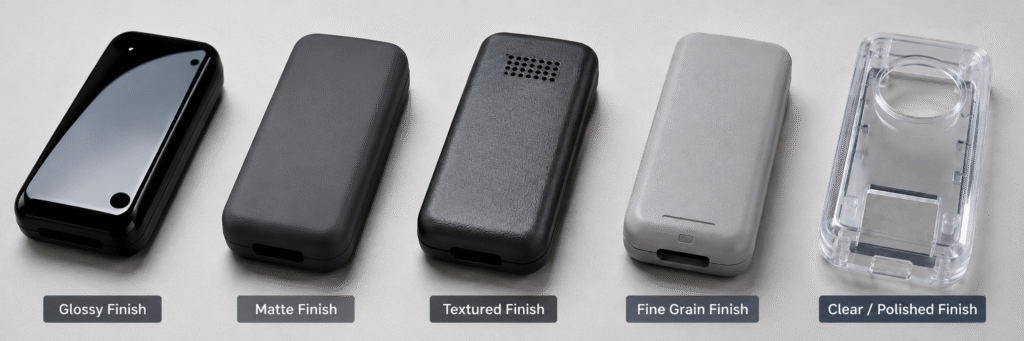
1. Glossy Finish
A glossy finish creates a smooth, shiny, and premium-looking surface. This injection mold surface finish is suitable for products that need a refined and high-value appearance.
It is often used for:
- Decorative front covers
- Display panels
- Consumer electronic housings
- High-end plastic covers
- Visible product surfaces
For plastic electronic enclosures, glossy surfaces can make the final product look more polished. However, they are also more sensitive to molding and handling defects.
Common risks include:
- Flow marks
- Sink marks
- Scratches
- Dust marks
- Uneven gloss
- Visible weld lines
From a tooling perspective, glossy parts usually require better mold polishing and suitable mold steel. If the mold steel does not polish well, the final surface may show haze, polishing marks, or uneven reflection.
Glossy finish is suitable when the product needs a premium appearance, but it requires stricter control over mold polishing, material drying, gate location, molding parameters, and cosmetic inspection.
2. Matte Finish
A matte finish has lower reflection and a softer visual appearance. As a practical injection mold surface finish, matte finish is widely used when the product needs a clean appearance without strong reflection.
It is one of the most common surface finish choices for plastic electronic enclosures because it offers a good balance between appearance and manufacturability.
Matte finish is often used for:
- Smart home devices
- Sensor housings
- Router housings
- Control boxes
- Power supply enclosures
- General plastic covers
Compared with glossy surfaces, matte surfaces can reduce glare and make small scratches less obvious. They also give the product a clean and professional look without making the surface too sensitive.
However, matte finish still requires stable molding control. If mold temperature, material flow, or injection parameters are not consistent, the part may show gloss variation, flow marks, or color inconsistency.
For many electronic products, matte finish is a practical and reliable choice.
3. Textured Finish
A textured finish adds a visible grain or pattern to the plastic surface. This injection mold surface finish is useful when the enclosure needs better grip, fingerprint resistance, or a more durable visual effect.
It can improve grip, reduce fingerprints, and help hide small scratches or minor surface marks.
Textured finish is commonly used for:
- Handheld electronic devices
- Remote controls
- Industrial electronic enclosures
- Control panels
- Plastic housings with frequent user contact
This type of surface finish can make the product feel more durable and less slippery. It is also useful when the customer wants a more practical surface instead of a smooth glossy appearance.
However, texture affects mold design.
The deeper the texture, the more important the draft angle becomes. If the draft angle is too small, the molded part may rub against the cavity surface during mold release.
This can cause:
- Drag marks
- Whitening
- Scratches
- Part deformation
- Unstable ejection
Before choosing a textured finish, the part design should be reviewed carefully. Texture depth, draft angle, plastic material, and mold release direction must work together.
4. Fine Grain Finish
Fine grain finish is a lighter and more refined texture. This injection mold surface finish works well for compact electronic products that need a refined but not overly glossy surface.
It is suitable for plastic electronic enclosures that need a clean, modern surface without strong gloss or heavy texture.
Fine grain finish is often used for:
- Compact electronic housings
- Smart home products
- Sensor covers
- Small control devices
- Consumer electronics
Compared with deep texture, fine grain finish gives a softer and more controlled appearance. It can improve the touch feeling while keeping the surface easy to clean and inspect.
This finish can also reduce the visibility of fingerprints, light scratches, and handling marks.
However, fine grain finish still needs stable production control. If the material temperature, mold temperature, or injection speed changes too much, the surface may show inconsistent texture or uneven gloss.
For products that require consistent appearance across different batches, process stability is very important.
5. Clear or Polished Finish
Clear or polished finish is used for transparent or semi-transparent plastic parts. Among different injection mold surface finish options, clear or polished finish usually requires stricter tooling and molding control.
In electronic products, it is commonly used for:
- LED windows
- Display covers
- Indicator light areas
- Transparent buttons
- Optical windows
- Clear plastic housings
This type of finish requires much stricter mold and process control because transparent parts make defects more visible.
Common risks include:
- Bubbles
- Silver streaks
- Flow marks
- Scratches
- Black spots
- Polishing marks
- Uneven transparency
For clear or polished surfaces, mold steel selection is especially important. The mold cavity must be polished to a high level, and the steel should support good polishing performance.
Material drying is also critical, especially for transparent plastics that are sensitive to moisture.
Clear or polished finish can improve the visual value of electronic products, but it should be selected with realistic expectations about tooling cost, inspection standards, and production difficulty.
6. Functional Texture
Functional texture is not only used for appearance. It is designed to improve how the product is touched, held, operated, or assembled. This type of injection mold surface finish is selected not only for appearance, but also for product usability.
For plastic electronic enclosures, functional texture may be used around:
- Button areas
- Grip zones
- Removable covers
- Battery doors
- Handles
- Handheld product surfaces
For example, a textured grip area can help users hold the product more securely. A slightly different texture around a button area can also improve touch recognition.
However, functional texture must be planned carefully.
If the texture is too deep, it may collect dust or become difficult to clean. If it is placed near snap-fit areas, sliding surfaces, or assembly interfaces, it may increase friction or affect part fitting.
A good functional texture should improve usability without creating unnecessary molding or assembly problems.
7. Secondary Finish-Ready Surface
Some plastic enclosures are not used directly after molding. This injection mold surface finish should be confirmed before tooling because it can affect coating, printing, marking, or plating quality.
They may need secondary processes such as:
- Painting
- Silk printing
- Pad printing
- Laser marking
- UV coating
- Plating
In this case, the molded surface must be suitable for the next process.
A part may look acceptable after molding but still fail later if the surface is not prepared correctly. For example, poor surface condition may cause weak coating adhesion, uneven printing, or inconsistent laser marking.
Secondary finish-ready surfaces are common for:
- Logo areas
- Button markings
- Front covers
- Decorative panels
- Product labels
Before mold manufacturing, it is important to confirm whether the plastic part will need painting, printing, coating, or laser marking later.
This helps avoid a common problem: the molded part passes dimensional inspection but fails during finishing or final assembly.
How Surface Finish Affects Mold Steel Selection
The selected injection mold surface finish can directly affect mold steel requirements.
Different finishes require different levels of polishing performance, wear resistance, corrosion resistance, and long-term mold maintenance.
For example, high-gloss and transparent parts usually require mold steel with better polishing performance. If the steel cannot be polished well, the final plastic surface may show haze, polishing marks, or uneven gloss.
Textured parts may have different requirements. If the production volume is high or the plastic material contains glass fiber or other abrasive fillers, the mold steel may need better hardness and wear resistance.
Otherwise, the texture may wear down over time, leading to inconsistent surface appearance.
This is why surface finish should be considered together with plastic injection mold steel, material selection, expected production volume, and cosmetic requirements.
Mold steel is not only about mold life. It also affects the final appearance and production stability of plastic parts.
How Surface Texture Affects Draft Angle and Mold Release
Draft angle is one of the most important design factors for textured plastic parts.
When a molded part is released from the mold, the surface must move smoothly along the mold opening direction. If the texture is too deep and the draft angle is too small, the plastic part may rub against the cavity surface.
This may cause:
- Drag marks
- Scratches
- Whitening
- Deformation
- Difficult ejection
- Unstable surface appearance
These problems are especially common on vertical walls, deep side surfaces, ribs, bosses, and snap-fit areas.
For plastic electronic enclosures, draft angle should be reviewed before the texture is confirmed. A smooth surface may require less draft, while a deep texture usually requires more.

General injection molding design guidance also shows that textured or bead-blasted surfaces usually require more draft than smooth surfaces to support clean part release.
The final requirement depends on part geometry, texture depth, material shrinkage, and mold release direction.
For this reason, the selected injection mold surface finish should always be checked together with draft angle during the DFM stage.
A proper DFM review can help identify these risks early. It is much easier to adjust the part design before mold manufacturing than to fix mold release problems after the tool is completed.
How Gate Location and Flow Direction Affect Surface Appearance
Gate location has a strong influence on surface appearance.
Plastic melt enters the mold through the gate, and the flow direction can affect:
- Weld lines
- Flow marks
- Jetting
- Gloss variation
- Color consistency
- Gate marks on visible surfaces
For cosmetic surfaces, obvious gate marks should be avoided whenever possible. If the gate is placed on a visible surface, it may leave a mark that affects the product appearance.
For plastic electronic enclosures, cosmetic surfaces should be clearly defined before mold design.
The mold designer needs to know:
- Which surfaces are visible after assembly
- Which areas are covered by other parts
- Which zones are critical for appearance
- Where gate marks are acceptable
- Which surfaces require texture or polishing
Good mold design should balance appearance, filling, strength, and production efficiency.
A surface finish decision should not be made separately from gate location and part structure. The chosen injection mold surface finish should be reviewed together with gate location to reduce visible marks on cosmetic areas.
Common Surface Defects in Injection Molded Plastic Enclosures
Even with the right injection mold surface finish, surface defects may still occur if mold design, material selection, or injection molding parameters are not well controlled.
A poorly controlled injection mold surface finish can make these defects more visible, especially on cosmetic surfaces.
Below are common surface defects in injection molded plastic enclosures.
| Surface Defect | Possible Cause |
|---|---|
| Flow marks | Melt flow, gate design, temperature, or injection speed |
| Weld lines | Two flow fronts meeting around holes, ribs, or complex structures |
| Sink marks | Uneven wall thickness, ribs, bosses, or insufficient packing |
| Silver streaks | Moisture, material degradation, trapped air, or processing issues |
| Gloss variation | Uneven mold temperature, unstable flow, or inconsistent texture |
| Drag marks | Insufficient draft angle or poor mold release |
| Scratches | Ejection, handling, assembly, or packaging damage |
| Whitening | Stress around snap-fits, tight assembly, or release problems |
| Color inconsistency | Material batch difference, pigment mixing, or temperature variation |
Surface defects should not be treated only as appearance problems. They often point to deeper issues in mold design, material preparation, part structure, or process control.
What to Confirm Before Choosing a Surface Finish
Before selecting an injection mold surface finish, it is helpful to confirm the following points. The selected injection mold surface finish should match cosmetic requirements, product function, tooling conditions, and secondary process needs.
Cosmetic Surface Requirements
- Which surfaces are visible after assembly?
- Which areas are touched by users?
- Which surfaces need strict appearance control?
- Are gate marks allowed on any visible area?
Product Function Requirements
- Does the product need grip or anti-slip texture?
- Are there buttons, display windows, or LED areas?
- Will the surface affect assembly or user operation?
- Is the product used indoors, outdoors, or in a harsh environment?
Manufacturing Requirements
- What plastic material will be used?
- What is the expected production volume?
- Does the selected texture need a larger draft angle?
- Does the mold steel support the required polishing or texture?
- Are the molding parameters stable enough for the required appearance?
Secondary Process Requirements
- Will the part need painting?
- Will it need silk printing or pad printing?
- Will there be laser marking?
- Does the surface need coating or plating?
- Is the molded surface suitable for the next process?
These questions help reduce the risk of late mold changes, unstable appearance, poor finishing quality, or production delays.
For plastic electronic enclosures, surface finish should be confirmed before tooling starts, not after the first trial samples are made.
How Cindy Mould Supports Surface Finish Control for Plastic Electronic Enclosures
At Cindy Mould, surface quality is reviewed as part of the complete manufacturing process.
By reviewing the injection mold surface finish early, potential issues related to polishing, texture, mold release, and appearance inspection can be reduced.
For plastic electronic enclosures, appearance should not be separated from tooling, molding, assembly, and functional product requirements.
Our team can support customers through:
- DFM review before mold manufacturing
- Cosmetic surface identification
- Mold steel and material suggestions
- Mold polishing and texture planning
- Gate location and draft angle review
- Trial molding and sample inspection
- Plastic enclosure molding and appearance control
- Product assembly and functional testing support
For many electronic products, the plastic housing must work together with the internal PCBA, buttons, connectors, display areas, and final assembly structure.
Cindy Mould supports customers from plastic injection molding to product assembly and electronics manufacturing support, helping reduce risks between design, tooling, molding, and final product delivery.
Conclusion
Choosing the right injection mold surface finish is not only an appearance decision.
It affects:
- Mold steel selection
- Polishing quality
- Texture design
- Draft angle
- Gate location
- Mold release
- Surface defect control
- Final product consistency
For plastic electronic enclosures, the best injection mold surface finish should balance appearance, function, cost, assembly, and long-term production stability.
Glossy, matte, textured, clear, functional, and secondary finish-ready surfaces all have different advantages and risks.
By reviewing surface finish requirements before tooling, manufacturers and product developers can avoid many common problems, including flow marks, scratches, drag marks, poor coating adhesion, and inconsistent surface appearance.
A well-planned surface finish helps the final plastic enclosure look better, assemble more smoothly, and perform more reliably in real production.
FAQ
What is injection mold surface finish?
Injection mold surface finish is the texture, gloss, or appearance created on a plastic part by the mold cavity surface. It can be glossy, matte, textured, clear, or prepared for secondary processes such as painting, printing, coating, or laser marking.
The selected injection mold surface finish should match the plastic material, product appearance requirement, mold design, and production volume.
What surface finish is best for plastic electronic enclosures?
There is no single best surface finish for all plastic electronic enclosures. Matte and fine grain finishes are common for general housings, glossy finishes are used for premium appearance, textured finishes improve grip, and clear polished finishes are used for display windows or LED areas.
The best injection mold surface finish depends on the product function, cosmetic standard, material, tooling budget, and mass production requirement.
Does textured surface finish need more draft angle?
Yes. In most cases, textured surfaces need more draft angle than smooth surfaces. If the draft angle is not enough, the plastic part may show drag marks, scratches, whitening, or release problems during molding.
Which mold steel is suitable for high-gloss plastic parts?
High-gloss or clear plastic parts usually require mold steel with good polishing performance. The final choice depends on the plastic material, production volume, surface requirement, and mold maintenance needs.
How can surface defects be reduced in injection molded parts?
Surface defects can be reduced through proper DFM review, suitable mold steel, good gate location, enough draft angle, material drying, stable injection molding parameters, and clear cosmetic inspection standards during trial molding and mass production.