
This IP rating guide explains how IP ratings apply to electronic products, especially when waterproof enclosure design, plastic housings, PCB protection, assembly, and testing are involved.
Many buyers simply say they need a “waterproof product.” But in real product development, the better question is: what IP rating does the product actually need, and can the enclosure design, material, molding process, assembly method, and testing plan support that rating?
This IP rating guide for electronic products explains how IP ratings work, how to choose a suitable protection level, and what design details matter most when developing IP-rated electronic enclosures. According to IEC, IEC 60529 is used to rate and grade the resistance of electrical and electronic device enclosures against the intrusion of dust and liquids (IEC Official Site).
IP Rating Guide: What Does It Mean for Electronic Products?
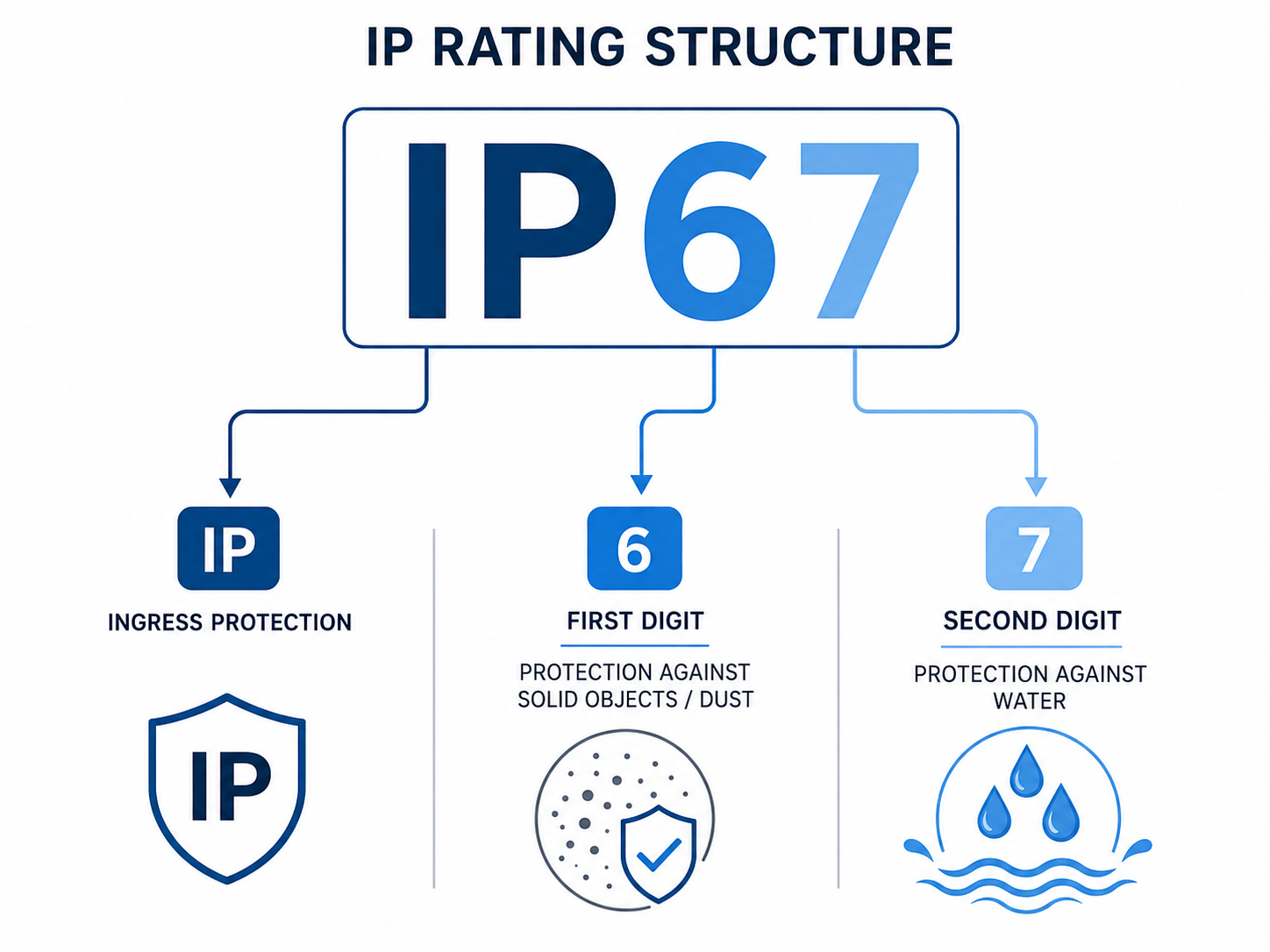
IP rating, also known as Ingress Protection rating, is used to describe how well an enclosure protects internal components from solid objects, dust, and water.
An IP rating usually includes two numbers:
- The first digit refers to protection against solid objects and dust.
- The second digit refers to protection against water or liquid ingress.
For example, in IP67:
- 6 means the enclosure is dust-tight.
- 7 means the enclosure can resist temporary immersion under defined test conditions.
This is why IP rating is more specific than simply saying a product is “waterproof.” Different IP ratings are tested under different conditions, and a higher number does not always mean the product is better for every application.
| IP Rating | Common Meaning | Typical Application |
|---|---|---|
| IP54 | Dust protected and splash resistant | Indoor or light industrial electronics |
| IP65 | Dust-tight and protected against water jets | Outdoor control boxes, smart devices, sensors |
| IP66 | Dust-tight and protected against stronger water jets | Harsh outdoor or industrial environments |
| IP67 | Dust-tight and protected against temporary immersion | Portable outdoor devices, sealed electronics |
| IP68 | Dust-tight and protected against deeper or longer immersion | Special waterproof or submerged applications |
The right IP rating should be selected based on the real usage environment, not only based on marketing expectations. Following this IP rating guide, designers can plan the appropriate enclosure and assembly process.
Waterproof vs Water-Resistant: Why the Difference Matters
“Waterproof” is a common word in product marketing, but it can be too general for engineering and manufacturing discussions. This IP rating guide emphasizes the importance of using precise IP ratings instead of marketing terms.
A product exposed to light rain, occasional splashing, cleaning water, high-pressure jets, or temporary immersion may require very different enclosure designs. For this reason, it is better to define protection requirements using a specific IP rating.
For example:
- A wall-mounted indoor device may only need basic splash resistance.
- An outdoor sensor may require IP65 or IP66.
- A portable product that may fall into water may require IP67.
- A device used in long-term wet or submerged conditions may need a more specific IP68 testing requirement.
In many electronic product projects, the real question is not simply “How can we make it waterproof?” but “What level of water resistance does the product actually need?” Following this IP rating guide, engineers can make informed design decisions.
Over-designing the enclosure can increase tooling complexity, gasket cost, assembly difficulty, and testing requirements. Under-designing it can lead to water ingress, PCB failure, customer complaints, and warranty risks.
How to Choose the Right IP Rating for Your Electronic Product
Choosing the right IP rating should happen before the enclosure structure is finalized. Once the mold has been built, changing the sealing structure can be much more expensive and time-consuming.
Indoor Electronic Products
For indoor electronic products, the main risks may include dust, accidental contact, light moisture, or occasional splashing. In these cases, a moderate IP rating may be enough.
Examples may include:
- Indoor control panels (Product Assembly)
- Smart home devices
- Consumer electronic housings
- Wall-mounted electronic modules
For these products, designers should avoid unnecessary over-engineering. A very high IP rating may increase cost without providing real value to the end user. This IP rating guide helps clarify these considerations early.
Outdoor Electronic Products
Outdoor electronic products face more demanding conditions. Rain, dust, temperature change, UV exposure, and humidity can all affect enclosure performance.
Examples may include:
- Outdoor sensors
- Security devices
- Garden electronics
- Industrial control boxes
- Outdoor smart home products
For these products, IP65 or IP66 may be common choices, depending on the environment. However, the enclosure design must also consider plastic material stability, gasket aging, screw torque, cable exit sealing, and long-term exposure.
Portable or Immersion-Risk Products
If an electronic product may be dropped into water or exposed to temporary immersion, IP67 may be considered.
However, IP67 should not be selected only because it looks stronger. Temporary immersion protection requires more careful sealing design, tighter assembly control, and reliable testing. If the product needs longer or deeper water resistance, IP68 requirements should be defined clearly between the buyer, designer, and manufacturer. Using this IP rating guide, designers can evaluate risks before prototyping.
7 Waterproof Enclosure Design Tips for Electronic Products
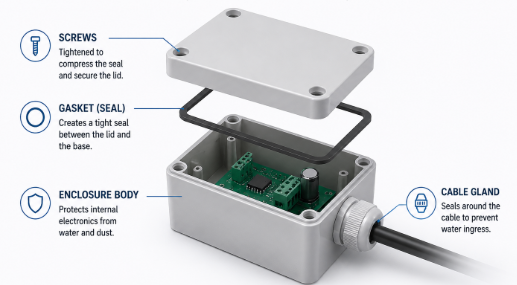
Waterproof enclosure design is not controlled by one single part. It depends on the complete relationship between housing structure, gasket design, plastic part accuracy, fastening method, PCB layout, assembly process (PCB Services), and testing.
Below are seven important design tips following this IP rating guide:
1. Define the Required IP Rating Before Enclosure Design
One common mistake is designing the product first and discussing waterproof requirements later. Following this IP rating guide ensures early consideration of:
- Housing parting lines
- Gasket groove position
- Screw boss layout
- Button and connector sealing
- Wall thickness
- Plastic material selection
- Assembly sequence (Product Assembly)
- Testing method
Waterproof enclosure design should start before tooling, not after the first molded samples are finished. This IP rating guide helps avoid late-stage modifications, unstable sealing solutions, and unnecessary mold changes.
2. Design the Gasket Groove Correctly
A gasket is not effective simply because it is added to the enclosure. The gasket must be designed, compressed, and assembled correctly. This IP rating guide emphasizes the importance of proper gasket groove design.
3. Control Plastic Wall Thickness and Deformation
Plastic enclosure quality has a direct effect on waterproof performance. Following this IP rating guide, even a well-designed gasket may fail if the plastic housing surface is warped after injection molding.
4. Pay Attention to Screws, Bosses, and Fastening Pressure
Screws strongly affect enclosure sealing. This IP rating guide recommends:
- Number of screws
- Screw spacing
- Boss strength
- Screw torque
- Fastening sequence
- Plastic material strength
- Assembly fixture support (Product Assembly)
5. Avoid Leakage Points Around Buttons, Connectors, and Cable Exits
Functional openings are the most common leakage points. Following this IP rating guide, designers should seal:
- Buttons
- LED windows
- Charging ports
- Speaker holes
- Sensor openings
- Cable exits
- Connectors
- Housing seams
- Screw holes
6. Consider PCB Layout and Internal Protection
Even with a sealed enclosure, internal moisture can be a risk. The IP rating guide recommends:
- Keeping critical components away from high-risk openings
- Avoiding exposed pads near possible moisture paths
- Considering conformal coating
- Allowing enough internal clearance
- Avoiding interference between PCB and gasket structure
- Planning test points without weakening the enclosure
- Separating mechanical fastening areas from sensitive circuits (PCB Services)
7. Verify Sealing Performance Through Assembly and Testing
A prototype passing one water test does not always mean the product is ready for stable production. This IP rating guide highlights the need for:
- Prototype sealing test
- Pre-production sample test
- Assembly process validation (Product Assembly)
- Screw torque verification
- Visual inspection of gasket placement
- Functional testing after assembly
- Random water-resistance testing during production
- Final inspection before shipment
Why IP-Rated Enclosures Can Fail in Mass Production
Many failures happen because production processes are not controlled well enough. Following this IP rating guide, manufacturers should monitor:
- Plastic warpage
- Gasket compression consistency
- Screw torque control
- Cable sealing
- Assembly repeatability
- Material shrinkage variation
- Testing plan execution
How a Manufacturing Partner Supports IP-Rated Electronic Products
A capable manufacturing partner can help implement this IP rating guide:
- Reviewing enclosure structure before tooling (About Us)
- Checking gasket groove and sealing surface design
- Evaluating plastic wall thickness and deformation risk
- Supporting injection molding (Injection Molding)
- Controlling critical dimensions
- Reviewing PCB position (PCB Services)
- Defining screw torque and assembly sequence
- Supporting product assembly (Product Assembly)
- Conducting functional testing
- Preparing final inspection and packaging
Final Checklist Before Production
This IP rating guide recommends reviewing:
| Checklist Item | Why It Matters |
|---|---|
| Target IP rating confirmed | Avoids over-design or under-design |
| Real usage environment reviewed | Defines suitable water/dust protection |
| Gasket groove checked | Ensures stable sealing compression |
| Housing deformation reviewed | Prevents uneven sealing surfaces |
| Plastic material selected | Affects strength and stability |
| Screw torque defined | Improves assembly consistency |
| Buttons and connectors sealed | Reduces leakage risk |
| Cable exit design reviewed | Prevents water ingress |
| PCB layout checked | Protects sensitive components |
| Testing plan prepared | Confirms performance before shipment |
FAQs About IP Rating and Waterproof Enclosure Design
IP Rating Guide FAQs for Outdoor Electronic Products
- What IP rating is suitable for outdoor electronics?
Many use IP65 or IP66 depending on rain, dust, and exposure conditions. - Is IP67 always better than IP65?
No, IP67 focuses on temporary immersion, while IP65 handles water jets. - Can a plastic enclosure achieve IP67?
Yes, if design, material, gasket, molding, assembly, and testing are controlled. - Why do waterproof enclosures fail after mass production?
Failures occur due to plastic warpage, gasket compression inconsistencies, screw torque errors, poor cable sealing, and assembly issues. - Should IP rating be considered before or after tooling?
Before tooling. Adding waterproof requirements later may require redesign and additional cost.
Conclusion
IP rating is critical for electronic product development. This IP rating guide emphasizes that waterproof enclosure design depends on complete coordination between mechanical design, electronics integration, injection molding, assembly (Product Assembly), and quality control. Early planning using this IP rating guide ensures that products achieve their intended protection consistently in production.
Early planning using this IP rating guide ensures that products achieve their intended protection consistently in production. For more information on electronics manufacturing best practices, see the IPC standards overview