
When a buyer sends a PCB assembly inquiry, the first question is often simple:
“Can you quote this project?”
But for an electronics manufacturing supplier, an accurate quote rarely depends on the PCB image alone. It depends on the files, specifications, production stage, component sourcing method, testing requirements, assembly details, and delivery expectations behind the project.
A PCB assembly RFQ that only includes a board photo or a short message usually leads to more questions. The supplier may need to ask for the BOM, Gerber files, Pick and Place file, quantities, test requirements, and packaging details before the quotation can move forward. This back-and-forth can delay the project and sometimes leads to inaccurate early pricing.
A clear PCB assembly RFQ checklist helps buyers prepare the right information before requesting a quote. It also helps the EMS supplier review cost, manufacturability, lead time, sourcing risk, and production requirements more efficiently.
This guide explains what buyers should prepare before sending a PCB assembly RFQ, especially for projects involving PCB assembly, functional testing, plastic enclosures, box build assembly, or final product delivery through one-stop electronics manufacturing services.
This PCB assembly RFQ checklist is designed to help buyers reduce missing information before starting a quotation discussion.
What Is a PCB Assembly RFQ?
RFQ stands for Request for Quotation. In PCB assembly, an RFQ is not just a request for a unit price. It is a project information package that allows a manufacturer to evaluate what needs to be built, how it should be assembled, what materials are required, how it should be tested, and how it should be delivered.
For a simple PCB assembly project, the supplier may only need PCB fabrication files, a BOM, assembly files, and quantity information. For a more complete electronics product, the RFQ may also need enclosure drawings, cable details, functional testing instructions, labeling requirements, packaging standards, and shipment information.
A complete RFQ helps both sides avoid assumptions. It allows the supplier to quote based on the real production scope instead of guessing what may be needed later.
In many electronics projects, the quote can change not because the supplier made a mistake, but because the original RFQ was incomplete. Missing component information, unclear testing requirements, or unconfirmed assembly steps can all affect the final cost.
Before contacting an EMS supplier, using a PCB assembly RFQ checklist can help buyers organize the files, quantities, testing details, and production requirements that affect the final quote.
A PCB assembly RFQ checklist is useful because it turns a general inquiry into a clearer manufacturing request.
Quick PCB Assembly RFQ Checklist
Before sending your inquiry, check whether the following information is ready.
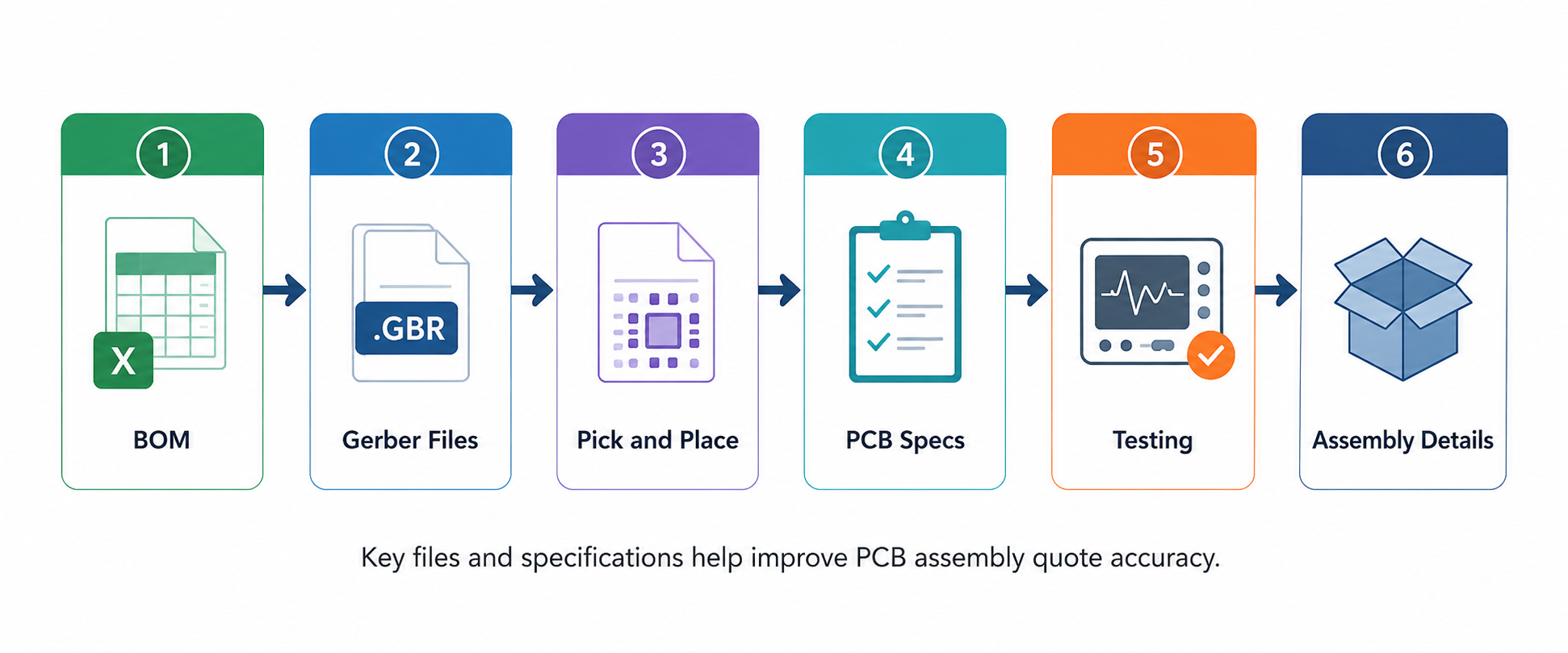
The following PCB assembly RFQ checklist gives buyers a practical overview of the main files and specifications usually needed for an accurate quote.
| RFQ Item | Why It Matters | Required or Optional |
|---|---|---|
| BOM file | Used for component sourcing, cost calculation, and availability review | Required |
| Gerber files | Used to review PCB fabrication requirements | Required |
| Pick and Place file | Helps confirm SMT component position and orientation | Required for SMT assembly |
| PCB specifications | Defines board material, layers, thickness, copper, and surface finish | Required |
| Assembly drawing | Clarifies polarity, orientation, special components, and manual assembly notes | Recommended |
| Quantity | Affects setup cost, unit cost, component MOQ, and lead time | Required |
| Production stage | Prototype, pilot run, or mass production affects quoting logic | Required |
| Testing requirements | Determines inspection method, fixture needs, labor, and quality process | Required |
| Component sourcing method | Turnkey, consigned, or mixed sourcing changes the quote structure | Required |
| Box build details | Needed if the supplier handles enclosure, wiring, final assembly, or packaging | If applicable |
| Quality and compliance requirements | Impacts material selection, documentation, traceability, and inspection | If applicable |
| Packaging and shipping requirements | Affects final handling, protection, labeling, and delivery cost | If applicable |
| Target delivery date | Helps the supplier evaluate whether the schedule is realistic | Recommended |
The more complete this information is, the faster the supplier can provide a meaningful quotation.
1. BOM File: The Starting Point for Component Cost
The BOM, or Bill of Materials, is one of the most important files in a PCB assembly RFQ. It tells the supplier what components are needed, how many are used on each board, and whether there are specific sourcing requirements.
A BOM that only lists general descriptions such as “resistor,” “capacitor,” or “IC” is usually not enough. The supplier needs exact part information to check price, stock, lead time, package type, and possible replacement options.
A good BOM should include:
- Manufacturer part number
- Component description
- Quantity per board
- Reference designators
- Package or footprint
- Manufacturer name
- Approved alternative parts
- Supplier part number, if available
- Special sourcing notes
- Do-not-substitute parts, if any
For turnkey PCB assembly, the BOM is especially important because the supplier is responsible for component procurement. If some parts are obsolete, out of stock, or only available with high minimum order quantities, this can affect both cost and delivery time.
For consigned assembly, where the buyer provides components, the BOM is still needed. The supplier must confirm whether all components match the PCB design, whether quantities are sufficient, and whether any special storage or handling is required.
If alternative components are acceptable, it is better to mention this early. Approved alternatives can help reduce sourcing risk, especially when certain ICs, connectors, sensors, or power components have long lead times.
A clear BOM does not only help the supplier quote faster. It also reduces the chance of component mismatch during production.
In a complete PCB assembly RFQ checklist, the BOM is usually the first file suppliers review because it directly affects component cost, availability, and sourcing risk.
2. Gerber Files and PCB Fabrication Data
Gerber files are used to manufacture and review the bare PCB. Even if the buyer only asks for assembly, the supplier still needs to understand the board structure and fabrication requirements.
Screenshots, PDF images, or photos of the PCB are not enough for an accurate quote. They may help the supplier understand the general design, but they do not provide the technical data required for PCB fabrication or assembly review.
A complete PCB data package usually includes:
- Gerber files
- Drill files
- Board outline
- Layer stack-up
- Copper thickness
- Board thickness
- Solder mask color
- Silkscreen color
- Surface finish
- Controlled impedance requirements, if any
- Special fabrication notes
If the supplier is responsible for both PCB fabrication and PCB assembly services, Gerber files are essential.They help the engineering team evaluate board size, panelization, layer count, drill requirements, solder mask openings, and other details that may affect cost and lead time.
For more complex boards, such as high-speed designs, impedance-controlled boards, or boards with tight spacing, the stack-up and impedance requirements should be provided clearly. Otherwise, the first quote may not reflect the real fabrication requirements.
Gerber files are a basic part of any practical PCB assembly RFQ checklist, because they allow the supplier to review both fabrication requirements and assembly feasibility before quoting.
3. Pick and Place File for SMT Assembly
The Pick and Place file, sometimes called the centroid file, is used for SMT component placement. It tells the assembly team where each component should be placed on the PCB and how it should be oriented.
This file usually includes:
- Reference designator
- X and Y coordinates
- Rotation angle
- Component side
- Package information
Without a Pick and Place file, the supplier may need extra engineering time to prepare placement data. This can slow down the quote and may also increase the chance of interpretation errors.
This file is especially important for boards with:
- Fine-pitch components
- BGAs
- QFNs
- LEDs
- Connectors
- Polarized capacitors
- Diodes
- Double-sided SMT assembly
For some simple prototypes, a supplier may still be able to quote with limited placement information. But for production, the Pick and Place file should be treated as a standard part of the RFQ package.
For SMT projects, the Pick and Place file should be included in the PCB assembly RFQ checklist, especially when the board has fine-pitch components, double-sided placement, or orientation-sensitive parts.
4. PCB Specifications Buyers Should Confirm
PCB specifications have a direct impact on fabrication cost, production lead time, and assembly risk. Even when two PCB designs look similar, small specification differences can change the quote.
Buyers should confirm the following details before requesting a quote:
| Specification | Common Options / Notes |
|---|---|
| Board layers | 1-layer, 2-layer, 4-layer, 6-layer, or higher |
| Base material | FR-4 or special material |
| Board thickness | Common options include 1.0 mm, 1.2 mm, 1.6 mm |
| Copper thickness | 1 oz, 2 oz, or custom |
| Surface finish | HASL, lead-free HASL, ENIG, OSP |
| Solder mask color | Green, black, white, blue, red, or custom |
| Silkscreen color | Usually white or black |
| Minimum trace/spacing | Important for manufacturability review |
| Controlled impedance | Required for some high-speed designs |
| Panelization | Customer-defined or supplier-supported |
| Special process | Blind vias, buried vias, gold fingers, castellated holes, etc. |
If these details are not confirmed, the supplier may need to quote based on common assumptions. That can create problems later if the actual requirement is different.
For example, a 2-layer FR-4 board with HASL surface finish is very different from a 6-layer impedance-controlled board with ENIG surface finish. The assembly process may look similar, but the PCB fabrication cost and lead time will not be the same.
For this reason, PCB specifications should not be treated as minor details. They are an important part of the PCB assembly RFQ checklist because they affect cost, manufacturability, and production planning.
5. Assembly Requirements: SMT, Through-Hole, and Mixed Assembly
PCB assembly can involve different production processes. A quote should clearly state whether the board requires SMT assembly, through-hole assembly, hand soldering, or mixed assembly.
Buyers should clarify:
- Is the board SMT only?
- Are there through-hole components?
- Are any components hand-soldered?
- Are there connectors, switches, sockets, or terminals?
- Is double-sided assembly required?
- Are there heat sinks, shielding covers, or mechanical parts?
- Is conformal coating required?
- Is glue, potting, or thermal material needed?
- Are there wires, cables, or harnesses connected to the PCB?
These details matter because they affect labor, process flow, inspection, fixture needs, and production time.
For example, a board with standard SMT components may be relatively straightforward. But if the project includes hand-soldered connectors, wire harnesses, adhesive, enclosure fitting, and functional testing, the quotation must reflect a wider assembly scope.
For projects that go beyond PCB assembly, buyers should also clarify whether the supplier needs to support product assembly services, enclosure integration, functional testing, labeling, or packaging.
This is where the RFQ becomes more than a PCBA quote. It becomes a product manufacturing quote.
Adding assembly details to the PCB assembly RFQ checklist helps suppliers understand whether the project is simple PCBA work or a wider product integration project.
6. Quantity, Batch Size, and Production Stage
Quantity is one of the first details a supplier needs, but it is often missing from early RFQs.
The same PCB assembly project can have very different pricing depending on whether the quantity is 10 pieces, 100 pieces, 1,000 pieces, or 10,000 pieces.
In a practical PCB assembly RFQ checklist, quantity and production stage should always be confirmed early.
Quantity affects:
- Setup cost allocation
- Component pricing
- Component MOQ
- PCB panelization
- Labor planning
- Testing time
- Fixture cost
- Packaging method
- Production schedule
It is also important to state the production stage.
Prototype RFQ
A prototype RFQ usually focuses on speed, design validation, and engineering feedback. The BOM may still change, and testing may be basic. The unit cost is often higher because setup cost is spread across a small quantity.
Pilot Production RFQ
A pilot run is used to check whether the design is ready for stable production. At this stage, buyers should pay attention to assembly issues, test methods, yield, packaging, and process repeatability.
Mass Production RFQ
A mass production RFQ requires more stable documentation. The BOM, PCB files, test method, quality requirements, packaging, and delivery plan should be clearly defined. At this stage, unit cost, yield, production stability, and supply chain planning become more important.
If the project is still in the prototype stage, buyers should avoid expecting a fully optimized mass production quote. If the project is ready for production, the RFQ should be detailed enough for the supplier to evaluate long-term manufacturing requirements.
7. Testing Requirements: AOI, ICT, FCT, and Final Product Testing
Testing is not just a quality step. It affects labor, fixtures, cycle time, documentation, production planning, and the overall quality control and functional testing process.
Some buyers assume testing is included by default. But testing can mean many different things.
It may include:
- Visual inspection
- AOI inspection
- X-ray inspection, if required
- ICT testing
- Functional testing
- Programming
- Aging test or burn-in test
- Final product testing
- Customer-specific test procedures
- Test fixture development
For a simple PCB, basic visual inspection and AOI may be enough. For a functional electronic product, the supplier may need a test procedure, test fixture, firmware, power supply requirements, acceptance criteria, and pass/fail standards.
If the buyer already has a test procedure, it should be included in the RFQ. If not, the buyer should at least explain the product function and key performance checks.
For example:
- What should the product do after power-on?
- What signals or outputs should be checked?
- Are LEDs, buttons, speakers, sensors, motors, or wireless functions involved?
- Is firmware programming required?
- Does the product need a final functional test after assembly?
- What failure criteria should be used?
Testing is not just a quality step. It affects labor, fixtures, cycle time, documentation, and production planning. If testing is not discussed at the RFQ stage, the first quote may not reflect the real production cost.
For this reason, testing requirements should always be included in a PCB assembly RFQ checklist, especially when functional testing, programming, or final product testing is needed.
8. Box Build or Final Product Assembly Requirements
Many electronics projects do not stop at PCB assembly. The PCB may need to be installed into a plastic enclosure, connected with cables, fixed with screws, tested as a complete product, labeled, packed, and prepared for shipment. For projects that also require plastic enclosure manufacturing, mechanical files should be shared together with PCB assembly documents.
For box build projects, the PCB assembly RFQ checklist should include both electronic and mechanical assembly information.
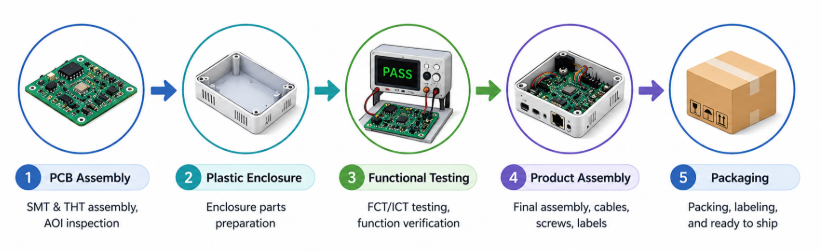
If the RFQ includes box build assembly or final product assembly, buyers should provide more than PCB files.
Useful information includes:
- 3D drawings of the enclosure
- 2D drawings with tolerances, if available
- Plastic housing material
- Surface finish requirements
- Assembly drawing
- Screw and fastener details
- Cable and wire harness requirements
- Connector details
- Labeling requirements
- Product photos or reference samples
- Functional testing steps
- Packaging method
- Accessory list
- User manual or insert requirements, if any
For box build projects, the supplier needs to understand how the PCB fits into the enclosure, how cables are routed, how connectors align with openings, how the product will be tested, and how it should be packed.
This is important because many production problems are not caused by the PCB itself. They happen at the integration stage.
Common examples include:
- PCB does not align with enclosure bosses
- Connector position does not match housing opening
- Cable routing interferes with closing the enclosure
- Screws are difficult to install during production
- Test points are blocked after assembly
- Product cannot be tested efficiently after final assembly
- Packaging does not protect the finished unit properly
If the supplier supports both PCB assembly and product assembly, sharing complete mechanical and assembly information early can help identify these risks before production.
9. Quality Standards and Compliance Requirements
Quality and compliance requirements should not be left until the end of the project. They should be included in the RFQ if they affect materials, production process, inspection, documentation, or shipment.
Buyers may need to specify:
- IPC class requirement, if applicable
- RoHS requirement
- REACH requirement
- ESD control requirement
- Traceability requirement
- Inspection report requirement
- Functional test report requirement
- Material certificate requirement
- First article inspection requirement
- Packaging inspection requirement
- Special customer quality standard
Not every project needs the same level of documentation. A consumer prototype may not require the same control as a medical-related device, industrial controller, or automotive electronics project.
However, if certain documents or standards are required, the supplier needs to know early. Documentation, traceability, inspection records, and compliance-related material control may affect project management and cost.
For international buyers, it is better to include compliance expectations in the RFQ instead of assuming the supplier already knows the final market requirements. For products entering the EU market, buyers may need to confirm RoHS requirements for electrical and electronic equipment during the RFQ stage.
Quality and compliance requirements can also be included in the PCB assembly RFQ checklist when the product needs specific inspection records, material control, or documentation before shipment.
10. Delivery, Packaging, and Shipping Requirements
Delivery requirements can also affect the quote. A PCB assembly supplier needs to know not only how many units to build, but also how they should be packed and shipped.
Buyers should clarify:
- Target delivery date
- Delivery location
- Shipping method, if known
- Whether partial shipment is acceptable
- Packaging type
- Anti-static packaging requirements
- Carton labeling requirements
- Export packaging requirements
- Finished product packaging requirements
- Batch delivery plan
- Special handling requirements
For bare PCB assemblies, anti-static packaging may be enough. For finished products, packaging may include product protection, labels, manuals, accessories, cartons, pallets, and shipment preparation.
Packaging should not be treated as an afterthought. Poor packaging can damage products after they pass production testing. If the product is already assembled into a complete device, packaging becomes part of the final delivery quality.
Delivery and packaging details may look simple, but they belong in the PCB assembly RFQ checklist when the supplier is also responsible for final assembly, finished product packing, or export shipment preparation.
Common RFQ Mistakes That Delay PCB Assembly Quotes
Many RFQ delays come from small missing details. These issues are common, especially when the buyer is still moving from design to production.
A PCB assembly RFQ checklist can prevent many of these delays by reminding buyers what information should be prepared before requesting a quote.
Here are some RFQ mistakes that often slow down the quotation process:
Sending only photos instead of production files
A photo can help the supplier understand the product, but it cannot replace Gerber files, BOM, or assembly data.
BOM missing manufacturer part numbers
Without exact part numbers, the supplier may not be able to check availability, price, or approved alternatives.
Quantity not confirmed
A quote for 20 pieces is very different from a quote for 2,000 pieces. Even an estimated quantity range is better than no quantity.
Testing requirements not defined
If the buyer expects functional testing, programming, or final product testing, these requirements should be mentioned before quotation.
Not clarifying turnkey or consigned assembly
The quote structure changes depending on whether the supplier buys all components, the buyer supplies all components, or both sides share sourcing responsibility.
No enclosure or assembly drawing for box build projects
If final assembly is required, the supplier needs mechanical and assembly information, not only PCB files.
No target lead time
If the delivery schedule is urgent, the supplier needs to check component availability, production capacity, and testing time early.
Compliance requirements mentioned too late
RoHS, REACH, ESD, traceability, and inspection reports should be discussed at the RFQ stage if they are required.
BOM changes after quotation without revision notes
If the BOM changes, the buyer should highlight revisions clearly. Otherwise, old and new quotation versions can become confusing.
A good RFQ does not need to be perfect, but it should be clear enough for the supplier to understand the project scope.
Prototype RFQ vs Mass Production RFQ: What Changes?
A prototype RFQ and a mass production RFQ should not be prepared in the same way. The project stage changes what the supplier needs to evaluate.
| RFQ Area | Prototype Stage | Mass Production Stage |
|---|---|---|
| Main goal | Design validation | Stable output and cost control |
| Quantity | Low volume | Higher volume |
| BOM | May change often | Should be stable and controlled |
| Testing | Basic functional validation | Defined test procedure |
| Cost focus | Speed and flexibility | Unit cost, yield, and repeatability |
| Documentation | May be incomplete | Should be controlled and updated |
| Supplier role | Engineering feedback | Process control and delivery stability |
| Packaging | Often simple | Should match final shipment needs |
During the prototype stage, it is normal for the design to change. The supplier may help identify assembly risks, sourcing problems, or manufacturability issues.
During mass production, changes should be controlled more carefully. BOM revisions, firmware versions, test requirements, labels, packaging, and inspection standards should be clearly managed.
If buyers want a production-ready quote, the RFQ should be prepared with production-level information.
Copyable PCB Assembly RFQ Template
Buyers can use the PCB assembly RFQ checklist below as a simple template when preparing files for a new PCB assembly, PCBA, or box build project.
Project Information
- Product name:
- Product application:
- Project stage: Prototype / Pilot production / Mass production
- Estimated order quantity:
- Estimated annual quantity:
- Target delivery date:
- Delivery country or region:
PCB Information
- Gerber files attached: Yes / No
- Drill files attached: Yes / No
- Board layers:
- Board size:
- PCB material:
- Board thickness:
- Copper thickness:
- Surface finish:
- Solder mask color:
- Silkscreen color:
- Controlled impedance required: Yes / No
- Special PCB requirements:
BOM and Component Information
- BOM attached: Yes / No
- Manufacturer part numbers included: Yes / No
- Approved alternatives included: Yes / No
- Component sourcing method: Turnkey / Consigned / Mixed
- Critical components:
- Components with no substitution allowed:
- Special sourcing notes:
Assembly Information
- Assembly type: SMT / Through-hole / Mixed
- Pick and Place file attached: Yes / No
- Assembly drawing attached: Yes / No
- Single-sided or double-sided assembly:
- Hand soldering required: Yes / No
- Connectors, cables, or mechanical parts:
- Conformal coating required: Yes / No
- Programming required: Yes / No
- Special assembly notes:
Testing Requirements
- Visual inspection:
- AOI:
- ICT:
- Functional testing:
- Programming:
- Aging or burn-in test:
- Test fixture required:
- Test procedure attached:
- Acceptance criteria:
Box Build Information, If Applicable
- Enclosure drawing attached:
- Plastic housing material:
- Surface finish:
- Screws or fasteners:
- Cable or wire harness:
- Labeling requirements:
- Final product testing:
- Packaging method:
- Accessories included:
Quality and Compliance
- RoHS required:
- REACH required:
- IPC class requirement:
- ESD control requirement:
- Traceability required:
- Inspection report required:
- Test report required:
- Material certificate required:
- Other compliance requirements:
For PCB assembly projects, buyers may also refer to the IPC-A-610 acceptability standard when defining assembly quality expectations.
Packaging and Shipping
- Packaging type:
- Anti-static packaging:
- Carton labeling:
- Export packaging:
- Partial shipment acceptable:
- Preferred shipping method:
- Shipping destination:
This template does not need to be filled out perfectly before the first discussion. But the more information a buyer can provide, the more accurate and useful the first quotation will be.
How Cindy Mould Supports PCB Assembly RFQ Review
CINDY MOULD supports electronics manufacturing projects that require more than PCB assembly alone. Many projects we review involve a combination of PCB assembly, component sourcing, plastic enclosures, functional testing, product assembly, packaging, and shipment preparation.
When customers send a complete PCB assembly RFQ checklist, our engineering team can review the project scope more efficiently.
During RFQ review, our team can help check whether the provided files are complete, whether the BOM has sourcing risks, whether the PCB and enclosure need further DFM review, and whether the testing or assembly process requires additional clarification.
For projects involving final product assembly, it is especially helpful to provide both electronic and mechanical information at the beginning. This allows our engineering team to review how the PCB, enclosure, cables, connectors, screws, labels, and test process work together before production begins.
A complete RFQ helps us evaluate:
- PCB fabrication and assembly requirements
- BOM and component sourcing risks
- SMT and through-hole assembly process
- Functional testing needs
- Plastic enclosure integration
- Final product assembly steps
- Packaging and delivery requirements
- Potential manufacturing risks before production
For OEM electronics projects, early communication can prevent many problems that would otherwise appear during trial production or mass production.
Conclusion: A Better RFQ Leads to a More Accurate Quote
A PCB assembly quote is only as accurate as the information behind it. If the RFQ is missing BOM details, Gerber files, quantities, testing requirements, assembly instructions, or packaging expectations, the supplier may only be able to provide a rough estimate.
For simple PCB assembly, buyers should prepare at least the BOM, Gerber files, Pick and Place file, PCB specifications, quantity, and testing requirements.
For projects involving box build assembly or final product delivery, buyers should also provide enclosure drawings, assembly details, cable information, functional testing instructions, labeling requirements, and packaging expectations.
A complete RFQ does not only help the supplier quote faster. It helps both sides understand the real project scope, identify production risks earlier, and move from inquiry to manufacturing with fewer surprises.
A well-prepared PCB assembly RFQ checklist helps both the buyer and the supplier reduce assumptions, confirm the real project scope, and move from inquiry to production with fewer delays.
If your project requires PCB assembly, plastic enclosure integration, functional testing, or final product assembly, you can contact our team for a PCB assembly quote and send us your BOM, Gerber files, quantity, testing requirements, and assembly details.