
Introduction: Component Sourcing Is Where Most Projects Quietly Fail
Component sourcing challenges in electronics manufacturing are no longer just procurement issues—they have become critical risks that directly impact production timelines, product quality, and overall project success.
A product may be well-designed.
The PCB layout may be optimized.
The assembly process may be stable.
Yet the project still fails.
Why?
Because a single sourcing issue—an unavailable MCU, a counterfeit IC, or an unstable supplier—can quietly disrupt everything. These real-world risks highlight how component sourcing challenges can silently impact even the most well-prepared projects.
In today’s environment, component sourcing has evolved from a purchasing activity into a strategic capability that directly determines whether a product can be delivered on time, within budget, and at the expected quality level.
This is especially true for companies relying on external manufacturing partners. Without a robust sourcing system, risks multiply across the entire production lifecycle.
In this article, we break down 7 critical component sourcing challenges—not just what they are, but why they happen, how they impact real projects, and how leading manufacturers solve them.
For companies looking to improve overall production efficiency, understanding how electronics manufacturing services integrate sourcing, assembly, and quality control is equally important.

What Are Component Sourcing Challenges in Electronics Manufacturing?
Component sourcing challenges refer to the various risks and difficulties involved in sourcing electronic components, including supply instability, long lead times, and quality concerns. In modern electronics manufacturing, these component sourcing challenges are becoming increasingly complex due to global supply chain disruptions and rising demand uncertainty.
1. Supply Chain Instability Is No Longer an Exception—It’s the New Normal
What’s Really Happening
Global electronics supply chains are no longer predictable systems, as highlighted by insights from McKinsey & Company.
They are dynamic, fragile networks influenced by:
- Regional manufacturing concentration (e.g., semiconductor hubs)
- Political and trade uncertainties
- Sudden demand spikes (consumer electronics, automotive, AI hardware)
What used to be “rare disruptions” are now recurring events.
Why This Becomes a Problem
Most companies still operate with:
- Single-source dependencies
- Minimal buffer stock
- Reactive procurement strategies
This creates a system where any disruption immediately becomes a production problem. In reality, this is one of the most common component sourcing challenges affecting modern manufacturers.
Real-World Impact
- Production lines stop waiting for one missing component
- Project timelines shift unpredictably
- Customers lose confidence
How Advanced Manufacturers Solve It
Instead of reacting to shortages, mature EMS providers design resilient sourcing systems:
- Dual or multi-sourcing strategies for critical components
- Dynamic safety stock models based on risk level
- Supplier tier classification (primary / backup / emergency)
At CINDY Mould, sourcing decisions are aligned with production planning—not treated as a separate function—ensuring continuity even under unstable supply conditions.
2. Long Lead Times Are Not Just Delays—They Are Planning Failures
The Hidden Issue
Long lead times are often blamed on suppliers, but the real issue is late visibility.
By the time procurement starts:
- The design is already finalized
- The BOM is fixed
- Alternatives are no longer viable
Why This Is Dangerous
Critical components such as:
- Microcontrollers (MCUs)
- Power management ICs
- Communication modules
can have lead times extending beyond 6–12 months. Long lead times remain one of the most critical component sourcing challenges for electronics manufacturers today.
At that point, you are no longer managing supply—you are waiting for it.
The Real Cost
- Missed product launch windows
- Lost revenue opportunities
- Increased pressure for costly last-minute sourcing
How to Solve It Strategically
Leading manufacturers shift sourcing earlier into the product lifecycle:
- BOM risk analysis during design phase
- Pre-qualification of alternative components
- Forecast-driven procurement before production starts
| Strategy | What It Solves | Result |
|---|---|---|
| Early BOM review | Late sourcing issues | Faster readiness |
| Alternate part validation | Supply risk | Flexibility |
| Forecast procurement | Lead time pressure | Stable delivery |
3. Counterfeit Components: The Invisible Risk That Destroys Reliability
Why This Problem Is Growing
When supply is tight, the market fills with:
- Unauthorized brokers
- Grey market suppliers
- Recycled or remarked components
These components often pass visual inspection but fail under real operating conditions.
Why It’s So Dangerous
Unlike sourcing delays, counterfeit risks are not immediately visible. Ensuring component authenticity is another major component sourcing challenges companies must address.
They show up later as:
- Intermittent failures
- Field returns
- System instability
The Real Impact
- Warranty costs increase
- Product recalls become possible.In many cases, these failures are closely related to issues in the PCB assembly process, where poor-quality or counterfeit components can directly lead to defects and performance instability.
- Brand reputation suffers long-term damage
How High-Quality EMS Providers Control This
- Strict approved vendor list (AVL)
- Incoming inspection + functional verification
- Full component traceability system
More importantly, experienced manufacturers avoid risky sourcing channels entirely, even under pressure.
4. Cost Fluctuations Are a Strategy Problem, Not a Market Problem
What Most Companies Think
“Component prices are unstable—we just have to accept it.”
What Actually Happens
Cost fluctuations are amplified when:
- Procurement is reactive
- Suppliers are not strategically managed
- Design is not optimized for cost
The Hidden Cost Layer
Beyond unit price, companies lose money through:
- Frequent redesigns
- Urgent sourcing premiums
- Inventory inefficiencies
How to Solve It Like an Advanced Manufacturer
- Design-to-cost engineering
- Long-term supplier agreements
- Volume-based negotiation strategies
The key is shifting from price-based sourcing → cost-structured sourcing. Without a structured approach, cost volatility becomes one of the persistent component sourcing challenges in large-scale production.
5. Supplier Communication Breakdowns Create Hidden Production Risks
The Overlooked Reality
Many sourcing issues are not caused by shortages—but by misalignment of information.
Common problems include:
- Incorrect specifications
- Unclear delivery expectations
- Delayed updates
Poor coordination can further increase component sourcing challenges across the supply chain.
Why This Happens
Because sourcing is often:
- Fragmented across teams
- Managed manually
- Lacking real-time data systems
The Result
- Wrong components delivered
- Production interruptions
- Increased operational chaos
How Leading EMS Providers Fix This
- Centralized communication protocols
- Dedicated sourcing management roles
- ERP-integrated real-time supply visibility
6. Lack of Traceability Turns Small Issues Into Major Failures
What Most Companies Overlook
Traceability is often seen as a “compliance requirement”—not a business necessity.
Why It Matters More Than You Think
When issues occur:
- Can you identify which batch is affected?
- Can you trace it back to a supplier?
- Can you isolate the problem quickly?
If not, the only option is often:
👉 Replace everything
The Real Risk
- High recall costs
- Inability to perform root cause analysis
- Loss of customer trust
How to Build a Robust Traceability System
- Component-level barcode tracking
- Supplier and batch documentation
- Integrated quality + sourcing data systems
7. Engineering and Procurement Misalignment Is the Root Cause of Many Failures
This Is the Most Critical—but Most Ignored—Challenge
In many organizations:
- Engineering designs the product
- Procurement sources the components
But they don’t work together.
What Goes Wrong
- Engineers select components based on performance only
- Procurement cannot find those components
- Projects get delayed or redesigned
Without alignment, component sourcing challenges become even more difficult to manage.
Why This Happens
Because sourcing is treated as a post-design activity, not a design constraint.
How Advanced EMS Solves This
- Integrating DFM (Design for Manufacturability)
- Running design + sourcing reviews simultaneously
- Building cross-functional engineering-procurement teams
At CINDY Mould, sourcing is integrated into the manufacturing process from the beginning—ensuring that every design decision is also a supply-ready decision.
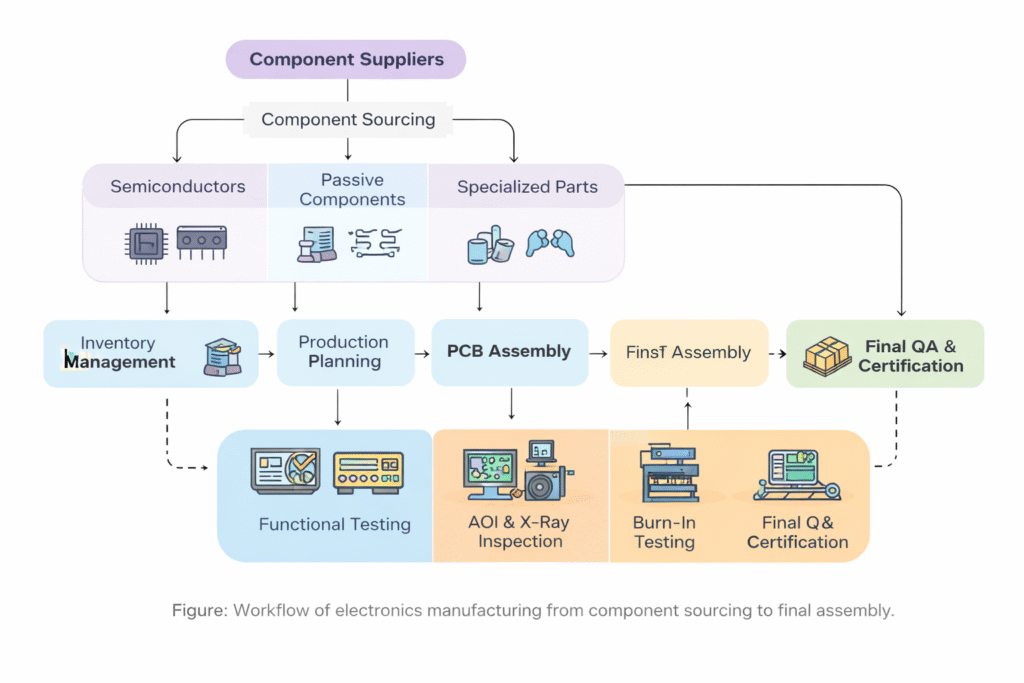
Summary: From Reactive Sourcing to Strategic Capability
These component sourcing challenges are interconnected and require a structured, strategic approach to solve effectively.
| Challenge | Root Cause | Strategic Solution |
|---|---|---|
| Supply instability | Over-reliance on single sources | Multi-sourcing strategy |
| Long lead times | Late sourcing involvement | Early-stage planning |
| Counterfeit risk | Uncontrolled suppliers | Strict vendor system |
| Cost fluctuation | Reactive procurement | Cost-driven strategy |
| Communication gaps | Fragmented systems | Process integration |
| Traceability issues | Lack of tracking | Full visibility system |
| Misalignment | Siloed teams | Integrated workflow |
Conclusion
Component sourcing challenges are not temporary—they are structural realities of modern electronics manufacturing.
The difference between successful and failed projects often comes down to one factor:
👉 Whether sourcing is treated as a strategy—or just a task.
Understanding and addressing component sourcing challenges is essential for achieving stable, efficient, and scalable production outcomes.
To achieve reliable production results, integrating sourcing with final box build assembly is essential for delivering complete and high-quality electronic products.
FAQ: Component Sourcing in Electronics Manufacturing
1. What is the biggest risk in component sourcing today?
The biggest risk is supply chain instability combined with limited visibility. Companies often realize shortages too late, leaving no time to react effectively.
2. How early should sourcing be involved in product development?
Sourcing should be involved at the design stage, especially during BOM creation. Early involvement allows for alternative component planning and risk reduction.
3. How can companies avoid counterfeit components?
- Work only with authorized distributors
- Implement strict inspection processes
- Avoid grey market sourcing
4. Why do long lead times happen even with common components?
Because demand spikes, supply constraints, and production concentration can affect even widely used parts.
5. What role does EMS play in component sourcing?
A strong EMS provider:
- Manages supplier networks
- Controls sourcing risks
- Integrates sourcing with production
6. What is the difference between sourcing and procurement?
- Procurement = buying components
- Sourcing = managing supply strategy, risk, and supplier relationships
7. How can companies improve sourcing efficiency quickly?
- Centralize sourcing processes
- Improve supplier communication
- Use data-driven planning