
Introduction: Speed Is Not the Only Goal
Rapid prototyping in electronics manufacturing is often associated with speed.
Faster samples.
Faster iterations.
Faster time-to-market.
But speed alone does not guarantee success.
A prototype that is built quickly but fails to reflect real production conditions can introduce hidden risks into the development process.
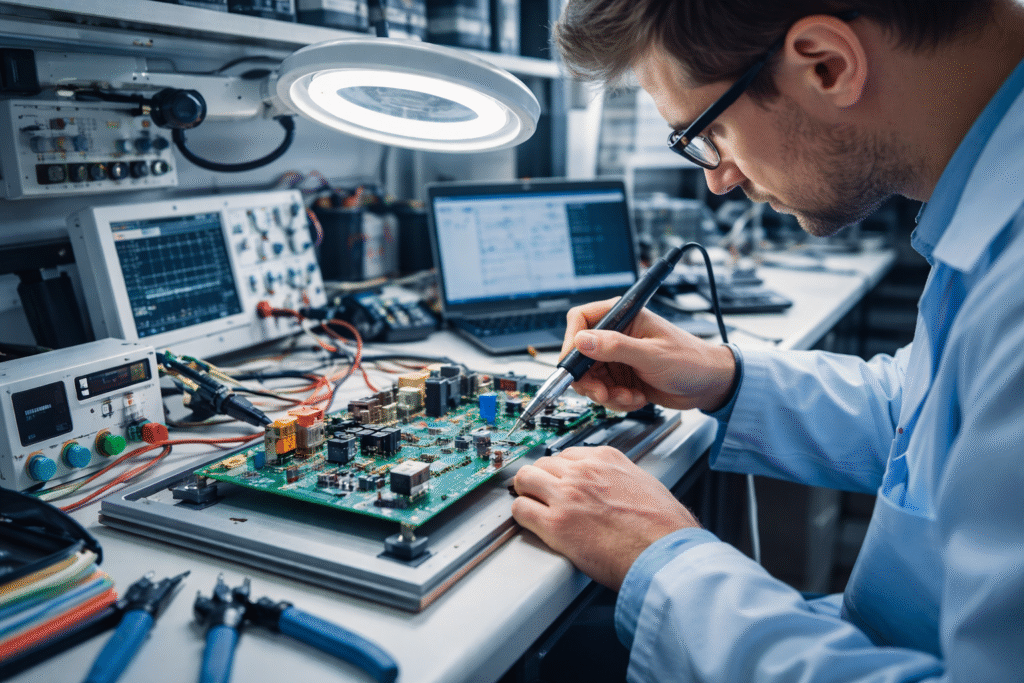
Engineering teams may validate the design during early testing.
However, manufacturing issues often emerge later — especially when the product transitions into volume production.
This is because rapid prototyping in electronics manufacturing does not only test whether a product works.
It tests whether a product can work consistently under real manufacturing constraints.
As electronic products become more complex — integrating PCB design, firmware, communication interfaces, and mechanical structures — the gap between prototype validation and production reality becomes more visible.
This is where rapid prototyping in electronics manufacturing becomes essential.
What Is Rapid Prototyping in Electronics Manufacturing
Rapid prototyping in electronics manufacturing refers to the process of quickly building and evaluating early versions of a product before full-scale production.
It is not limited to a single process.
Instead, it involves coordinated execution across multiple disciplines:
- PCB fabrication
- SMT assembly
- enclosure prototyping
- firmware integration
- functional testing
Unlike mass production, rapid prototyping in electronics manufacturing prioritizes flexibility, iteration speed, and learning efficiency over cost optimization.
The objective is not simply to produce a working sample.
It is to identify potential risks related to design, integration, and manufacturability before those risks become costly during production.
In this sense, rapid prototyping in electronics manufacturing acts as a validation bridge between design intent and manufacturing reality.
Key Objectives of Rapid Prototyping
Rapid prototyping in electronics manufacturing serves several critical objectives that directly influence product success.
Design Validation
Ensures that electrical functionality, signal behavior, and system logic operate as expected.
Fit and Assembly Verification
Confirms that PCB layout, enclosure design, connectors, and fastening structures align correctly during assembly.
Functional Testing Preparation
Allows early definition of testing strategies, including test points, fixtures, and validation procedures.
Risk Identification
Identifies issues related to tolerance stack-up, thermal performance, EMI interference, and mechanical constraints.
Process Feasibility Assessment
Evaluates whether the product can be manufactured using stable and repeatable processes.
These objectives ensure that rapid prototyping in electronics manufacturing contributes directly to both engineering validation and production readiness.
Types of Prototypes in Electronics Manufacturing
Rapid prototyping in electronics manufacturing is typically structured into several validation stages, each serving a distinct purpose.
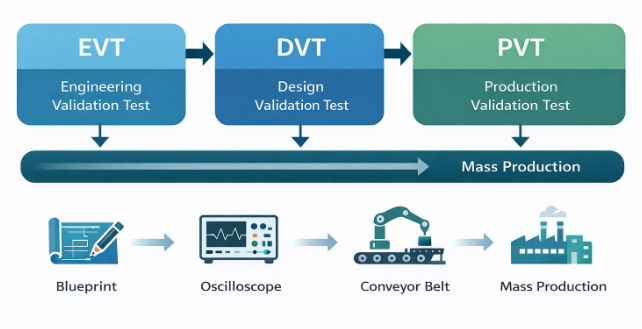
EVT (Engineering Validation Test)
At this stage, the focus is on verifying core functionality and confirming that the initial design concept is viable.
DVT (Design Validation Test)
This stage validates performance under realistic operating conditions, including environmental stress and usage scenarios.
PVT (Production Validation Test)
PVT ensures that the product design is ready for mass production, with stable processes and consistent output quality.
Each stage in rapid prototyping in electronics manufacturing reduces uncertainty and aligns the product closer to real manufacturing conditions.
Skipping or compressing these stages often leads to higher risks during production.
Where Rapid Prototyping Fits in the Product Lifecycle
Rapid prototyping in electronics manufacturing sits between product design and full-scale production.
Concept → Prototype → Validation → Production
However, this process is rarely linear.
In reality, rapid prototyping in electronics manufacturing is highly iterative.
Design adjustments made during EVT may require redesign before DVT.
Manufacturing issues discovered during DVT may influence tooling or assembly methods before PVT.
This iterative loop is essential.
It allows teams to refine both product design and manufacturing processes before scaling.
Without sufficient iteration, products may pass prototype validation but fail during mass production.
Common Challenges in Rapid Prototyping
Despite its advantages, rapid prototyping in electronics manufacturing introduces several operational and engineering challenges.
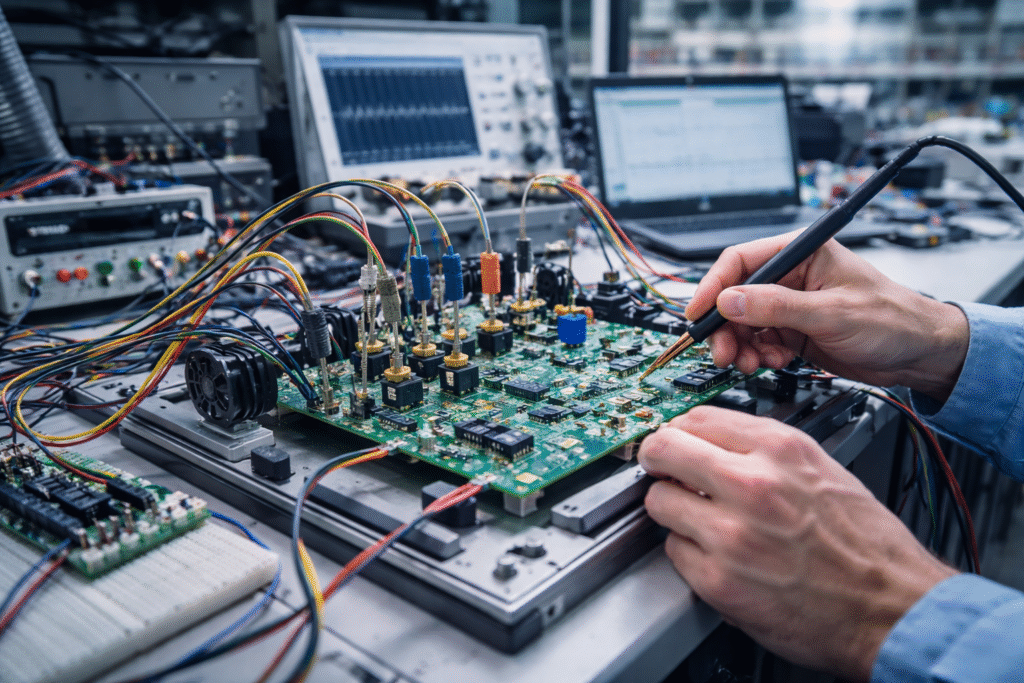
Incomplete Manufacturing Representation
Prototype builds often differ from real production environments.
- Manual assembly replaces automated processes
- Alternative materials may be used
- Tooling is simplified or temporary
This creates a gap between prototype validation results and actual production performance.
Limited Testing Coverage
Testing during rapid prototyping in electronics manufacturing is often incomplete.
- Edge cases may not be fully simulated
- Long-term reliability is rarely evaluated
- Test fixtures may not be finalized
As a result, some issues only appear during later production stages.
Iteration Delays
Rapid prototyping depends heavily on fast feedback loops.
However, delays in PCB fabrication, component sourcing, or assembly scheduling can slow down iteration cycles.
This reduces the effectiveness of rapid prototyping.
Cross-Team Misalignment
Rapid prototyping in electronics manufacturing requires coordination between multiple teams.
Electrical, mechanical, and manufacturing teams must align their decisions.
Without coordination, design choices may not reflect production realities, leading to rework and delays.
How Integrated Manufacturing Improves Prototyping
Integrated manufacturing environments significantly improve rapid prototyping in electronics manufacturing by aligning design, testing, and production processes.
Early DFM Integration (Design for Manufacturability)
Manufacturing considerations are incorporated during the design phase.
- PCB layouts are optimized for assembly
- enclosure designs consider tooling constraints
Cross-Functional Collaboration
Teams work within a unified system rather than isolated workflows.
- electrical and mechanical designs are aligned
- assembly and testing processes are coordinated
Faster Iteration Cycles
Integrated manufacturing reduces delays caused by supplier handoffs.
This enables faster feedback and more efficient iteration.
Data Feedback Loops
Data collected during rapid prototyping in electronics manufacturing is used to improve production processes.
- failure patterns are analyzed
- root causes are identified earlier
- design improvements are implemented more effectively
Conclusion
Rapid prototyping in electronics manufacturing is often viewed as a tool for speed.
In reality, its primary value lies in validation.
It ensures that products are not only functional at the prototype stage,
but also capable of achieving stable and scalable production.
Next Steps
If your prototype works but production becomes unstable,
the issue is not speed — it is validation depth.
Rapid prototyping in electronics manufacturing should not be treated as a shortcut.
It should be structured as a system.
Validate early.
Align design with manufacturing.
Reduce the gap between prototype and production.
Because successful products are not defined by how fast they are built.
They are defined by how reliably they scale.
If you are reviewing your prototyping strategy or preparing for production ramp-up,
you are welcome to connect with CINDY Mould to explore practical solutions based on real manufacturing experience.