
Introduction: When Assembly Is Not Enough
Functional testing in electronics manufacturing ensures that products not only pass inspection, but also perform reliably in real-world conditions.
SMT ensures components are placed correctly.
Inspection ensures manufacturing quality.
But neither guarantees that the product actually works.
A product can pass SPI, AOI, and AXI inspection (see our SMT Inspection Strategy: SPI AOI AXI Explained) — yet still fail during power-on, communication, or real-world operation.
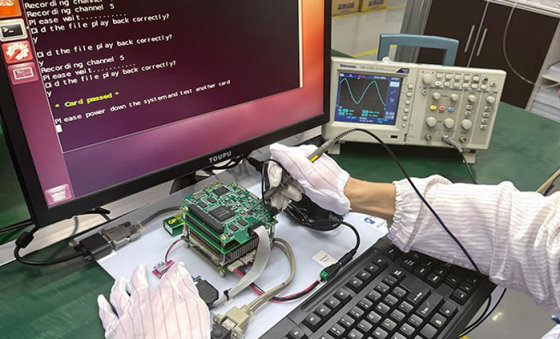
Because manufacturing accuracy does not automatically translate into functional reliability.
As electronic products become more complex, this gap becomes more visible. Modern products integrate PCB design, firmware logic, communication interfaces, mechanical structures, and user interaction.
Each of these layers introduces potential failure points that cannot be detected through visual inspection alone.
This is where functional testing in electronics manufacturing becomes essential.
Functional testing is where manufacturing meets real-world performance.
It validates whether engineering intent has been successfully translated into reliable product behavior.
What Is Functional Testing in Electronics Manufacturing
Functional testing verifies whether an electronic product performs according to its intended design under realistic operating conditions.
Unlike inspection systems that focus on physical defects, functional testing evaluates behavior, interaction, and system response.
In practice, functional testing in electronics manufacturing is used to validate system performance before products move into large-scale production.
It typically includes:
- Power-on initialization and boot sequence validation
- Signal transmission and communication protocol checks
- Input/output response verification
- Performance under simulated real-use conditions
In practical production environments, functional testing involves a combination of test software, hardware fixtures, and measurement systems.
These tools work together to replicate real operating scenarios, allowing engineers to validate how the product behaves under expected conditions.
To better understand its role:
| Testing Method | Focus | What It Detects |
|---|---|---|
| SPI | Solder paste | Printing defects |
| AOI | Appearance | Component placement issues |
| AXI | Internal solder joints | Hidden defects |
| Functional Testing | System behavior | Whether the product actually works |
Functional testing answers a fundamentally different question:
Not “Is it built correctly?” — but “Does it perform correctly in real conditions?”
Types of Functional Testing
Functional testing spans multiple validation layers across the product lifecycle.
Each method targets a different level of functionality, especially in functional testing in electronics manufacturing environments where multiple systems interact.
In-Circuit Test (ICT)
ICT focuses on component-level electrical validation.
- Verifies resistance, capacitance, and connectivity
- Detects missing, misaligned, or defective components
- Ensures PCB-level integrity immediately after SMT
ICT is efficient for early defect detection, but it cannot validate system behavior.
Functional Circuit Test (FCT)
FCT evaluates whether the circuit performs its intended function.
- Simulates actual operating signals
- Verifies logic behavior and signal processing
- Detects functional defects that ICT cannot capture
FCT is a key method within functional testing in electronics manufacturing, especially for validating circuit-level performance.
System-Level Testing
System-level testing evaluates the complete assembled product (see our Box Build Assembly Process in Electronics Manufacturing).
- Includes enclosure, connectors, firmware, and interfaces
- Verifies interaction between hardware and software
- Detects integration-related issues such as interference, timing mismatches, or mechanical constraints
Many field failures originate at this level, making it one of the most critical stages in functional testing in electronics manufacturing.
Burn-In Testing
Burn-in testing applies stress conditions over time.
- Elevated temperature, voltage, or continuous operation
- Identifies early-life failures (infant mortality)
- Screens out weak components before shipment
This method strengthens long-term reliability in functional testing in electronics manufacturing workflows.
Where Functional Testing Fits in Production
Functional testing is not a single checkpoint at the end of production.
It is embedded throughout the manufacturing process.
SMT → Inspection → Functional Test → Assembly → System Test → Final Validation
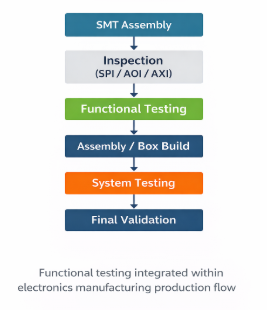
| Stage | Testing Objective |
|---|---|
| Post-SMT | Early electrical validation |
| Post-Assembly | Functional verification |
| System Integration | Full product validation |
| Pre-Shipment | Reliability confirmation |
At each stage, functional testing in electronics manufacturing helps identify issues before they scale into mass production problems.
This multi-layered testing strategy provides several advantages:
- Defects are detected earlier, reducing rework cost
- Root causes are easier to identify
- Production ramp-up becomes more stable
- Product consistency improves across batches
In advanced manufacturing environments, testing is also used as a feedback loop. Data collected during functional testing can reveal trends related to solder quality, component variation, or assembly alignment.
This allows manufacturers to continuously optimize upstream processes.
Testing, therefore, is not an isolated step.
It is a continuous validation system integrated into the production lifecycle.
Common Challenges in Functional Testing
Despite its importance, functional testing often introduces operational challenges that impact production efficiency and consistency.
Incomplete Test Coverage
It is difficult to simulate all real-world scenarios.
- Edge cases may not be tested
- Environmental factors may be excluded
- Rare failures may only appear in field conditions
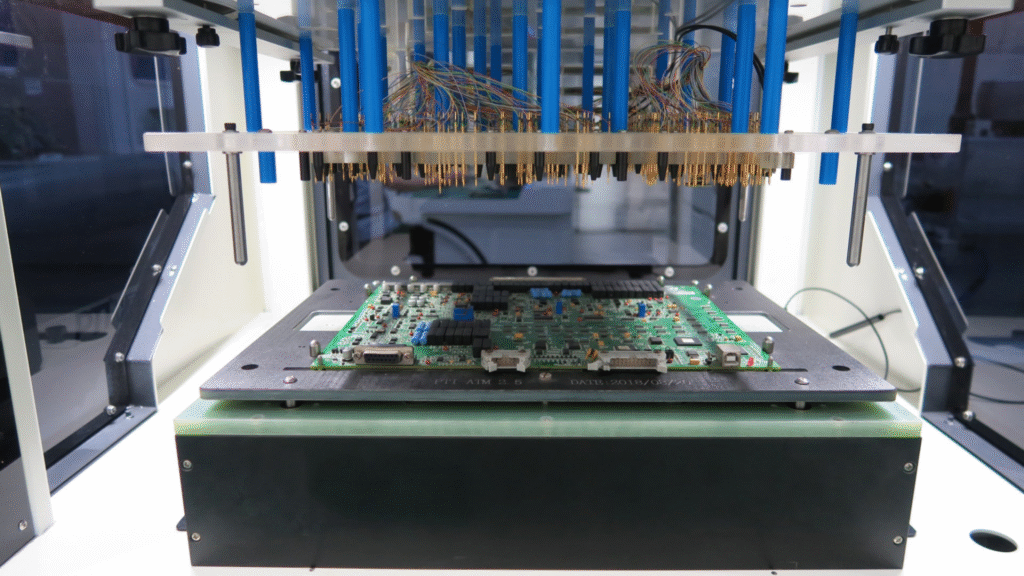
Test Fixture Stability
Functional testing relies on dedicated fixtures.
- Mechanical wear affects repeatability
- Poor contact leads to inconsistent results
- Maintenance requirements increase over time
Cycle Time Constraints
Testing directly impacts production efficiency.
- Longer testing cycles reduce throughput
- Complex products require multiple test steps
Inconsistent Standards Across Suppliers
In multi-vendor manufacturing models:
- Testing criteria vary between suppliers
- Data formats are not aligned
- Results are difficult to compare
These challenges show that even functional testing in electronics manufacturing requires system-level coordination.
How Integrated Manufacturing Improves Testing
Integrated manufacturing environments improve how functional testing in electronics manufacturing is implemented and controlled (see our guide on Integrated Manufacturing Systems).
Design for Testability (DFT)
Testing is considered early in product design.
- Test points are predefined during PCB layout
- Accessibility for probing is ensured
Cross-Disciplinary Alignment
Electrical, mechanical, and manufacturing teams collaborate.
- Enclosure design supports testing access
- Assembly aligns with testing requirements
Data Feedback Loops
Testing data is actively used.
- Failure trends are analyzed
- Processes are continuously optimized
Unified Testing Standards
Standardization improves consistency.
- Comparable data across suppliers
- Stronger traceability
In this environment, functional testing in electronics manufacturing becomes a core control mechanism for production stability.
Conclusion
Functional testing is often viewed as the final checkpoint before shipment.
In reality, effective functional testing in electronics manufacturing ensures that products are not only built correctly, but also perform reliably in real-world conditions.
Next Steps
If products are passing inspection but still failing in use, the gap is not in manufacturing — it is in validation.
Functional testing should not be treated as a final checkpoint.
It should be planned as part of the system.
Review your test coverage.
Align testing with design.
Ensure consistency across production stages.
Because reliability is not tested at the end.
It is built into the process.