
Introduction
Why Small Tolerances Can Create Big Assembly Problems
Modern electronics products are rarely manufactured through a single process. Instead, they are produced through a combination of specialized manufacturing disciplines such as PCB fabrication, SMT assembly, injection molding, mechanical machining, and final product assembly.
Each of these processes introduces its own dimensional tolerances.
Individually, these tolerances may appear small and well controlled. However, when multiple components are assembled together, small dimensional variations from each process can accumulate.
This phenomenon is commonly known as tolerance stack-up.
In electronics product development, tolerance stack-up is one of the most common causes of unexpected assembly problems, alignment issues, and production instability.
These dimensional interactions often become visible when multiple production stages meet during manufacturing, creating broader manufacturing challenges across the product development process.
Many engineering teams focus heavily on electrical functionality or structural strength during product development. However, when the product moves from design validation to large-scale production, dimensional interaction between different components often becomes the hidden factor influencing manufacturing efficiency.
Understanding how tolerance stack-up occurs is essential for improving product design and ensuring stable manufacturing processes.
What Is Tolerance Stack-Up?
Tolerance stack-up refers to the accumulation of dimensional variation when multiple components are assembled together.
Every manufactured component has an allowable dimensional tolerance. These tolerances are necessary because no manufacturing process can produce perfectly identical parts every time.
In electronics product manufacturing, typical tolerances may include:
- PCB mounting hole position tolerance
- injection molded housing dimensional tolerance
- connector alignment tolerance
- screw boss location tolerance
- metal bracket machining tolerance
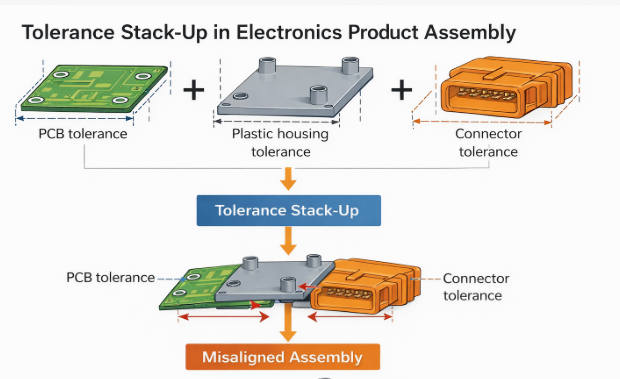
Individually, each component may fall within its acceptable dimensional limits. However, when several parts are assembled together, their combined dimensional variation can shift the final assembly beyond the intended alignment range.
For example, a small positional deviation of a PCB mounting hole combined with a small shift in a plastic housing boss location may cause screws to become difficult to insert during assembly.
These interactions may seem minor during design review but can create significant manufacturing challenges once production begins.
Where Tolerance Stack-Up Appears in Electronics Products
Tolerance stack-up can occur in several critical areas of electronics product assembly.
Understanding these areas helps engineers anticipate potential problems earlier in development.
PCB Mounting Alignment
One of the most common tolerance stack-up issues occurs between PCB mounting holes and plastic enclosure bosses.
PCBs typically have tight positional tolerances for mounting holes. At the same time, injection molded plastic housings also have dimensional tolerances associated with the molding process.
Many of these dimensional variations originate from early mold design decisions that influence housing accuracy during mass production.
When these tolerances accumulate in opposite directions, the PCB may no longer align perfectly with the enclosure structure. Assembly operators may then need to apply additional force to insert screws, which can introduce mechanical stress into the PCB.
Over time, this stress may influence long-term product reliability.
Connector Position Misalignment
Connector positioning is another area highly sensitive to tolerance accumulation.
Many electronics products expose connectors such as USB ports, power connectors, or communication interfaces through openings in the product enclosure.
If tolerance stack-up causes the PCB to shift even slightly within the housing, the connector may no longer align perfectly with the enclosure opening.
This misalignment can lead to:
- cosmetic appearance issues
- difficulty inserting cables
- mechanical wear on connector components
In high-volume production environments, even small alignment errors can significantly affect product consistency.
Structural Deformation During Assembly
Tolerance stack-up can also create hidden stress within the product structure.
If internal components do not align properly, assembly screws may force the housing to flex slightly in order to complete assembly.
Although this deformation may not be immediately visible, it can create internal stress in the housing material.
Over time, repeated mechanical stress or temperature variation may cause cracks, deformation, or structural fatigue in plastic components.
Why Tolerance Stack-Up Often Appears During Production
Tolerance stack-up problems are sometimes difficult to detect during early prototype stages.
During prototype builds, engineering teams often assemble products manually. Engineers and technicians can compensate for minor alignment issues by adjusting component positions or modifying assembly procedures.
These temporary adjustments allow prototypes to function properly during early design validation.
However, once production begins and volumes increase, manual adjustments are no longer feasible.
Production lines require consistent and repeatable assembly operations. If tolerance stack-up has not been properly considered during product design, several manufacturing challenges may appear:
- increased assembly time
- inconsistent product alignment
- higher defect rates
- recurring troubleshooting during production
These problems often become visible during production ramp-up, when manufacturing systems transition from small batch builds to continuous production cycles.
Engineering Methods to Reduce Tolerance Stack-Up Risk
Reducing tolerance stack-up requires coordination between electrical engineering, mechanical design, and manufacturing engineering.
Several engineering practices can help minimize these risks.
Cross-Disciplinary Design Reviews
One effective approach is to conduct design reviews involving both electrical and mechanical engineering teams.
PCB layout decisions, connector positions, and mounting hole locations should be evaluated together with enclosure structures and assembly methods.
Early collaboration allows engineers to identify potential alignment conflicts before tooling or production begins.
Tolerance Analysis During Product Design
Tolerance stack-up analysis is a useful engineering method for evaluating dimensional variation within product assemblies.
Engineers can simulate worst-case tolerance scenarios to determine whether components will still align correctly when dimensional variation occurs.
This type of analysis is especially important in products that involve multiple manufacturing processes such as PCB fabrication and injection molding.
Design for Assembly (DFA)
Design for Assembly principles can significantly reduce tolerance-related risks.
Examples of DFA improvements include:
- using slotted mounting holes to allow minor positional adjustment
- providing sufficient clearance around connectors
- designing flexible alignment features
- optimizing screw boss locations in plastic housings
These design adjustments can greatly improve assembly robustness while maintaining product performance.
The Role of Integrated Manufacturing
In integrated manufacturing environments where PCB fabrication, tooling development, and assembly engineering operate within a coordinated system, tolerance stack-up problems can often be identified earlier.
Integrated manufacturing teams allow engineers from different disciplines to evaluate how their design decisions influence downstream production stages.
For example:
- PCB engineers can review enclosure mounting structures
- tooling engineers can evaluate injection molding tolerance capability
- assembly engineers can assess accessibility and alignment during product assembly
When these teams collaborate during product development, many tolerance-related risks can be addressed before production begins.
Conclusion
Managing Tolerance Stack-Up for Stable Product Assembly
Tolerance stack-up is an inevitable part of multi-process manufacturing.
However, when engineering teams understand how dimensional variations interact across different components, many assembly challenges can be prevented.
By improving coordination between PCB design, enclosure design, and manufacturing engineering, companies can significantly reduce production instability and improve overall product quality.
In electronics product manufacturing, small dimensional variations are unavoidable. What determines manufacturing success is not the absence of variation, but how effectively engineers manage those variations during product design.