
Introduction
Where Manufacturing Problems Often Begin
Modern products rarely depend on a single manufacturing process. Even relatively simple electronic products may require several specialized production stages before reaching final assembly.
A typical product development project may involve multiple disciplines, including PCB fabrication, SMT assembly, injection molding for plastic housings, mechanical assembly, and product testing.
Individually, each process may function correctly. PCB fabrication may meet electrical requirements, injection molded parts may meet dimensional tolerances, and assembly procedures may appear straightforward when evaluated independently.
However, many manufacturing challenges do not originate within a single process.
Instead, they often emerge between processes, where engineering decisions from different disciplines interact during real production.
Understanding these cross-process interactions is essential for identifying manufacturing challenges early and improving production stability while reducing manufacturing risk. In many cases, integrated manufacturing systems help reduce these issues by improving coordination between production stages.
The Growing Complexity of Multi-Process Manufacturing
Modern electronic and mechanical products increasingly combine electrical systems, structural components, and mechanical assemblies within compact designs.
A typical production workflow may involve the following chain:
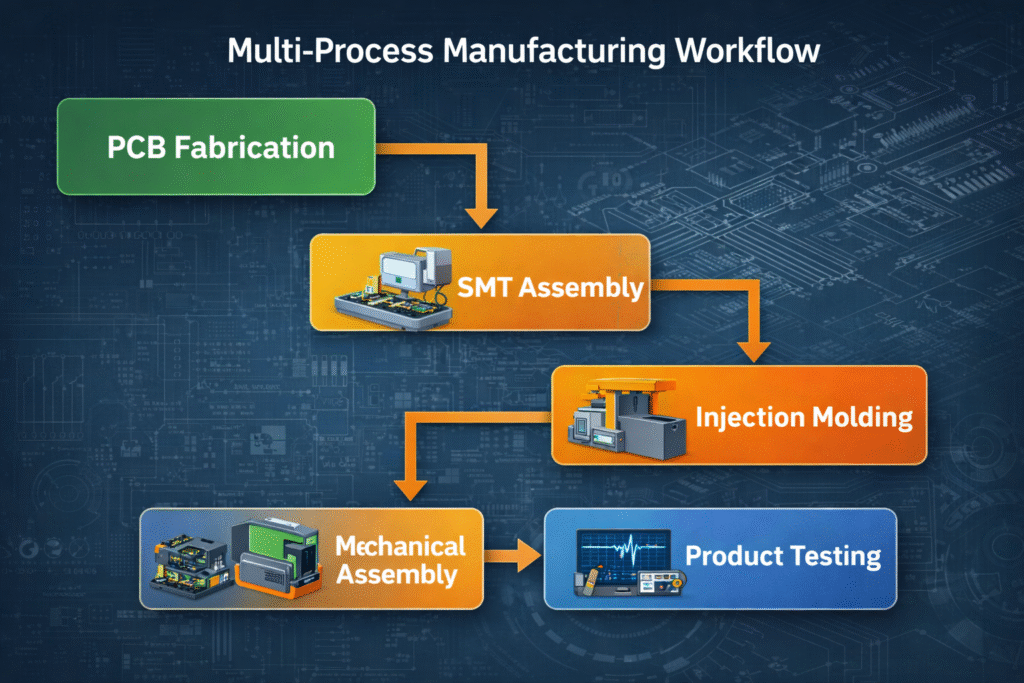
PCB fabrication – producing the circuit board structure
SMT assembly – mounting electronic components
Injection molding – producing plastic housings
Mechanical assembly – integrating structural and electronic components
Functional testing – verifying performance and reliability
Each stage requires specialized engineering expertise.
| Discipline | Primary Focus |
|---|---|
| Electrical engineering | Circuit performance, signal routing, component layout |
| Mechanical engineering | Enclosure design, structural support, mounting systems |
| Manufacturing engineering | Tooling feasibility, production efficiency, process stability |
Individually, each discipline optimizes its own design objectives.
However, once the product enters production, these engineering decisions must function as a single integrated system.
This is where many manufacturing challenges begin to appear as complexity increases.
Where Engineering Decisions Begin to Interact
Many manufacturing challenges appear not because a single process fails, but because design assumptions interact across processes.
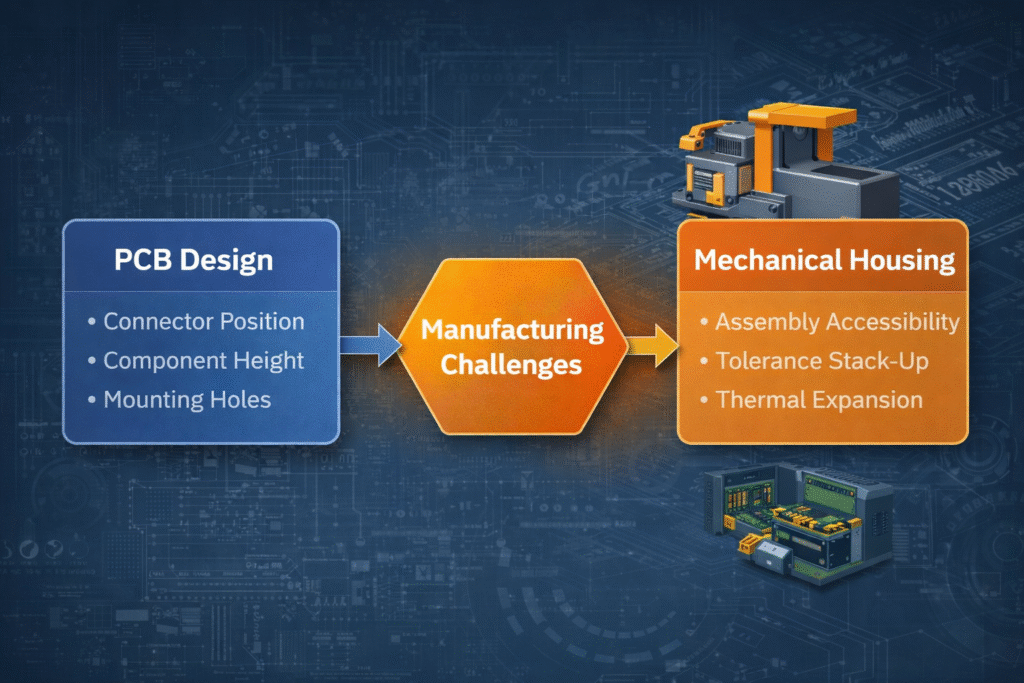
Several common examples illustrate this interaction.
PCB and Mechanical Structure
PCB mounting holes must align precisely with enclosure mounting structures. Even small dimensional deviations can complicate final assembly or introduce stress into the board during fastening.
Connector Accessibility
Connector placement decisions made during PCB layout may affect accessibility during assembly or interfere with mechanical features inside the enclosure.
Component Height Restrictions
Component height limitations must be considered during mechanical enclosure design. Many of these issues originate from early engineering decisions. In injection molding projects, for example, early mold design decisions can significantly influence production yield and long-term stability.In compact products, vertical clearance becomes a critical constraint.
Tolerance Stack-Up
Tolerance stack-up between plastic housings, fasteners, and PCB mounting points can influence product alignment, connector mating, and structural stability.
Material Interaction
Different materials expand at different rates under temperature changes. When plastic housings, metal components, and PCBs interact, thermal behavior can influence long-term product reliability.
These issues rarely appear when each component is evaluated separately. They become visible only when the entire product system is assembled, which is when cross-process manufacturing challenges often surface.
Why Problems Often Appear During Production
During early development stages, engineering teams can often compensate for design inconsistencies.
Prototype builds allow engineers to manually adjust fixtures, reposition components, or adapt assembly procedures.
These temporary adjustments may support early validation builds.
However, once production volume increases, these workarounds become difficult to maintain.
At larger production scale, unresolved design inconsistencies may lead to several operational challenges:
- increased assembly time
- dimensional variation between units
- alignment difficulties during assembly
- recurring troubleshooting on the production line
Small design inconsistencies that appear insignificant during development can gradually evolve into recurring manufacturing challenges.
This is one reason why production ramp-up frequently reveals manufacturing challenges that were not visible during prototype builds.
The Role of Early Engineering Coordination
Effective engineering coordination helps prevent many of these issues before production begins.
Instead of evaluating each process independently, design decisions should be reviewed within the context of the entire manufacturing system.
Common coordination practices include:
- cross-disciplinary design reviews
- tolerance stack-up analysis
- assembly feasibility studies
- early tooling and manufacturing input
When these practices are implemented early in product development, engineering teams can identify potential conflicts before designs are finalized.
Early coordination often leads to:
- fewer engineering changes during production
- improved assembly efficiency
- better dimensional consistency
- shorter development cycles
By addressing potential manufacturing challenges early in development, companies can significantly improve production stability.
Integrated Manufacturing and Cross-Process Visibility
Integrated manufacturing environments often make cross-process coordination easier.
When PCB fabrication, tooling development, and assembly planning operate within a coordinated system, engineering teams gain better visibility into how design decisions affect downstream production stages.
For example:
- tooling engineers can review enclosure designs before mold development
- assembly engineers can evaluate connector accessibility during product development
- manufacturing teams can assess how design choices affect production efficiency
This visibility helps identify potential risks earlier and improves communication between engineering disciplines.
As product complexity increases, the ability to evaluate engineering decisions across the entire manufacturing chain becomes increasingly valuable for reducing long-term manufacturing challenges.
Key Takeaways
Manufacturing challenges rarely originate from a single process failure.
Instead, they often arise from how engineering decisions interact across multiple disciplines.
Important insights include:
- modern products require coordination between electrical, mechanical, and manufacturing engineering
- many production issues appear at the interfaces between processes
- prototype builds may temporarily hide design inconsistencies
- early engineering coordination significantly improves production stability
Manufacturing success therefore depends not only on process capability, but also on cross-process engineering alignment.
Conclusion
Manufacturing Success Depends on Cross-Process Alignment
In modern product development, manufacturing success is rarely determined by the performance of a single process.
Instead, it depends on how effectively engineering decisions from multiple disciplines work together during production.
When electrical design, mechanical design, tooling development, and assembly planning are evaluated in isolation, small inconsistencies can accumulate and eventually appear during manufacturing.
By improving coordination between these engineering domains, companies can reduce production risk, improve product consistency, and build more stable manufacturing systems.
In complex manufacturing environments, successful products are not only well designed — they are well coordinated across the entire production chain.