
Introduction
Integrated Manufacturing is increasingly discussed when companies evaluate manufacturing partners and production strategies—because cost is often the first comparison point.
Tooling price.
Unit cost.
Assembly cost.
These numbers are easy to compare on paper. But for complex products, total production cost rarely comes from a single manufacturing process.
Modern programs often include multiple stages such as PCB fabrication, SMT assembly, injection molding, mechanical assembly, and product testing. Each process may look cost-efficient when evaluated independently.
However, once these stages are handled by different suppliers, additional cost factors begin to appear: transportation delays, engineering coordination overhead, production debugging time, and supply chain complexity.
This is where Integrated Manufacturing can influence cost—not necessarily by lowering the price of every individual step, but by improving how the entire production system operates.
Manufacturing Cost Beyond Individual Processes
Many procurement decisions start with comparing quotations from individual suppliers.
One factory may offer a lower injection molding price.
Another may provide competitive PCB assembly rates.
From a single-process perspective, these options can appear cost-efficient. But when production stages are fragmented across suppliers, hidden cost layers often develop:
- repeated transportation between facilities
- packaging and inventory handling
- scheduling and communication overhead
- longer root-cause analysis cycles when issues appear
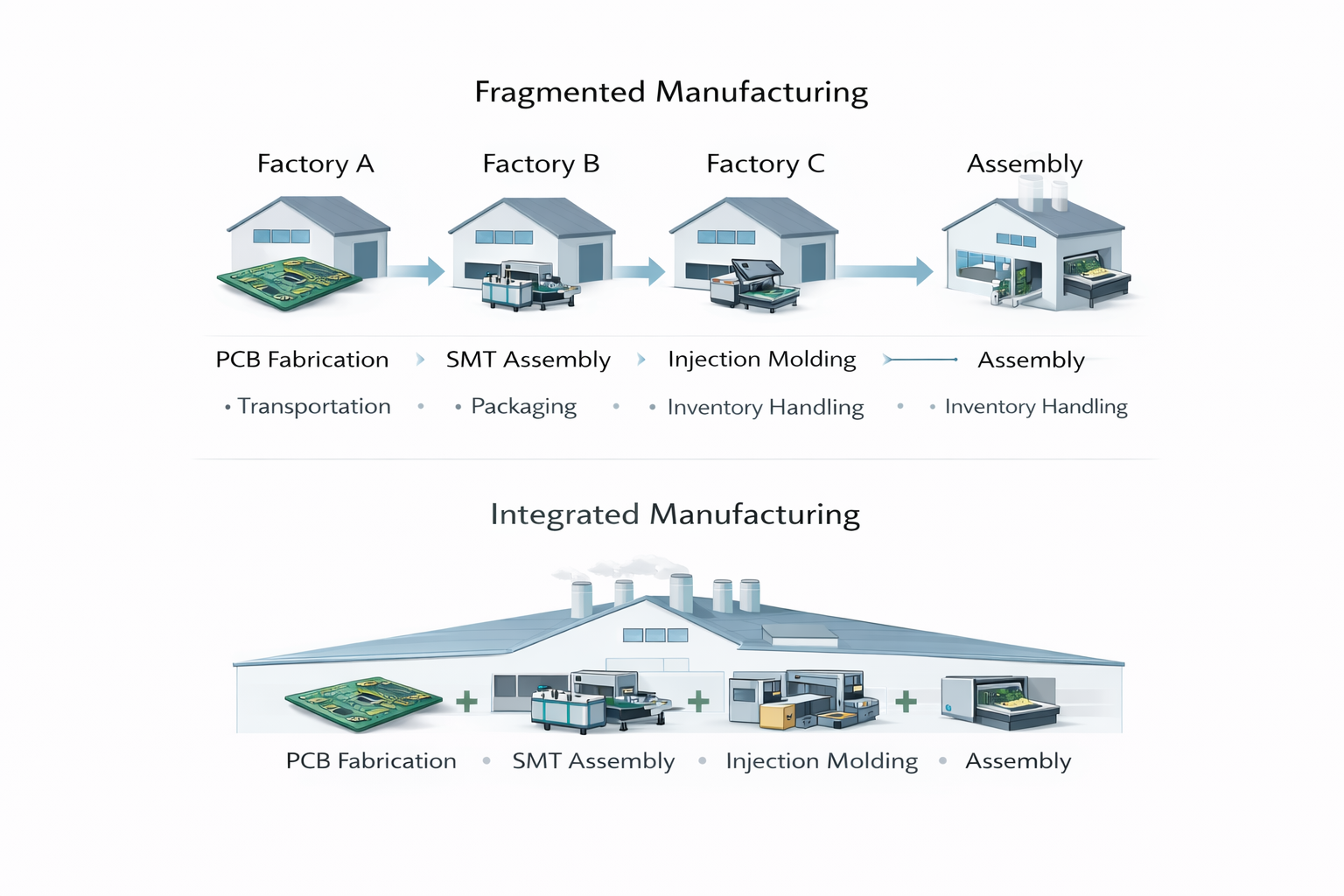
In contrast, Integrated Manufacturing coordinates multiple stages within one unified production structure. That coordination often influences total production cost in several predictable areas.
Integrated Manufacturing and Reduced Logistics Complexity
One of the most visible cost advantages of Integrated Manufacturing comes from reduced logistics.
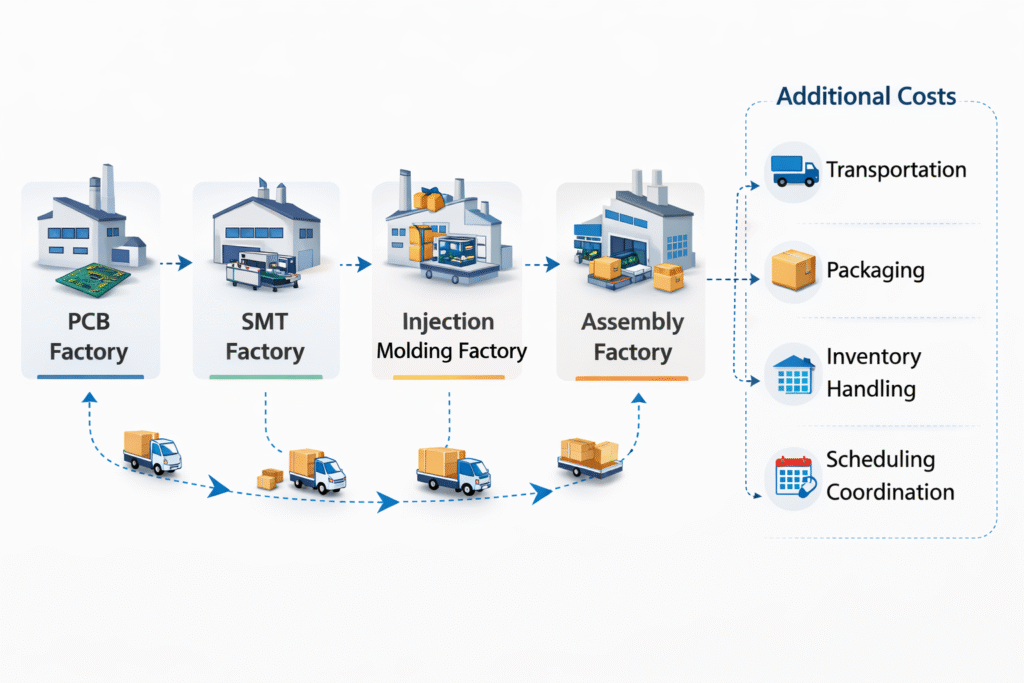
When manufacturing stages are separated, components frequently move between factories. A product may begin with PCB fabrication in one location, move elsewhere for SMT, then ship again for plastic components, and later to a final assembly site.
Each transfer introduces additional cost, including:
- transportation
- packaging
- inventory handling
- scheduling coordination
Integrated Manufacturing environments can reduce or eliminate many of these intermediate steps.
According to the Society of Plastics Engineers (SPE), manufacturing system design and process integration can significantly influence production efficiency and cost outcomes.
Fewer transfers usually mean lower logistics cost, less handling risk, and fewer schedule disruptions.
Integrated Manufacturing and Faster Engineering Iteration
Engineering changes are normal during prototyping and early production.
During ramp-up, small adjustments may be required to improve assembly performance, fit, or production stability. When different suppliers own different stages, implementing changes often becomes slower and more complicated:
- engineering teams must coordinate across organizations
- changes must be synchronized between suppliers
- feedback loops become longer
With Integrated Manufacturing, design, tooling, and assembly teams can operate within the same operational framework. That typically shortens iteration cycles, reduces coordination cost, and lowers the time-to-stabilize during early production.
Fewer Interface Issues Between Processes
Many production problems do not originate inside a single process. They appear at the boundaries between processes—where parts must interact.
Common examples include:
- PCB alignment with mechanical enclosures
- connector positioning within molded structures
- tolerance stack-ups across multiple parts and fasteners
When different suppliers manage these processes independently, identifying and resolving interface issues can take longer. Integrated Manufacturing allows teams to evaluate these interactions earlier and diagnose cross-process issues faster, which helps prevent expensive troubleshooting later in production.
Integrated Manufacturing and Improved Production Stability
Production stability has a direct cost impact.
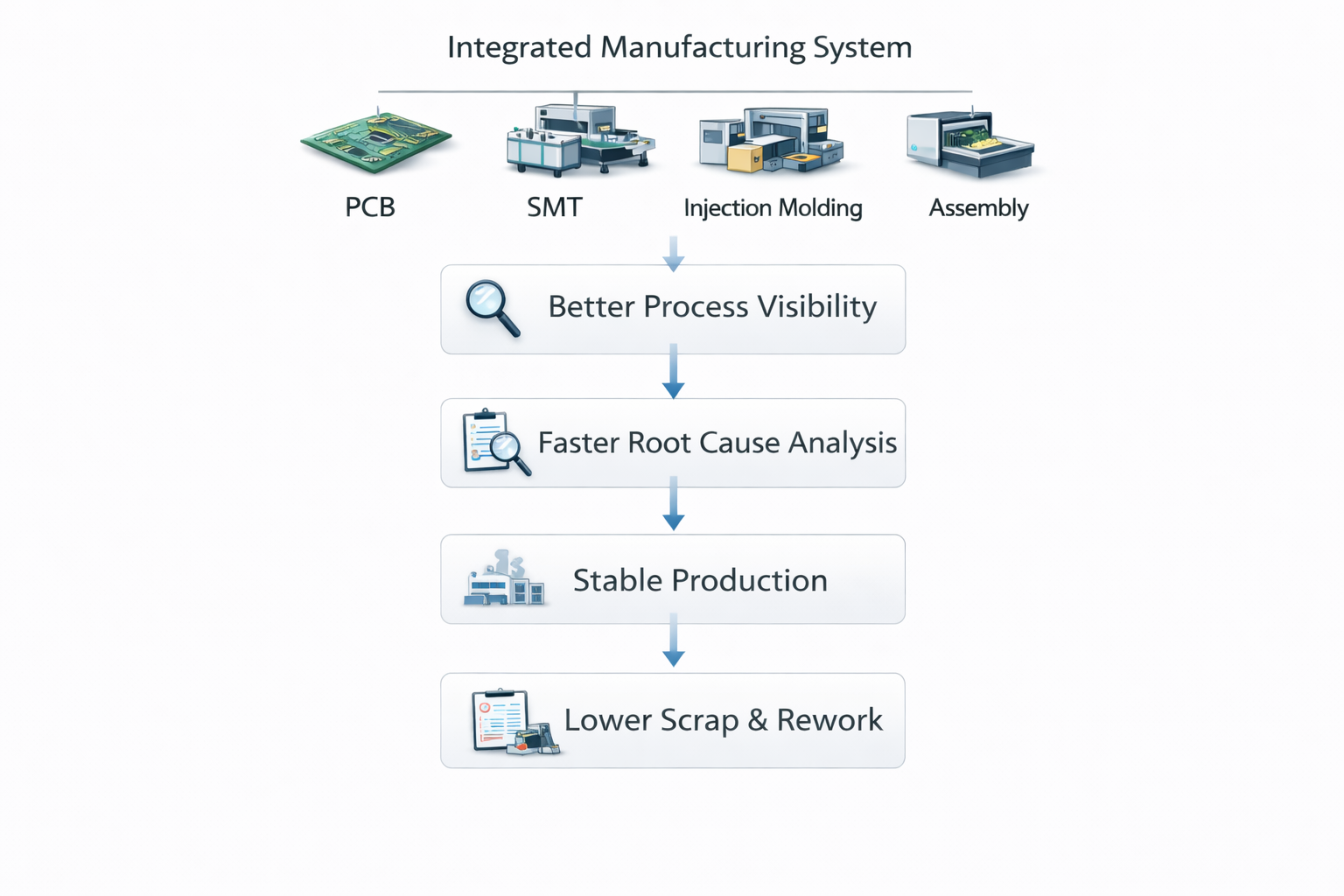
Instability often increases:
- scrap and rework
- troubleshooting time
- downtime and missed output
- quality inspection load
Because Integrated Manufacturing provides better visibility across multiple production stages, engineering teams can often diagnose root causes faster—especially when problems involve interactions between molded parts, PCBA, and assembly operations. Stabilizing production sooner typically reduces long-term manufacturing cost.
A Practical Cost Comparison Scenario
Consider a typical electronics product that requires PCB assembly, a plastic housing, and final product assembly.
In a fragmented supply chain, these stages may be handled by three or four suppliers. Components must move between factories multiple times before the final unit is built. Each handoff adds cost through transportation, handling, scheduling coordination, and slower engineering feedback.
In an Integrated Manufacturing environment, several stages are combined within a single operational structure. Engineering teams can coordinate changes more efficiently, and production issues can be diagnosed across processes more quickly.
Even if an individual process price is not the lowest, total production cost can often be reduced when the manufacturing system operates with fewer handoffs and faster stabilization.
When Integrated Manufacturing Creates the Most Value
Integrated Manufacturing is not automatically the best option for every product.
It tends to create the most value when products involve multiple production technologies or frequent engineering adjustments, such as:
- complex electronics products
- products combining plastic components and PCBs
- programs requiring rapid iteration during ramp-up
- production environments where stability is critical
In these scenarios, system efficiency often has a larger impact on cost than the quotation of any single manufacturing process.
Looking Beyond Unit Price
A common misconception in manufacturing sourcing is that the lowest unit price automatically results in the lowest total cost.
In reality, total production cost is shaped by how efficiently multiple processes operate together. Logistics efficiency, iteration speed, stability, and supply chain coordination all affect the final cost outcome.
Integrated Manufacturing may not always provide the lowest price for each individual step. But by reducing system inefficiencies across the production chain, it often creates meaningful advantages in total production cost.
Conclusion
Evaluating manufacturing cost requires looking beyond individual process prices.
For complex products, total production cost reflects the efficiency of the entire manufacturing system—not only the cost of a single stage.
Integrated Manufacturing influences this cost structure by reducing logistics steps, accelerating engineering iteration, minimizing cross-process interface issues, improving production stability, and simplifying supply chain coordination.
When these factors are considered early, teams can make more informed decisions when selecting manufacturing partners and planning scale-up production.