
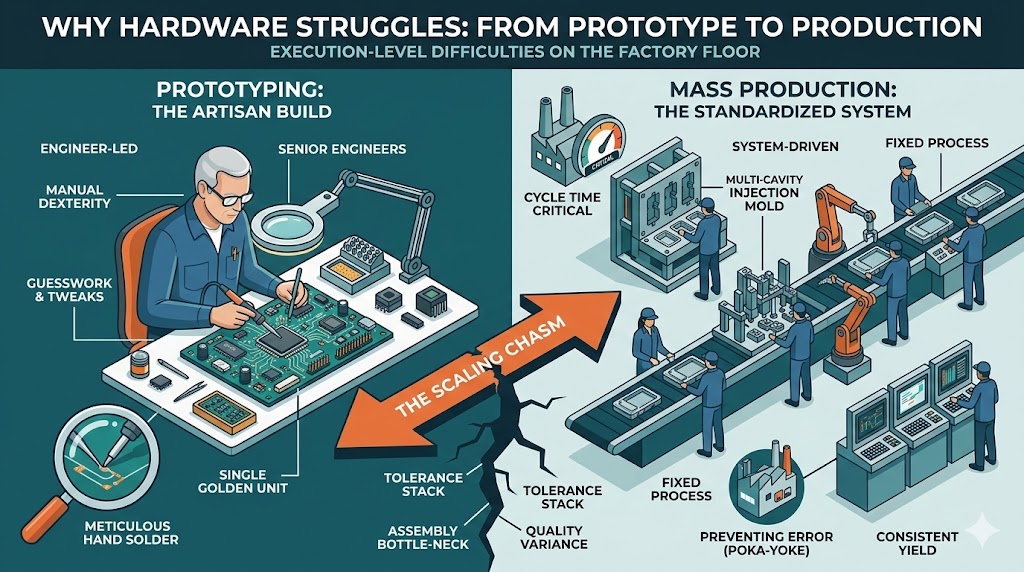
The “Hardware is Hard” Reality Check
In the hardware startup world, there’s a common saying:
“The first 1% is the idea, the next 9% is the prototype, and the remaining 90% is the struggle to scale.”
For many engineering teams, seeing a functional prototype finally come to life is a moment of triumph. The PCBA design works, the mechanical enclosure fits, and the firmware performs as expected.
However, the transition from a single “golden unit” to a production run of 10,000 units is rarely straightforward. What appears stable in a prototype environment often becomes fragile when exposed to the realities of mass manufacturing.
Products that perform perfectly in a lab environment may experience assembly issues, quality inconsistencies, or supply chain disruptions once production volumes increase.
Understanding why hardware products struggle when scaling from prototype to production is essential for teams preparing to commercialize their designs.
1. The Fundamental Dichotomy: Prototyping vs Mass Production
To understand why scaling hardware is difficult, we must first acknowledge that prototyping and manufacturing are fundamentally different disciplines.
The Artisan Nature of Prototyping
During the prototyping phase (often referred to as EVT — Engineering Validation Test), the goal is speed and functional validation.
Typical characteristics of prototype builds include:
- Intensive engineering supervision
- Flexible parameter adjustments
- Manual intervention when required
- Small production quantities
If a rib on a plastic enclosure is slightly too thick, an engineer might sand it down manually. If an assembly step requires modification, it can be adjusted on the spot.
This flexibility allows teams to move quickly during early development.
The Disciplined World of Mass Production
Mass production environments operate under very different constraints.
Production systems require:
- Repeatable processes across shifts
- Consistent assembly procedures
- Predictable cycle times
- Stable supply chain coordination
Unlike prototyping environments, production systems must function without constant engineering intervention. Assembly operators may have minimal training, and the process must remain stable across thousands of units.
A product that relies on manual correction during prototyping will struggle to survive in a production environment.
2. The Hidden Assassin: Cumulative Tolerance Stacking
One of the most common mechanical challenges during scale-up is tolerance stacking.
Prototype parts are often produced using high-precision CNC machining with tight tolerances. During mass production, however, many components transition to processes such as injection molding or metal stamping, which introduce wider variations.
What is Tolerance Stacking?
Imagine three components assembled together:
- Part A: +0.1 mm deviation
- Part B: +0.1 mm deviation
- Part C: +0.1 mm deviation
Individually, each component is within specification. However, when assembled together, the total deviation becomes +0.3 mm.
During prototyping, engineers may only test a small number of parts that happen to fit well together.
In mass production, however, thousands of components are mixed randomly during assembly. Eventually, a “worst-case combination” will occur, resulting in products that cannot be assembled properly.
To mitigate this risk, engineers often perform Worst Case Analysis (WCA) or Root Sum Square (RSS) calculations during design validation.
3. Injection Molding Challenges During Scale-Up
For many hardware products, plastic injection molded parts form the structural backbone of the product.
While prototype enclosures may be produced using CNC machining or 3D printing, mass production typically requires injection molding.
However, injection molding introduces its own set of challenges during scale-up.
Common issues include:
- Sink marks caused by uneven wall thickness
- Warpage due to material shrinkage
- Weld lines affecting structural strength
- Gate placement affecting cosmetic surfaces
During prototyping, these issues may not appear because parts are produced slowly and inspected closely.
In high-volume production, however, cycle times shorten and process variation increases. Small design issues that seemed insignificant during early builds can lead to cosmetic defects or dimensional variation.
Applying Design for Manufacturability (DFM) principles early in the development stage helps reduce these risks significantly.
4. The Fragility of a Fragmented Supply Chain
Another major challenge during the prototype-to-production transition is supplier fragmentation.
Many hardware startups source components from multiple vendors during early development:
- PCB fabrication from one supplier
- PCBA assembly from another
- plastic housing from a separate mold shop
- silicone components from yet another vendor
This fragmented approach may work for small prototype batches.
However, once production volumes increase, integration problems often emerge.
For example:
- Plastic materials may react with silicone components
- PCB tolerances may conflict with enclosure mounting features
- Assembly procedures may vary between vendors
When multiple suppliers operate independently, identifying the root cause of production issues becomes more difficult.
In these situations, engineering teams often become the bottleneck, spending valuable time coordinating between vendors rather than improving the product itself.
5. Designing for Excellence: The Role of DfX
To bridge the gap between prototype and production, engineering teams must shift from pure product design to Design for Excellence (DfX).
This approach focuses on ensuring that the product is not only functional but also manufacturable and scalable.
Design for Manufacturability (DFM)
DFM ensures that product designs are optimized for the manufacturing process.
For injection molded components, DFM considerations include:
- uniform wall thickness
- adequate draft angles
- optimized gate placement
- controlled shrinkage behavior
These design adjustments help ensure consistent part quality during large production runs.
Design for Assembly (DFA)
DFA focuses on simplifying the assembly process.
Key strategies include:
- reducing total part count
- using self-aligning features
- standardizing fasteners
- designing error-proofing features (poka-yoke)
Simplifying assembly processes improves production efficiency while reducing the likelihood of operator error.
6. The Importance of Quality Management Systems
In prototype environments, documentation is often informal. In production environments, it becomes essential.
A structured Quality Management System ensures that every product can be traced and validated.
Organizations such as the American Society for Quality emphasize that manufacturing traceability is critical for managing long-term product reliability.
Important documentation systems include:
- Bill of Materials (BOM)
- Work Instructions (WI)
- Engineering Change Orders (ECO)
- traceability records
- inspection reports
Without these systems, scaling production becomes extremely difficult to manage.
7. Rapid Engineering Support During Pilot Production
Most production challenges emerge during the NPI (New Product Introduction) phase.
During this stage, manufacturers typically conduct pilot runs of 50–200 units using the actual production equipment.
Pilot runs help identify issues related to:
- assembly procedures
- tooling performance
- test station efficiency
- operator workflow
Manufacturing partners that provide cross-functional engineering support during this stage can resolve problems much faster.
Engineers may need to adjust:
- assembly fixtures
- torque specifications
- functional test procedures
- material handling processes
Rapid response during this phase significantly reduces delays before full-scale production.
8. Why Integrated Manufacturing Matters During Scale-Up
One of the most effective ways to reduce scale-up risk is to minimize fragmentation across the manufacturing chain.
When plastics, electronics, and final assembly are handled by separate suppliers, integration issues often appear late in the development process.
An integrated manufacturing approach helps coordinate these processes more effectively.
Instead of treating each manufacturing stage independently, integrated manufacturing considers the entire product system.
This includes coordination between:
- plastic injection molding
- electronic component integration
- mechanical assembly processes
- functional testing procedures
Early collaboration between product design teams and manufacturing engineers helps identify potential production risks before tooling investment and mass production begin.
This system-level perspective significantly improves the transition from prototype builds to stable manufacturing.
Supporting the Prototype-to-Production Journey
For hardware startups and product development teams, moving from concept to scalable production requires close collaboration between engineering and manufacturing.
Manufacturing partners with experience in injection mold development, plastic component production, and product assembly can help identify potential risks early in the development process.
By combining DFM analysis, mold engineering expertise, and coordinated assembly planning, manufacturing teams can support product developers in preparing their designs for stable production.
This collaborative approach helps reduce development delays and improves the likelihood of successful product commercialization.
Conclusion
Building a functional prototype is an important milestone in hardware development, but it represents only the beginning of the manufacturing journey.
Scaling production introduces new challenges related to process stability, tolerance management, supply chain coordination, and assembly efficiency.
Successful hardware companies recognize that manufacturing scalability must be designed into the product from the very beginning.
By applying DFM and DFA principles, managing tolerance stacks carefully, and coordinating manufacturing processes early, engineering teams can significantly reduce the risks associated with scaling hardware production.
Ultimately, the transition from prototype to production is not simply an operational step—it is a design challenge that must be addressed strategically.
Frequently Asked Questions
Why does a prototype work but fail in mass production?
Prototype units are typically built under controlled conditions with direct engineering supervision. Mass production introduces material variation, operator differences, and process fluctuations that may expose weaknesses in the design.
When should manufacturing planning begin?
Manufacturing considerations should be integrated during the product design stage. Early DFM analysis can help prevent costly redesigns later in development.
What is the biggest challenge when scaling hardware products?
One of the most common challenges is integrating multiple manufacturing processes—such as electronics, plastic components, and mechanical assembly—into a stable and repeatable production system.