
Introduction
Production instability in high-volume injection molding rarely begins with a sudden breakdown. Most programs pass mold trials with acceptable dimensions, cosmetic quality, and cycle performance. Validation runs confirm feasibility, and early production appears stable.
However, once mass production extends beyond initial verification phases, variability gradually emerges. Scrap rates begin to fluctuate. Cycle times drift. Cavity performance becomes inconsistent. Maintenance intervals shorten.
Production instability is typically not a machine problem. It is a structural outcome of how part design, tooling architecture, process tolerance, and durability planning interact under sustained cycle stress.
Understanding these structural causes is essential for long-run manufacturing control.
Thermal Architecture and Long-Run Drift
Thermal imbalance is one of the most persistent contributors to production instability in injection molding.
Cooling systems may perform adequately during short validation runs. Yet in high-volume production, continuous thermal cycling magnifies even minor asymmetries in cooling channel layout.
Structural risks commonly include:
- Uneven cooling channel spacing
- Localized hot spots near thicker wall sections
- Insufficient cooling near gate regions
- Progressive scaling or restriction inside cooling circuits
Over extended cycles, these conditions lead to dimensional drift, warpage variation, packing inconsistency, and surface fluctuation.
In many high-volume programs, early instability signals become statistically visible after 30,000–50,000 cycles, particularly in multi-cavity molds where temperature differences compound across cavities.
Thermal balance is not simply a productivity variable—it is a structural stability parameter.
You can explore detailed cooling strategies in our guide on Cooling Channel Layout in Injection Mold Design.
Flow Balance and Cavity Symmetry
Flow architecture directly influences injection molding production stability.
Runner geometry, gate dimensions, and venting efficiency must be engineered for durability, not merely short-term feasibility. Among these variables, gate positioning plays a particularly critical role in maintaining long-term cavity balance. Detailed analysis of gate strategy is provided in our article on Gate Location in Injection Molding.
While cavity balance may appear acceptable during mold trials, extended production often exposes even small asymmetries.
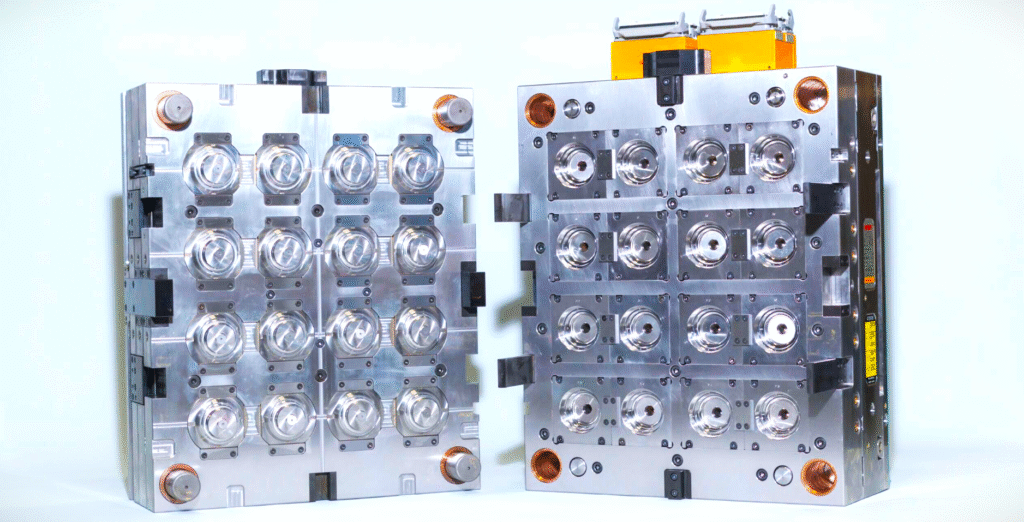
Long-run consequences of flow imbalance include:
- Uneven packing pressure between cavities
- Progressive gate wear altering flow resistance
- Increased flash risk in specific cavities
- Short shots under narrow processing windows
Production instability caused by flow imbalance rarely manifests as catastrophic failure. Instead, it appears as fluctuating reject rates, uneven cavity output, and increasing process adjustment frequency.
Sustained stability requires engineered symmetry that remains robust as wear accumulates.
Tool Wear and Lifecycle Durability
Tool wear is inevitable in high-volume injection molding. The critical issue is whether durability was engineered into the original design.
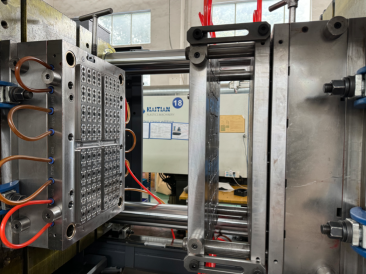
Key structural considerations include:
- Steel grade aligned with projected cycle volume
- Surface treatment suitable for abrasive or filled materials
- Balanced ejection force distribution
- Controlled shear stress near gate regions
When durability planning is insufficient, production instability gradually increases. Dimensional consistency narrows. Parting line integrity degrades. Maintenance interventions become reactive rather than preventive.
Wear-related instability often becomes noticeable after tens of thousands of cycles, when corrective maintenance becomes more disruptive and costly.
Durability must be treated as a design parameter—not a post-production remedy. A more detailed examination of long-run degradation mechanisms can be found in our article on Mold Wear in High-Volume Production.
Design Decisions That Amplify Long-Run Instability
Production instability is frequently amplified by design-level compromises made early in development.
Examples include:
- Excessive wall thickness variation
- Aggressive rib geometry without balanced cooling support
- Gate placement optimized for aesthetics rather than flow symmetry
- Tight tolerances without realistic process buffers
Such decisions may pass validation trials but introduce structural stress into the system. Over time, interaction between part geometry and tooling constraints accelerates instability trends.
In high-volume injection molding, part design must be evaluated not only for manufacturability but for long-term durability across projected lifecycle volume.
Process Sensitivity During Ramp-Up
Ramp-up marks the transition from controlled validation to sustained operational exposure.
During mold trials, engineers actively monitor and fine-tune parameters. In full-scale production, however, systems must tolerate variation in:
- Material batch consistency
- Ambient temperature fluctuation
- Operator handling differences
- Maintenance timing
If mold architecture depends on narrow process windows, even minor deviations trigger scrap or cycle fluctuation.
Production instability often indicates excessive process dependency rather than operator error.
Structurally stable systems absorb normal variation without constant parameter correction.
Statistical Early Warning Signals
Production instability rarely appears without measurable indicators. In high-volume injection molding environments, early detection is possible when statistical monitoring is properly implemented.
Before instability becomes operationally disruptive, warning signals often include:
- Gradual Cp/Cpk reduction
- Increasing cavity-to-cavity dimensional deviation
- Minor but recurring cycle time drift
- Incremental rise in rework frequency
Statistical process capability metrics such as Cp and Cpk are widely used in manufacturing quality control frameworks recognized by industry organizations such as the Society of Plastics Engineers.
These deviations may remain within tolerance limits initially, but they reveal structural sensitivity within the system.
Monitoring only final scrap rate is often too late. Early statistical trend recognition significantly reduces corrective cost and protects long-term stability.
System-Level Interaction
Production instability rarely originates from a single isolated variable. It is the cumulative interaction between:
- Part design geometry
- Mold cooling architecture
- Flow balance strategy
- Tool durability planning
- Maintenance scheduling
Wall thickness influences cooling performance. Cooling affects packing behavior. Packing impacts dimensional repeatability. Wear modifies flow resistance.
When these elements are engineered independently rather than as an integrated system, long-run instability becomes increasingly likely.
High-volume injection molding demands system-level coordination from DFM through sustained production.
Impact on Delivery and Lifecycle Cost
Production instability extends beyond quality metrics. It directly affects operational efficiency and supply reliability.
Consequences often include:
- Increased scrap and material waste
- Unplanned downtime for corrective maintenance
- Fluctuating cycle time performance
- Reduced predictability in delivery scheduling
For B2B manufacturing programs, instability introduces financial risk and supply chain vulnerability.
Stable production performance is not merely an operational metric—it is a contractual obligation.
Conclusion
Production instability in high-volume injection molding is rarely caused by isolated machine fluctuation. It develops when structural design decisions interact under sustained production stress.
Thermal architecture, flow symmetry, tooling durability, and process tolerance collectively determine whether a program remains stable beyond initial validation.
Long-term reliability is not achieved through reactive adjustment. It is established through deliberate structural engineering from the outset.
In high-volume injection molding, stability must be designed—not corrected.
Frequently Asked Questions
Why does production instability appear after successful mold trials?
Mold trials validate short-term feasibility under controlled conditions. Extended mass production exposes thermal drift, cavity imbalance, and wear-related changes that are not visible during limited validation runs.
Can process adjustments permanently solve production instability?
Process tuning may temporarily reduce variation. Persistent instability typically indicates structural tooling or design limitations rather than parameter misalignment.
At what production volume does instability become noticeable?
In many high-volume injection molding programs, instability trends begin to emerge between 30,000 and 50,000 cycles, depending on material selection, tooling durability, and maintenance strategy.
How can production instability be minimized before mass production?
Comprehensive DFM analysis, thermal simulation, cavity balance validation, durability planning, and statistical monitoring significantly reduce structural risk before sustained production begins.