
Injection molding boss design may seem like a small detail, but it directly affects part strength, screw or insert retention, assembly alignment, and molding quality.
During DFM review, boss wall thickness, diameter, height, draft, fillets, spacing, and rib support should be evaluated together. Poorly designed bosses can create excess material concentration, leading to sink marks, voids, cracking, warpage, difficult filling, or failures during fastening and final assembly.
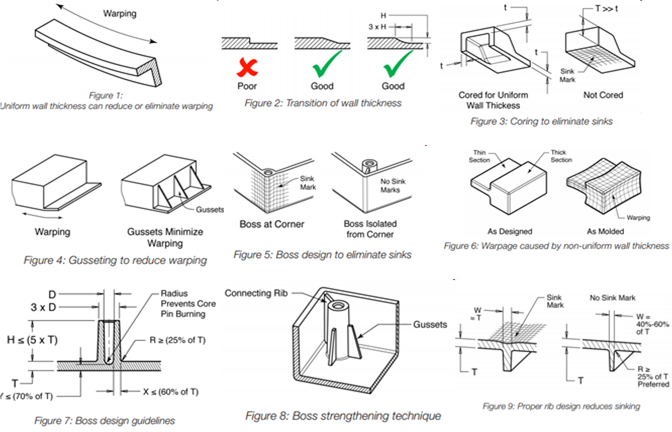
We have shared similar design-for-manufacturing insights from real production projects in other articles on our Design & DFM blog.
Most teams focus heavily on gate location, wall thickness uniformity, and ejection system layout. Bosses are typically viewed as small features—details that can be adjusted later if problems appear.
We’ve all seen the same pattern:
- T1 mold trials run smoothly
- Parts eject cleanly without sticking
- Fasteners (usually self-tapping or machine screws) tighten without resistance
- The first 50–100 assembled samples look stable and repeatable
With no immediate failures, boss design is often pushed aside as a secondary concern.
But once mass production ramps up—especially beyond 10k, 50k, or 100k cycles—boss design injection molding problems frequently become the source of gradual quality drift, rising scrap rates, and unstable assembly behavior.
These failures are rarely sudden.
They creep in quietly.
In one consumer electronics project, scrap rose from 0.3% in early production to 2.8% after 30k cycles, driven entirely by micro-cracks at the boss base—issues that were invisible during T1 trials.
The root cause is rarely operator error or poor process control.
It is the gap between design assumptions and real mass production behavior.
Why Injection Molding Boss Design Problems Rarely Appear During Mold Trials
Boss-related failures are extremely difficult to detect during T0 or T1 trials because trial conditions are fundamentally different from real production environments.
Let’s be honest—mold trials are run under forgiving conditions to achieve fast, acceptable samples, not to replicate high-volume stress.
During early sampling, we typically see:
Extended Cycle Times
Usually 15–20% longer than target production cycles.
A 28-second production cycle may be tested at 32–35 seconds, giving bosses extra cooling time and masking thermal stress.
Stable, Closely Monitored Cooling
Water temperature is often held within ±1°C, with clean channels and no scale buildup—conditions that are difficult to maintain during 24/7 production.
Slow, Manual Assembly by Skilled Technicians
Screws are inserted carefully, torque is applied gently, and minor resistance can be adjusted or corrected.
Human Compensation for Misalignment
If a screw feels tight, an operator can back off and retry—something automated lines cannot do.
Under these conditions, bosses experience minimal thermal stress and limited mechanical loading.
Even designs with narrow safety margins in boss design injection molding can appear completely acceptable.
Mold trials answer one question:
Can this boss function under controlled, low-stress conditions?
They do not answer the question that matters in production:
Can this boss survive 100k+ cycles under short cycle times, automated fastening, and fluctuating cooling conditions?
That’s why boss issues often surface only after tooling is released, when changes become expensive and disruptive.
Boss Structures as Stress Amplifiers in Mass Production

In high-volume production, bosses act as stress amplifiers, concentrating multiple risk factors into a small volume of material.
Based on shop-floor experience, this is what actually happens:
Localized Thickness Variation
Bosses create thick-to-thin transitions (for example, a 3.0 mm main wall connected to a 2.5 mm boss wall).
As cycle times shorten, these transitions cause uneven shrinkage and internal stress accumulation.
In one automotive interior project, a boss matching the main wall thickness led to sink marks and cracking after 40k cycles.
Slower Heat Dissipation
Cooling channels cannot be placed too close to bosses without weakening tooling.
As a result, bosses often retain heat longer than surrounding material.
A tall boss may require 5–7 seconds more cooling than adjacent areas. When cycle times are reduced, this residual heat accumulates, amplifying stress.
Repeated Mechanical Loading from Fastening
Automated assembly applies fixed torque, fixed speed, and no correction.
In one case, an automated screwdriver set to 9 N·m for an M3 screw caused boss base cracking after 20k cycles, exceeding the material’s fatigue limit.
Interaction with Assembly Tools
Even small misalignment—as little as 0.5 mm—can introduce side loading.
Over time, this leads to micro-cracks that grow gradually and escape early inspection.
The result is progressive instability, not immediate failure:
- intermittent cosmetic marks (stress whitening)
- degraded screw retention
- micro-cracks at the boss base
- increasing assembly force and rejection rates
These symptoms are often misattributed to material variation or process drift, when the real issue lies in the design.
Functional vs. Production-Stable Boss Design
Many boss design injection molding problems stem from confusing functional success with production stability.
A Functional Boss
- Accepts a screw
- Survives initial manual assembly
- Meets dimensional inspection requirements
A Production-Stable Boss
- Withstands 100k+ thermal cycles
- Tolerates repeated automated fastening
- Absorbs small material and temperature variations
- Remains stable at high assembly speeds
In one medical device project, two boss designs passed trials.
Only the rib-reinforced design remained stable in mass production, reducing scrap from 3.1% to 0.2%.
A design that works once does not necessarily work consistently.
Design Assumptions That Break Down at Scale
Boss failures usually arise from reasonable assumptions that no longer hold in mass production:
- Assuming fastening occurs only once
- Assuming cooling remains uniform over time
- Assuming dimensional compliance guarantees assembly robustness
- Assuming material behavior is consistent batch to batch
Individually, each assumption seems valid.
Together, they create a system with no margin for variation.
Why Boss-Related Yield Loss Is Hard to Fix Later
Once mass production begins, structural corrections become costly:
- Wall thickness changes affect weight and cosmetics
- Rib modifications require core/cavity rework
- Cooling adjustments demand tooling changes
One mold modification to add boss ribs cost $12k, plus 3 days of downtime—another $24k in lost production.
As a result, teams rely on containment measures:
- reducing torque
- slowing cycle times
- adding inspection and rework
These stabilize output temporarily, but yield loss becomes a hidden operating cost.
Evaluating Boss Design Through a Production-Safe Lens
A production-safe boss is defined by behavior under sustained stress, not trial success.
Key questions to ask early:
- How does this boss behave after prolonged thermal cycling?
- How sensitive is it to small material or temperature variation?
- What happens at target automated assembly speeds?
- Where is stress concentrated at the boss base?
Asking these questions early shifts design evaluation from feasibility to long-term stability.
Final Thoughts
Bosses rarely fail loudly.
They fail quietly.
They pass T1 trials, survive early builds, and only reveal weaknesses when production volume increases and margins tighten.
In injection molding, yield loss caused by boss design injection molding is rarely a process issue.
It is a design decision revealing itself too late.
Mold trials confirm feasibility.
Mass production exposes behavior.
For readers less familiar with the fundamentals of injection molding, a general overview of the process is available on Wikipedia.
Next time you review a part design, take a second look at the bosses.
They may be small—but they can make or break your production run.